Objective Type Questions and Answers for Class 11 Chemistry Chapter 9 Hydrogen

Questions
1 Hydrogen resembles halogens in many respects for which several factors are responsible. Of the following factors which one is most important in this respect?
A Its tendency to lose an electron to form a cation.
B Its tendency to gain a single electron in its valence shell to attain stable electronic configuration.
C Its low negative electron gain enthalpy value.
D Its small size.

Answer:Its tendency to gain a single electron in its valence shell to attain stable electronic configuration.
2 Why does H+ ion always get associated with other atoms or molecules?
A Ionisation enthalpy of hydrogen resembles that of alkali metals.
B Its reactivity is similar to halogens.
C It resembles both alkali metals and halogens.
D Loss of an electron from hydrogen atom results in a nucleus of very small size as compared to other atoms or ions. Due to smal size it cannot exist free.

Answer:Loss of an electron from hydrogen atom results in a nucleus of very small size as compared to other atoms or ions. Due to smal size it cannot exist free.
3 Metal hydrides are ionic, covalent or molecular in nature. Among LiH, NaH, KH, RbH, CsH, the correct order of increasing ionic character is
A LiH > NaH > CsH > KH>RbH
B LiH < NaH < KH < RbH < CsH
C RbH > CsH > NaH > KH > LiH
D NaH > CsH > RbH > LiH > KH

Answer:LiH < NaH < KH < RbH < CsH
4 Which of the following hydrides is electron-precise hydride?
A B2H6
B NH3
C H2O
D CH4

Answer:CH4
5 Radioactive elements emit α, β and γ rays and are characterised by their halflives. The radioactive isotope of hydrogen is
A Protium
B Deuterium
C Tritium
D Hydronium

Answer:Tritium
6 Consider the reactions

(A) H2O2 + 2HI → I2 + 2H2O (B) HOCl + H2O2 → H3O+ + Cl+ O2

Which of the following statements is correct about H2O2 with reference to these reactions? Hydrogen perioxide is ________.

A an oxidising agent in both (A) and (B)
B an oxidising agent in (A) and reducing agent in (B)
C a reducing agent in (A) and oxidising agent in (B)
D a reducing agent in both (A) and (B)

Answer:an oxidising agent in (A) and reducing agent in (B)
7 The oxide that gives H2O2 on treatment with dilute H2SO4 is —
A PbO2
B BaO2 .8H2O + O2
C MnO2
D TiO2

Answer:BaO2 .8H2O + O2
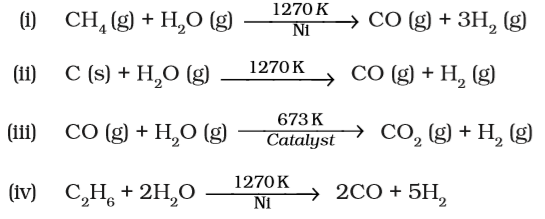
8 Which of the following reactions increases production of dihydrogen from synthesis gas?
Hydrogen

A (i)
B (ii)
C (iii)
D (iv)

Answer:(iii)
9 When sodium peroxide is treated with dilute sulphuric acid, we get ______.
A sodium sulphate and water
B sodium sulphate and oxygen
C sodium sulphate, hydrogen and oxygen
D sodium sulphate and hydrogen peroxide

Answer:sodium sulphate and hydrogen peroxide
10 Hydrogen peroxide is obtained by the electrolysis of ______.
A water
B sulphuric acid
C hydrochloric acid
D fused sodium peroxide

Answer:sulphuric acid
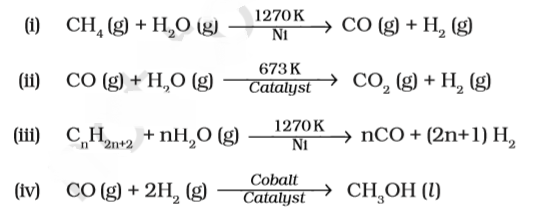
11 Which of the following reactions is an example of use of water gas in the synthesis of other compounds?
Hydrogen

A (i)
B (ii)
C (iii)
D (iv)

Answer:(iv)
12 Which of the following ions will cause hardness in water sample?
A Ca2+
B Na+
C Cl
D K+

Answer:Ca2+
13 Which of the following compounds is used for water softening?
A Ca3(PO4)2
B Na3PO4
C Na6P6O18
D Na2HPO4

Answer:Na6P6O18
14 Elements of which of the following group(s) of periodic table do not form hydrides.
A Groups 7, 8, 9
B Group 13
C Groups 15, 16, 17
D Group 14

Answer:Groups 7, 8, 9
15 Only one element of ________ forms hydride.
A group 6
B group 7
C group 8
D group 9

Answer:group 6
16 Which of the following statements are not true for hydrogen?
A It exists as diatomic molecule.
B It has one electron in the outermost shell.
C It can lose an electron to form a cation which can freely exist
D It forms a large number of ionic compounds by losing an electron.

Answer:C, D
17 Dihydrogen can be prepared on commercial scale by different methods. In its preparation by the action of steam on hydrocarbons, a mixture of CO and H2 gas is formed. It is known as
A Water gas
B Syngas
C Producer gas
D Industrial gas

Answer:A, B
18 Which of the following statement(s) is/are correct in the case of heavy water?
A Heavy water is used as a moderator in nuclear reactor.
B Heavy water is more effective as solvent than ordinary water.
C Heavy water is more associated than ordinary water.
D Heavy water has lower boiling point than ordinary water.

Answer:A, C
19 Which of the following statements about hydrogen are correct?
A Hydrogen has three isotopes of which protium is the most common.
B Hydrogen never acts as cation in ionic salts.
C Hydrogen ion, H+, exists freely in solution.
D Dihydrogen does not act as a reducing agent.

Answer:A, B
20 Some of the properties of water are described below. Which of them is/are not correct?
A Water is known to be a universal solvent.
B Hydrogen bonding is present to a large extent in liquid water.
C There is no hydrogen bonding in the frozen state of water.
D Frozen water is heavier than liquid water.

Answer:C, D

Chapters