NCERT Solutions for class 12 Physics | Chapter 3 - Current Electricity
Questions
1
Two conductors of equal length and radii the ratio of 2 : 3 are; connected in parallel the source of electricity. The ratio of the velocity of electrons in the conductor be :
Answer:1 : 1
2
The smallest resistance that can be obtained by the combination of n resistors each resistance r is :
Answer:r/n
⭐ Make GKSeries Your Preferred Source on Google
Add GKSeries as Preferred Source
3
The charge flowing in a conductor varies with time as :
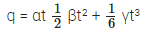
Where α, β, γ are positive constants. Then the initial current (l) is given by the condition :
Answer:l = α
4
The specific resistance of a conductor increases with :
Answer:increase in temperature
7
Why is the Wheatstone bridge more accurate than other methods of measuring resistances: ‘
Answer:It is a null method
8
When three identical bulbs of 60 W, 200 V rating are connected in series to a 200 V supply, the power drawn by them will be:
Answer:20 W
9
Kirchhoffs first and second laws for electrical circuits are consequences of:
Answer:conservation of electrical charge and energy respectively
10
How much electric energy is consumed by a 100 W lamp used for 6 hours everyday for 30 days?
Answer:18 kWh
11
Two wires of copper are of the same length but’have different diameters. When they are connected in series across a battery, the heat generated is H1 When connected in parallel across the same battery, the heat generated during the same time is H2 Then :
Answer:H1 < H2
14
The specific resistance of a rod of copper as compared to that of thin wire of copper is :
Answer:same
15
Given three equal resistors, how many different combinations (taken all of them together) can be made?
Answer:4
19
Suppose H1 is the heat generated per second in the filament of a 100 W, 250 V lamp and H2 is the heat generated in the filament of a 200 W, 250 V lamp. Then H1/H2 is equal to:
Answer:1/2
20
A 5 A fuse wire can with stand a maximum power of 1 W in circuit. The resistance of the fuse wire is:
Answer:0.04 Ω
Chapters
- Electric Charges & Fields
- Electrostatic potential and capacitance
- Electricity
- Moving charges and magnetism
- Magnetism and matter
- Electromagnetic induction
- Alternating current
- Electromagnetic waves
- Ray optics and optical instruments
- Wave optics
- Dual nature of radiation and matter
- Atoms
- Nuclei
- Semiconductor electronics
- Communication systems