Kilauea Volcano Erupts On Hawaii’s Big Island
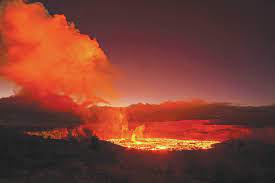
Kilauea volcano eruption:
The US Geological Survey (USGS) has downgraded the safety alert for Kilauea volcano in Hawaii, following a new eruption. The alert level has been dropped from "WARNING" to "WATCH" since effusion rates have decreased and there is no threat to infrastructure. The previous warning has been lowered to a watch, as high effusion rates have decreased and no infrastructure is considered to be under threat. Aviation warnings have shifted from red to orange also.
Kilauea volcano eruption: Key Points
• Aviation warnings have also been reduced from red to orange. Kilauea, one of the world’s most active volcanoes, is located in a closed national park on the Big Island of Hawaii.
• The ongoing eruption is expected to persist, however, lava flows will continue to be limited to the crater and summit of the volcano.
• Hawaiians are asking tourists to observe the volcano’s eruption from a respectful distance.
While lava flows are expected to remain confined to the surrounding crater and summit, USGS predicts that the eruption will continue.
Kilauea volcano: About
• Kīlauea is a volcano on the southeastern shore of Hawaii’s Big Island.
• • It originated between 210,000 and 280,000 years ago and is around 100,000 years old.
• Along with four other volcanoes, it comprises the island of Hawaii.
• Kīlauea is the most active of the five and one of the most active in the world, with recent eruptions in 2021 and 2023.
• Initially considered a satellite of its larger neighbor Mauna Loa, Kīlauea has its own structures, including a summit caldera and two active rift zones extending east and west.
• Halemaumau pit crater has an active lava lake, while Klauea saw practically constant eruptions from vents on its eastern rift zone between 1983 and 2018.
• In 2018, activity shifted to the lower Puna district, destroying hundreds of dwellings, Hawaii’s largest natural freshwater lake, and several communities.
• The eruption also prompted the closure of the Kīlauea section of Hawaii Volcanoes National Park. Kīlauea erupted again in 2020 and 2021, draining a water lake to create a lava lake in the Halemaʻumaʻu crater.
Indigo Ceo Pieter Elbers Appointed As Chair-Elect Of Iata’s Board Of Governors