42nd ASEAN Summit Begins In Indonesia with Focus on Becoming Global Growth Center
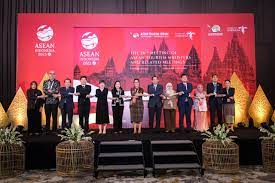
The 42nd Association of Southeast Asian Nations (ASEAN) Summit has begun in Indonesia, with the subject "ASEAN Affairs: Epicentre of Growth." The summit aims to demonstrate the bloc’s hopes and efforts to become the center and driving force behind global development.
President Joko Widodo, who holds the presidency of the bloc, emphasized the enormous potential of the ASEAN region, which has a total population of around 650 million inhabitants and consistently outperforms the world average in terms of economic growth. He urged member countries to pool their manufacturing strength in order to make Southeast Asia the centre of global growth.
Discussions to enhance economic integration and ASEAN’s global standing:
Leaders from the 10-country bloc, alongside their foreign affairs, trade, and national security ministers, will gather for a wide range of meetings. They are expected to discuss measures to enhance economic integration and ways to strengthen ASEAN’s global standing amid a deteriorating geopolitical security landscape. However, ASEAN is unlikely to bridge the gap between members who wish to take a stronger position against China and Russia and those who rely on commerce with and diplomatic backing from Beijing.
Attracting foreign investment and Timor-Leste’s bid to join ASEAN:
Enhancing ASEAN’s attractiveness to foreign investment will likely also be discussed. The bloc is keen to attract firms currently looking to divest their manufacturing base away from China. ASEAN offers cheaper labor costs, but red tape and underdeveloped high-tech industries remain an obstacle.
Another topic will be Timor-Leste's attempt to become the bloc's final Southeast Asian member. Taur Matan Ruak, Timor-Leste's Prime Minister, has confirmed his attendance at the summit. Indonesia’s vocal support for Timor-Leste’s application makes progress likely, but there have been concerns from other members due to the small country’s low development status and over-reliance on oil and gas revenue.
About ASEAN, Key points:
ASEAN stands for the Association of Southeast Asian Nations, a regional intergovernmental organization established on August 8, 1967, in Bangkok, Thailand, with the signing of the ASEAN Declaration.
Here are some key points about ASEAN:
1. Members: ASEAN currently has 10 member countries: Brunei Darussalam, Cambodia, Indonesia, Laos, Malaysia, Myanmar, the Philippines, Singapore, Thailand, and Vietnam.
2. Economic integration: ASEAN is attempting to establish the ASEAN Economic Community (AEC), a unified market and production base with the purpose of enabling the free flow of goods, services, investment, and skilled labour among member nations.
3. Political cooperation: ASEAN also aims to promote political stability and cooperation among its members, particularly in areas such as counterterrorism, disaster management, and conflict resolution.
4. Role in the region: As a regional organization, ASEAN plays an important role in promoting peace, stability, and economic development in Southeast Asia. It is also a key player in regional and international forums, such as the East Asia Summit, ASEAN Regional Forum, and the ASEAN Plus Three.
5. Challenges: ASEAN is confronted with a number of issues, including persistent territorial disputes in the South China Sea, economic inequalities among member nations, and disparities in political systems and priorities.
A Book Tittled “Droupadi Murmu: From Tribal Hinterlands to Raisina Hills” By Kasturi Ray