UGC NET(National Eligibility Test) English - Previous Years Solved Papers | Paper III November 2017
- (1) Manfred
- (2) Don Juan
- (3) Beppo
- (4) The Bride of Abydos
Answer: Option (3)
⭐ Make GKSeries Your Preferred Source on Google
Add GKSeries as Preferred Source- (1) Sarojini Naidu
- (2) Toru Dutt
- (3) Rabindranath Tagore
- (4) Kamala Das
Answer: Option (2)
- (1) The Wonderful Yeare
- (2) A Game at Chess
- (3) A King and No King
- (4) The Knight of the Burning Pestle
Answer: Option (2)
- (1) market
- (2) monopoly
- (3) imperialist
- (4) multinational
Answer: Option (4)
- (1) Peppermint
- (2) Dopey
- (3) Dynamo
- (4) Pookey
Answer: Option (1)
- (1) 1928
- (2) 1930
- (3) 1933
- (4) 1915
Answer: Option (3)
- (1) Volume III
- (2) Volume V
- (3) Volume VIII
- (4) Volume IX
Answer: Option (1)
(a) says that the first chapters of the narrative are recreated from the Archive of La Mancha
(b) says that it is a faithful rendering of a Catalan text in Spanish
(c) says that part of it has been translated from the Arabic by the Moorish author Cide Hamete Benengeli
(d) says that he is rewriting the history of a medieval knight altering the heroic vein with a farcical mode
The right combination according to the code is :- (1) (a) and (b)
- (2) (b) and (c)
- (3) (a) and (c)
- (4) (b) and (d)
Answer: Option (3)
- (1) cloud
- (2) chair
- (3) tree
- (4) river
Answer: Option (2)
- (1) Charles Wilkins
- (2) H. J. Colebrooke
- (3) Rammohan Roy
- (4) Nathaniel Halhed
Answer: Option (1)
- (1) Everyman
- (2) The Castle of Perseverance
- (3) The Second Shepherd’s Play
- (4) The Marshals
Answer: Option (3)
(a) She dreams of cats attacking her.
(b) She dreams of wolves attacking her.
(c) She dreams that she is dead and buried in a common grave where she lies with the corpses of strangers.
(d) She dreams that she is dead, stripped of her clothes and plagued by other naked corpses. The right combination according to the code is :
- (1) (a) and (c)
- (2) (a) and (d)
- (3) (b) and (c)
- (4) (b) and (d)
Answer: Option (2)
- (1) “Fears In Solitude”
- (2) “The Mad Monk”
- (3) “To William Wordsworth”
- (4) “Dejection : An Ode”
Answer: Option (2)
- (1) Laura buys fruits from the goblins in exchange of her “golden lock” of hair and a “tear more rare than pearl”
- (2) Jeanie, a girl who ate the goblins’ fruits, “pined away” and “sought them by night and day”
- (3) Laura, who goes to the market again, does not see the goblins but hears only “their shrill cry piercing the air”
- (4) Laura’s hair “grew thin and grey” and she wanes like the full moon to “swift decay”
Answer: Option (3)
- (1) “The Five Senses”
- (2) “Legend”
- (3) “Bullocky”
- (4) “Bora Ring”
Answer: Option (4)
- (1) Emmanuel Goldstein’s confession that he is a party operative; not an enemy of the party.
- (2) O’ Brien’s diary entry hinting at the non-existence of Big Brother.
- (3) A photograph which proves that some citizen accused of a crime was out of the country while it was committed.
- (4) A colleague’s revelation that the Inner Party members have systematically destroyed all historical documents and created false documents.
Answer: Option (3)
- (1) a heroic tragedy in rhymed couplets by John Dryden
- (2) a long poem in free verse by Keki Daruwalla
- (3) an autobiography of an Indian princess in exile
- (4) a fictional account of the Life of Maharani Gayatri Devi
Answer: Option (1)
- (1) Blake
- (2) Shelley
- (3) Byron
- (4) Coleridge
Answer: Option (3)
Reason (R) : The focus or the source of the myth are always shadows and virtualities which are elusive , unactualizable, and nonexistent in the first place. Any search for the discursive unity in the myth is, therefore, misplaced.
In the context of the above statements :- (1) Both (A) and (R) are true and (R) is the correct explanation of (A)
- (2) Both (A) and (R) are true but (R) is not the correct explanation of (A)
- (3) (A) is true but (R) is false
- (4) (A) is false, but (R) is true
Answer: Option (1)
- (1) Cornish cliffs
- (2) Dorset moors
- (3) Yorkshire moors
- (4) Chesil Beach
Answer: Option (3)
- (1) Memoirs of my Working Life
- (2) Without Fear or Favour
- (3) Roses in December
- (4) The Pen as My Sword
Answer: Option (3)
- (1) The King James Bible
- (2) Geoffrey Chaucer
- (3) Shakespeare
- (4) The Royal Society
Answer: Option (1)
- (1) Dr. Rieux describes the phenomenon of dying rats using the metaphors of disease, especially the bubonic plague.
- (2) Paneloux interprets the plague in his first sermon as a sign of the Apocalypse.
- (3) M. Michel is the first victim of the plague.
- (4) Tarrou thinks that the plague symbolizes human indifference.
Answer: Option (2)
- (1) The Pardoner’s Tale
- (2) The Wife of Bath’s Tale
- (3) The Knight’s Tale
- (4) The Miller’s Tale
Answer: Option (3)
- (1) The Input Hypothesis
- (2) The Affective Filter Hypothesis
- (3) The Monitor Hypothesis
- (4) The Writing Hypothesis
Answer: Option (4)
- (1) Pantomime
- (2) Dream on Monkey Mountain
- (3) Ti-Jean and His Brothers
- (4) The Charlatan
Answer: Option (1)
- (1) Every theory poses different questions and, therefore, what counts as ‘fact’ and ‘truth’ differs in every case.
- (2) All truth claims can be judged true or false, usually against empirical facts.
- (3) Causal statements about the relationship between dependent and independent variables can be made.
- (4) Truth is the foundation of all representational experience.
Answer: Option (1)
- (1) David Nunan
- (2) Michael Long
- (3) Alastair Pennycook
- (4) Claire Kramsch
Answer: Option (2)
(a) McGrath
(b) Goldberg
(c) McCann
(d) Robinson
The right combination according to the code is :- (1) (a) and (b)
- (2) (b) and (c)
- (3) (a) and (d)
- (4) (b) and (d)
Answer: Option (2)
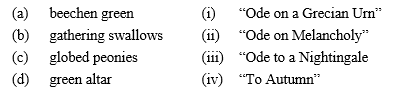
- (1) (iii) (ii) (iv) (i)
- (2) (iv) (ii) (iii) (i)
- (3) (iv) (iii) (ii) (i)
- (4) (iii) (iv) (ii) (i)
Answer: Option (4)
- (1) William Makepeace Thackeray
- (2) Charles Dickens
- (3) George Eliot
- (4) Anthony Trollope
Answer: Option (2)
(a) Patience
(b) Tenderheart
(c) Mercy
(d) Greatheart
The right combination according to the code is :- (1) (c) and (d)
- (2) (b) and (c)
- (3) (a) and (d)
- (4) (b) and (d)
Answer: Option (1)
- (1) The Bald Soprano
- (2) Amede or How to Get Rid of It
- (3) Exit the King
- (4) The Lesson
Answer: Option (2)
- (1) Lovelace in Samuel Richardson’s Clarissa
- (2) Rasselas in Samuel Johnson’s Rasselas
- (3) Matthew Bramble in Tobias Smollett’s Humphry Clinker
- (4) Harley in Henry Mackenzie’s The Man of Feeling
Answer: Option (2)
- (1) In Memoriam - A Christmas Carol - Men and Women - Henry Esmond
- (2) A Christmas Carol - In Memoriam - Men and Women - Henry Esmond
- (3) A Christmas Carol - In Memoriam - Henry Esmond - Men and Women
- (4) In Memoriam - A Christmas Carol - Henry Esmond - Men and Women
Answer: Option (3)
- (1) “Dear Life”
- (2) “Runaway”
- (3) “The Bear Came Over the Mountain”
- (4) “Dance of the Happy Shades”
Answer: Option (3)
- (1) Sir Gawain and the Green Knight
- (2) Le Morte D’arthur
- (3) Confessio Amantis
- (4) Piers Plowman
Answer: Option (2)
- (1) The Naxalite movement
- (2) The Freedom movement
- (3) The Non-Cooperation movement
- (4) The Khilafat movement
Answer: Option (1)
- (1) Rosencrantz
- (2) Guildenstern
- (3) The Player
- (4) Hamlet
Answer: Option (2)
- (1) A. K. Ramanujan
- (2) Anita Nair
- (3) Nandini Nopany
- (4) Gita Krishnankutty
Answer: Option (2)
Answer: Option (4)
- (1) T. S. Eliot ; Robert Frost
- (2) Siegfried Sassoon ; Wilfred Owen
- (3) Stephen Spender ; W. H. Auden
- (4) Dylan Thomas ; Robert Bridges
Answer: Option (3)
- (1) Lucien Carr
- (2) Carl Solomon
- (3) Herbert Huncke
- (4) Jack Kerouac
Answer: Option (2)
- (1) It is contrary to the natural ideas of justice.
- (2) It is contrary to neoplatonic idea of decorum.
- (3) It is contrary to the hope of the reader.
- (4) It is contrary to the faith of chronicles.
Answer: Option (2)
- (1) The Absence of War
- (2) Racing Demon
- (3) The Power of Yes
- (4) Murmuring Judges
Answer: Option (3)
- (1) poverty
- (2) development
- (3) race
- (4) religion
Answer: Option (3)
- (1) Stephen is talking to another student to get the answer to a Latin problem.
- (2) Stephen is not doing his work because his glasses are broken.
- (3) Stephen is looking out of the window towards the infirmary.
- (4) Stephen is lost in remembering his mother’s farewell and cannot hear Father Dolan calling out his name.
Answer: Option (2)
- (1) Dred
- (2) Beloved
- (3) Ceremony
- (4) End Zone
Answer: Option (3)
- (1) She sees it gleaming with a bluish aura.
- (2) She sees her dead mother walking through the orchard.
- (3) She sees it full of ripe fruits without a trace of leaves.
- (4) She sees her childhood friends playing in the orchard.
Answer: Option (2)
- (1) In a conversation with John Gay
- (2) After a reading of a maxim by la Rochefoucauld
- (3) While taking a walk near Dublin’s St. James’s graveyard
- (4) After reading Richard Burton’s Anatomy of Melancholy
Answer: Option (2)
(a) mutton
(b) pork
(c) sheep
(d) swine
The right combination according to the code is :- (1) (a) and (b)
- (2) (a) and (c)
- (3) (b) and (d)
- (4) (c) and (d)
Answer: Option (1)
- (1) Cassandra, cursed by Apollo predicts the death of Agamemnon, though her prophecy is ignored.
- (2) Aegisthus’s vengeful feelings for Agamemnon results from their rivalry for the hand of Clytemnestra.
- (3) Orestes, who has come back with the intention of murdering Clytemnestra unexpectedly meets her, and pretending to be a stranger, tells her that Orestes is dead.
- (4) Orestes, pursued by the Furies, flees from them when they fall asleep. Then, Clytemnestra’s ghost appears to wake them up.
Answer: Option (2)
- (1) The Two Gentlemen of Verona
- (2) As you Like It
- (3) Twelfth Night
- (4) A Midsummer Night’s Dream
Answer: Option (1)
- (1) primary imagination
- (2) secondary imagination
- (3) fancy
- (4) intuition
Answer: Option (1)
- (1) Additional language
- (2) Ancilliary language
- (3) Associate language
- (4) Administrative language
Answer: Option (3)
- (1) The Spectator
- (2) The Tatler
- (3) The Daily Courant
- (4) The Review
Answer: Option (2)
- (1) focus on grammar rules
- (2) vocabulary memorization
- (3) inductive teaching
- (4) focus on written language
Answer: Option (3)
- (1) Premala
- (2) Saroja
- (3) Rukmani
- (4) Mira
Answer: Option (3)
- (1) historicist critics should restrict their attention to a culture’s literary productions, all other data is irrelevant to the critic’s task
- (2) language conditions the way we see the world, and there is no reality beyond the ‘prison house’ of language
- (3) there is no meaning outside of textual meaning (contrary to the mimeticist’s position)
- (4) “literature” encompasses all cultural artifacts and all the values, power relations, and ways of seeing reflected in those artifacts; there is nothing outside of the “text” broadly conceived
Answer: Option (4)
(a) Elizabeth Bennet
(b) Fanny Price
(c) Emma Woodhouse
(d) Anne Elliot
The right combination according to the code is :- (1) (a) and (c)
- (2) (b) and (d)
- (3) (c) and (d)
- (4) (a) and (d)
Answer: Option (2)
- (1) English for specific purposes
- (2) English for basic purposes
- (3) English as a lingua Franca
- (4) English as a language tool
Answer: Option (3)
- (1) Heart of Darkness
- (2) The Man Who Would Be the King
- (3) Billy Budd
- (4) Death in Venice
Answer: Option (3)
- (1) Jai Ratan
- (2) P. Lal
- (3) Gordon C. Roadarmel
- (4) Christopher R. King
Answer: Option (4)
- (1) He takes out a large loan to enable him to woo Mary Garth.
- (2) He is an inveterate gambler.
- (3) He is paying off a blackmailer.
- (4) He runs a charity that has got into trouble.
Answer: Option (2)

- (1) (ii) (iv) (i) (iii)
- (2) (iii) (i) (iv) (ii)
- (3) (iii) (iv) (i) (ii)
- (4) (iv) (i) (ii) (iii)
Answer: Option (3)
- (1) Master Henry of Shrewsbury
- (2) Master William of Hereford
- (3) Master Freeman of Stamford
- (4) Master Nicholas of Guildford
Answer: Option (4)
- (1) The intervention of archangel Gabriel
- (2) His attendant Wagner persuades him to revoke the decision
- (3) The chiming of the bells announcing Easter festivities
- (4) Mephistopheles appears and offers to initiate him into magic art
Answer: Option (3)
- (1) Under Western Eyes
- (2) The Shadow Line
- (3) Victory
- (4) The Rescue
Answer: Option (2)
- (1) “This Be the Verse”
- (2) “An Arundel Tomb”
- (3) “High Windows”
- (4) “Next, Please”
Answer: Option (2)
- (1) Critics should not be ill-natured and malicious.
- (2) Critics should not look for portrait of real people in the play’s characters and remember that the play is a social satire.
- (3) Critics should avoid writing malicious reviews, lest they be charged with libel.
- (4) Critics should try to identify the real-life equivalent for each character.
Answer: Option (2)
- (1) “Death, be not proud”
- (2) “Thou hast made me”
- (3) “Holy Sonnet 17”
- (4) “At the round earth’s imagined corners”
Answer: Option (3)
- (1) a city suburb
- (2) a mountain resort
- (3) a natural environment
- (4) a highway motel
Answer: Option (3)
(a) details
(b) the car
(c) the wood
(d) the minutae
The right combination according to the code is :- (1) (a) and (b)
- (2) (a) and (d)
- (3) (b) and (c)
- (4) (c) and (d)
Answer: Option (2)
- (1) Dogs or groundhogs lead a better life than men or women
- (2) Irrespective of the place, the boring rhythm of doing things over and over in human life cannot be escaped
- (3) Myopia is the result if you live life in the lap of nature
- (4) Knowledge cures existential boredom
Answer: Option (2)