UGC NET(National Eligibility Test) Environmental Science - Previous Years Solved Papers | Paper III November 2017
- (1) Enthalpy
- (2) Gibbs free energy
- (3) Entropy
- (4) Helmholtz free energy
Answer: (1)
- (1) ~ 20.54 m/s
- (2) ~ 15.92 m/s
- (3) ~ 7.96 m/s
- (4) ~ 10.27 m/s
Answer: (2)
⭐ Make GKSeries Your Preferred Source on Google
Add GKSeries as Preferred Source- (1) 1618 nm - 23400 nm
- (2) 2168 nm - 4610 nm
- (3) 12500 nm - 17000 nm
- (4) 7000 nm - 13500 nm
Answer: (4)
- (1) Fanning
- (2) Fumigating
- (3) Looping
- (4) Coning
Answer: (1)
(a) An aqueous solution of sodium carbonate is alkaline.
(b) An aqueous solution of carbon dioxide is acidic.
- (1) (a) is correct, (b) is incorrect
- (2) (a) is incorrect, (b) is correct
- (3) Both (a) and (b) are incorrect
- (4) Both (a) and (b) are correct
Answer: (4)
- (1) O(3P)
- (2) O(1D)
- (3) O+
- (4) O−
Answer: (1)
- (1) 240 kPa kg mol−1
- (2) 220 kPa kg mol−1
- (3) 460 kPa kg mol−1
- (4) 400 kPa kg mol−1
Answer: (1)
- (1) Solute and solvent both obey Raoult’s law
- (2) Solute obeys Raoult’s law and solvent obeys Henry’s law
- (3) Solute obeys Henry’s law and solvent obeys Raoult’s law
- (4) Solute and solvent both obey Henry’s law
Answer: (3)
Assertion (A) : The living components of ecosystems are not immortal.
Reason (R) : Depending on the biological longevity, all living systems become abiotic constituents.
Choose the correct answer :- (1) Both (A) and (R) are correct and (R) is the correct explanation of (A).
- (2) Both (A) and (R) are correct and (R) is not the correct explanation of (A).
- (3) (A) is true, but (R) is false.
- (4) (A) is false and (R) is true.
Answer: (1)
- (1) The process of eating
- (2) The rate of rainfall
- (3) The rate of evaporation
- (4) The rate of transpiration
Answer: (1)
- (1) Top - down cascade
- (2) Bottom - up cascade
- (3) Population decline
- (4) Community collapse
Answer: (2)
- (1) Decreases from pole to equator.
- (2) Increases from tropic of cancer to tropic of Capricorn.
- (3) Increases from pole to equator.
- (4) Stabilizes at any point between two poles.
Answer: (1)
- (1) Trichonympha sp.
- (2) Enterococcus sp.
- (3) Enterobacter sp.
- (4) Citrobacter sp.
Answer: (1)
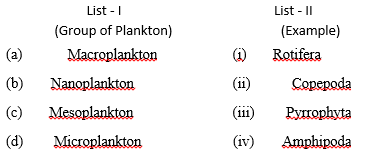
- (1) (iii) (iv) (i) (ii)
- (2) (ii) (i) (iv) (iii)
- (3) (i) (ii) (iii) (iv)
- (4) (iv) (iii) (ii) (i)
Answer: (4)
- (1) 0.2 - 2.0 µm
- (2) < 0.2 µm
- (3) > 5.0 µm
- (4) 0.5 - 1.0 µm
Answer: (2)
- (1) 127
- (2) 103
- (3) 97
- (4) 100
Answer: (2)
Assertion (A) : Some infectious particles loose their infectious - ability in territories closer to equator, with high average of daily sunshine hours.
Reason (R) : UV incidence can determine the survival of infectious particles.
Choose the correct answer :- (1) Both (A) and (R) are correct and (R) is the correct explanation of (A).
- (2) Both (A) and (R) are correct and (R) is not the correct explanation of (A).
- (3) (A) is true, but (R) is false.
- (4) (A) is false and (R) is true.
Answer: (2)
- (1) Phytoplankton
- (2) Bacterioplankton
- (3) Benthic algae
- (4) Zooplankton
Answer: (2)
Assertion (A) : The 18O/16O ratio in a natural system can be used as a thermometer.
Reason (R) : The fractions of 18O/16O depend on temperature. Choose the correct answer :
- (1) Both (A) and (R) are correct and (R) is the correct explanation of (A).
- (2) Both (A) and (R) are correct and (R) is not the correct explanation of (A).
- (3) (A) is true, but (R) is false.
- (4) (A) is false and (R) is true.
Answer: (1)
- (1) 3 - 5 µm
- (2) 8 - 10 µm
- (3) 10 - 12 µm
- (4) 1 - 3 µm
Answer: (3)
(a) Area of the island
(b) Distance from the mainland
(c) Shape of the island
Choose the correct code :- (1) (a) and (b) only
- (2) (b) and (c) only
- (3) (a) and (c) only
- (4) (a), (b) and (c)
Answer: (4)
- (1) 0.5 - 0.6 µm
- (2) 0.6 - 0.7 µm
- (3) 0.7 - 0.9 µm
- (4) 1 - 3 µm
Answer: (3)
- (1) The demand for minerals is expected to decline as the world’s nations become more industrialized.
- (2) Environment of Antarctica is extremely vulnerable and fragile to the disturbance that would occur with the development.
- (3) Territorial claims to Antarctica are unresolved.
- (4) Currenty known reserves of minerals and metals are considered inexhaustible.
Answer: (2)
- (1) It increases with increase in partial pressure of CO2.
- (2) It increases with increase in pH.
- (3) It increases with increase in temperature.
- (4) It decrease with increase in salinity.
Answer: (3)
- (1) ‘Caring for all life under the Sun’
- (2) ‘Ozone : All there is between you and UV’
- (3) ‘Ozone and Climate : Restored by a World United’
- (4) ‘30 years of healing Ozone Together’
Answer: (1)
Assertion (A) : OTEC power plants have low efficiences.
Reason (R) : Efficiency is governed by 2ND law of thermodynamics. Choose the correct answer :
- (1) Both (A) and (R) are correct and (R) is the correct explanation of (A).
- (2) Both (A) and (R) are correct and (R) is not the correct explanation of (A).
- (3) (A) is true, but (R) is false.
- (4) (A) is false and (R) is true.
Answer: (1)
Assertion (A) : The efficiency of a silicon solar cell decreases with increase in temperature.
Reason (R) : The intrinsic resistance of the solar cell increases with rise in temperature. Choose the correct answer :
- (1) Both (A) and (R) are correct and (R) is the correct explanation of (A).
- (2) Both (A) and (R) are correct and (R) is not the correct explanation of (A).
- (3) (A) is true, but (R) is false.
- (4) (A) is false and (R) is true.
Answer: (1)
Assertion (A) : The rotor blades of wind - turbine execute rotational motion when moving air impinges on them.
Reason (R) : The momentum of the moving air is transferred to the moving blades.
Choose the correct answer :- (1) Both (A) and (R) are correct and (R) is the correct explanation of (A).
- (2) Both (A) and (R) are correct and (R) is not the correct explanation of (A).
- (3) (A) is true, but (R) is false.
- (4) (A) is false and (R) is true.
Answer: (2)
- (1) Remove dissolved gases such as H2S
- (2) Remove volatile organic compounds
- (3) Oxidize soluble Fe2+ to Fe3+
- (4) Precipitate colloidal particles
Answer: (4)
- (1) Parathion
- (2) Chloropyritos
- (3) Aldicarb
- (4) Malathion
Answer: (2)
- (1) 5% P ; 10% N ; 5% K
- (2) 5% N ; 10% P2O5 ; 5% K2O
- (3) 5% N2O ; 10% PH3 ; 5% K2O
- (4) 5% N ; 10% PH3 ; 5% K2O
Answer: (2)
- (1) Waste must be present in a physical form that is susceptible to microbes.
- (2) Waste must be susceptible to biodegradation.
- (3) Environmental conditions such as pH, temperature and oxygen level must be appropriate.
- (4) Microbes of any type must be available.
Answer: (4)
Assertion (A) : Organophosphate insecticides have lower values of partition coefficient, KOW, than organochlorine pesticides.
Reason (R) : Organophosphate insecticide molecules have lower ability to form hydrogen bonds with water than organochlorine pesticides.
Choose the correct answer :- (1) Both (A) and (R) are correct and (R) is the correct explanation of (A).
- (2) Both (A) and (R) are correct and (R) is not the correct explanation of (A).
- (3) (A) is true, but (R) is false.
- (4) (A) is false and (R) is true.
Answer: (3)
Assertion (A) : NOX and volatile organic compounds (VOCs) are primary precursors in photochemical smog formation.
Reason (R) : NOX and VOCs form oxidants by thermal reactions.
Choose the correct answer :- (1) Both (A) and (R) are correct and (R) is the correct explanation of (A).
- (2) Both (A) and (R) are correct and (R) is not the correct explanation of (A).
- (3) (A) is true, but (R) is false.
- (4) (A) is false and (R) is true
Answer: (3)
- (1) CH4
- (2) CO
- (3) NO
- (4) NO2
Answer: (2)
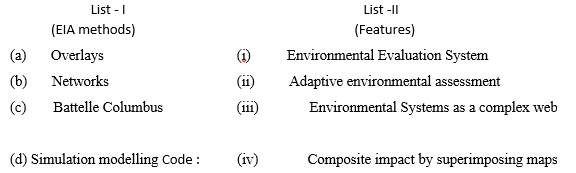
- (1) (i) (ii) (iii) (iv)
- (2) (ii) (iii) (iv) (i)
- (3) (iii) (iv) (i) (ii)
- (4) (iv) (iii) (i) (ii)
Answer: (4)
- (1) Collection of demographic data only
- (2) Prediction of significant residual environmental impact
- (3) Existing environmental setting of the proposed development area
- (4) Selection of the best project option available
Answer: (3)
- (1) Baseline descriptions and potential additional data collection needs
- (2) Description of environmental impacts and creation of contingency plan
- (3) Defining a set of criteria to assess the project
- (4) Setting of experts team that will conduct EIA
Answer: (2)
- (1) Beneficial aspects of the products produced by the plant
- (2) The legislative requirements related to the human health effects as a result of exposure to the pollutant
- (3) The quantification of hazards to the local environment from pollutants released
- (4) Detailed outline of the management process to reduce the health effects related to exposure to the pollutants
Answer: (4)
- (1) The identification of the alternatives to be evaluated and structuring of environmental parameters
- (2) Existing environmental quality of study area
- (3) The socio - economic status of the area
- (4) The risk involved in a development project
Answer: (1)
- (1) MOEFCC
- (2) Ministry of Home Affairs
- (3) Central Pollution Control Board (CPCB)
- (4) State Ministry of Home Affairs
Answer: (4)
- (1) Prevention is better than cure.
- (2) One who pollutes the water, must pay for it.
- (3) Every owner has a right to get unpolluted water without alteration.
- (4) All of the above
Answer: (3)
- (1) Environment (Protection) Act, 1986
- (2) Indian Forest Act, 1927
- (3) Forest Conservation Act, 1980
- (4) Traditional forest - Dwellers (Forest rights) Act, 2006
Answer: (3)
- (1) (a), (b) and (c)
- (2) (a) and (c) only
- (3) (a) and (b) only
- (4) (b) and (c) only
Answer: (3)
- (1) Organic peroxides
- (2) Arsenic bearing sludges
- (3) Organo - Chlorines
- (4) Vinylchlorides
Answer: (1)
- (1) IS/ISO 14852 : 1991
- (2) IS/ISO 17088 : 2008
- (3) IS 9833 : 1981
- (4) IS 14534 : 1998
Answer: (4)
- (1) Ensuring environmental sustainability
- (2) Eradicating extreme hunger and poverty
- (3) Developing global partnership for development
- (4) Achieving universal energy security
Answer: (4)
- (1) Liquid and gaseous substances
- (2) Solid, liquid and gaseous substances including noise
- (3) Gaseous substances
- (4) Solid, liquid and gaseous substances
Answer: (2)
- (1) 0.25
- (2) 0.50
- (3) 0.34
- (4) 0.75
Answer: (4)
- (1) 10±0.08
- (2) 10±8.23
- (3) 10±0.16
- (4) 10±4.15
Answer: (1)
- (1) ~ 180 µgm−3
- (2) ~ 320 µgm−3
- (3) ~ 240 µgm−3
- (4) ~ 415 µgm−3
Answer: (2)
- (1) (a) and (b) only
- (2) (a) and (c) only
- (3) (c) and (d) only
- (4) (b) and (d) only
Answer: (4)
- (1) 40
- (2) 80
- (3) 160
- (4) 800
Answer: (1)
Assertion (A) : In regression analysis, smaller the p - values, the more significant is the result of the experiment.
Reason (R) : The magnitude of p - value is an indicator of the association between the changes in the predictor’s value and the changes in the response variable.
Choose the correct answer :- (1) Both (A) and (R) are correct and (R) is the correct explanation of (A).
- (2) Both (A) and (R) are correct and (R) is not the correct explanation of (A).
- (3) (A) is true, but (R) is false.
- (4) (A) is false and (R) is true.
Answer: (4)
- (1) 24
- (2) 12
- (3) 18
- (4) 26
Answer: (3)
- (1) 7.50
- (2) 6.50
- (3) 7.75
- (4) 7.00
Answer: (3)
Assertion (A) : Sustainable mountain development should be the global priority.
Reason (R) : Mountain people are particularly vulnerable to impacts of climate change and natural disasters.
Choose the correct answer :- (1) Both (A) and (R) are correct and (R) is the correct explanation of (A).
- (2) Both (A) and (R) are correct and (R) is not the correct explanation of (A).
- (3) (A) is true, but (R) is false.
- (4) (A) is false and (R) is true.
Answer: (2)
- (1) USA
- (2) China
- (3) India
- (4) Brazil
Answer: (2)
Assertion (A) : Climate change induced monsoon variability may have serious consequences for Indian agriculture.
Reason (R) : Two third (2/3RD) of area under cultivation in India is rain dependent.
Choose the correct answer :- (1) Both (A) and (R) are correct and (R) is the correct explanation of (A).
- (2) Both (A) and (R) are correct and (R) is not the correct explanation of (A).
- (3) (A) is true, but (R) is false.
- (4) (A) is false and (R) is true.
Answer: (1)
- (1) 2014
- (2) 2015
- (3) 1989
- (4) 2012
Answer: (1)
- (1) Kerala
- (2) Arunachal Pradesh
- (3) Tamilnadu
- (4) Maharashtra
Answer: (3)
- (1) (a), (c) and (d) only
- (2) (a), (b) and (d) only
- (3) (b), (c) and (d) only
- (4) (a), (b), (c) and (d)
Answer: (2)
- (1) 9.6 µm
- (2) 11.2 µm
- (3) 6.9 µm
- (4) 17.3 µm
Answer: (1)