UGC NET(National Eligibility Test) Geography - Previous Years Solved Papers | Paper III November 2017
- (1) W.M. Davis
- (2) L.C. King
- (3) W. Penk
- (4) C.A. Cotton
Answer: (2)
- (1) Anticline
- (2) Dip
- (3) Syncline
- (4) Strike
Answer: (4)
⭐ Make GKSeries Your Preferred Source on Google
Add GKSeries as Preferred Source- (1) Penck
- (2) Davis
- (3) Johnson
- (4) Wood
Answer: (1)
- (1) Isostasy
- (2) Diastrophism
- (3) Uniformitarianism
- (4) Catastrophism
Answer: (3)
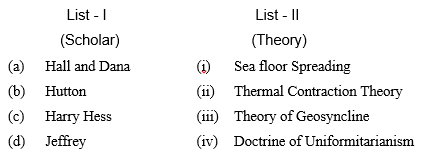
- (1) (i) (ii) (iv) (iii)
- (2) (ii) (i) (iii) (iv)
- (3) (iv) (ii) (i) (iii)
- (4) (iii) (iv) (i) (ii)
Answer: (4)
Assertion (A) : There is close relationship between volcanic activities and plate margins.
Reason (R) : A vast majority of the world’s volcanoes are associated with the convergent plate margins.
Code :- (1) Both (A) and (R) are true and (R) is the correct explanation of (A).
- (2) Both (A) and (R) are true, but (R) is not a correct explanation of (A).
- (3) (A) is true, but (R) is false.
- (4) (A) is false, but (R) is true.
Answer: (1)
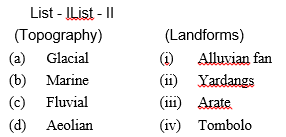
- (1) (ii) (i) (iii) (iv)
- (2) (iv) (ii) (i) (iii)
- (3) (iii) (iv) (ii) (i)
- (4) (iii) (iv) (i) (ii)
Answer: (4)
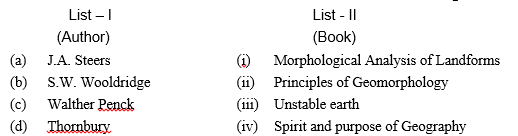
- (1) (ii) (iii) (iv) (i)
- (2) (i) (iv) (ii) (iii)
- (3) (iv) (ii) (i) (iii)
- (4) (iii) (iv) (i) (ii)
Answer: (4)
- (1) 1 : 150
- (2) 1 : 100
- (3) 1 : 50
- (4) 1 : 5
Answer: (2)
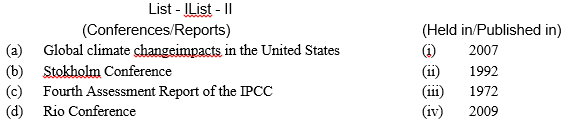
- (1) (i) (ii) (iii) (iv)
- (2) (ii) (i) (iii) (iv)
- (3) (iv) (iii) (ii) (i)
- (4) (iv) (iii) (i) (ii)
Answer: (4)
- (1) Stratosphere
- (2) Tropopause
- (3) Mesosphere
- (4) Troposphere
Answer: (2)
- (1) Polar easterlies, Westerlies, Subtropical highs, Trade winds
- (2) Subtropical highs, Westerlies, Trade winds, Polar easterlies
- (3) Trade winds, Polar easterlies, Westerlies, Subtropical highs
- (4) Trade winds, Subtropical highs, Westerlies, Polar easterlies
Answer: (4)
Assertion (A) : Above 1000 meter altitudes most winds follow a geostrophic or near-geostrophic course.
Reason (R) : The friction layer of the atmosphere extends to only about 1000 meters above the ground.
Code :- (1) Both (A) and (R) are true and (R) is the correct explanation of (A).
- (2) Both (A) and (R) are true, but (R) is not a correct explanation of (A).
- (3) (A) is true, but (R) is false.
- (4) (A) is false, but (R) is true.
Answer: (1)
- (1) 28C
- (2) 108C
- (3) 58C
- (4) 158C
Answer: (2)
Assertion (A) : The trade winds are predominantly easterly.
Reason (R) : An easterly wind blows from west to east.
Code :- (1) Both (A) and (R) are true and (R) is the correct explanation of (A).
- (2) Both (A) and (R) are true, but (R) is not a correct explanation of (A).
- (3) (A) is true, but (R) is false.
- (4) (A) is false, but (R) is true.
Answer: (3)
- (1) Subtropical Desert Climate
- (2) Subtropical Steppe Climate
- (3) Midlatitude Desert Climate
- (4) Midlatitude Steppe Climate
Answer: (1)
- (1) 28C
- (2) 08C
- (3) −28C
- (4) −108C
Answer: (3)
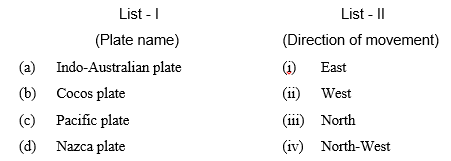
- (1) (iii) (iv) (i) (ii)
- (2) (iii) (iv) (ii) (i)
- (3) (iii) (ii) (i) (iv)
- (4) (i) (ii) (iii) (iv)
Answer: (2)
- (1) Holocene
- (2) Pleistocene
- (3) Miocene
- (4) Cambrian
Answer: (2)
Assertion (A) : The moon produces greater percentage of Earth’s tides than the Sun.
Reason (R) : The Sun is closer to the Earth than the Moon.
Code :- (1) Both (A) and (R) are true and (R) is the correct explanation of (A).
- (2) Both (A) and (R) are true, but (R) is not a correct explanation of (A).
- (3) (A) is true, but (R) is false.
- (4) (A) is false, but (R) is true.
Answer: (3)
- (1) Perennials
- (2) Annuals
- (3) Seasonal
- (4) Bi-annuals
Answer: (1)
Assertion (A) : The regional boundaries of biomes are some-what arbitrary.
Reason (R) : All kinds of major biomes are existing both in ocean and land.
Code :- (1) Both (A) and (R) are true and (R) is the correct explanation of (A).
- (2) Both (A) and (R) are true, but (R) is not a correct explanation of (A).
- (3) (A) is true, but (R) is false.
- (4) (A) is false, but (R) is true.
Answer: (3)
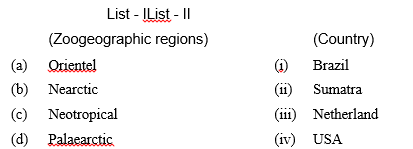
- (1) (iii) (i) (iv) (ii)
- (2) (iii) (iv) (ii) (i)
- (3) (ii) (iv) (i) (iii)
- (4) (iv) (ii) (i) (iii)
Answer: (3)
- (1) C. Darwin
- (2) C.O. Sauer
- (3) A. Humboldt
- (4) C. Ritter
Answer: (2)
- (1) Johnston
- (2) Kirk
- (3) Gregory
- (4) Burton
Answer: (2)
- (1) Gould and White
- (2) Boulding and Haggerstrand
- (3) Downs and Stea
- (4) Saarinen
Answer: (1)
- (1) Huntington
- (2) Semple
- (3) Jefferson
- (4) Ratzel
Answer: (3)
- (1) Aristotle
- (2) Herodotus
- (3) Anaximender
- (4) Eratosthenes
Answer: (4)
- (1) Behaviouralism
- (2) Logical Positivism
- (3) Structuralism
- (4) Post Modernism
Answer: (4)
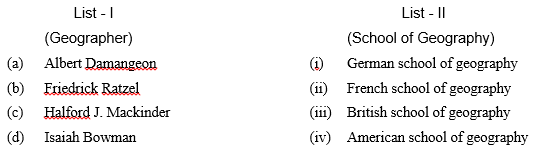
- (1) (i) (ii) (iv) (iii)
- (2) (ii) (i) (iv) (iii)
- (3) (ii) (i) (iii) (iv)
- (4) (iv) (ii) (iii) (i)
Answer: (3)
- (1) Aristotle
- (2) Posidonius
- (3) Plato
- (4) Erastosthenes
Answer: (1)
- (1) Europe
- (2) Asia
- (3) North America
- (4) Australia
Answer: (2)
- (1) USA
- (2) Brazil
- (3) Denmark
- (4) India
Answer: (3)
(a) Increase in Life Expectancy Rate
(b) Increase in Infant Mortality Rate
(c) Falling Death rate
(d) Better Living conditions
- (1) (a), (b) and (d) are correct
- (2) (a), (c) and (d) are correct
- (3) (a), (b), (c) are correct
- (4) (b), (c) and (d) are correct
Answer: (2)
- (1) Declining Fertility Rates
- (2) High Fertility Rates
- (3) Declining Death Rates
- (4) High Death Rates
Answer: (2)
- (1) Maximum distance that people can travel to use a service
- (2) Minimum distance required for opening a service
- (3) Minimum population size required for a service
- (4) Maximum population size required for a service
Answer: (3)
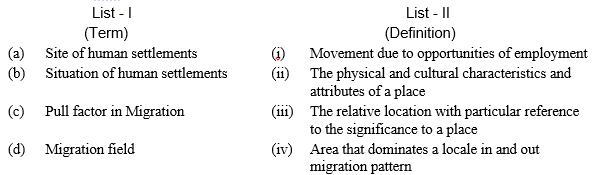
- (1) (i) (iv) (ii) (iii)
- (2) (ii) (iii) (i) (iv)
- (3) (iii) (ii) (iv) (i)
- (4) (iv) (ii) (i) (iii)
Answer: (2)
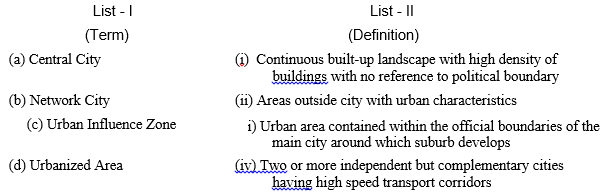
- (1) (i) (ii) (iv) (iii)
- (2) (iii) (iv) (ii) (i)
- (3) (ii) (iv) (iii) (i)
- (4) (iv) (ii) (i) (iii)
Answer: (2)
(a) Wholesale and Light Manufacturing
(b) High class residential
(c) Medium class residential
(d) Industrial Suburb
Code :- (1) (b) (c) (a) (d)
- (2) (a) (b) (c) (d)
- (3) (a) (c) (b) (d)
- (4) (c) (d) (a) (b)
Answer: (3)
- (1) Rapid increase in the population growth
- (2) High pressure of population on arable land
- (3) Low per capita income and glaring disparity between levels of income of urban and rural areas
- (4) Slow but consistent increase in amenities in rural areas and increase in per capita income
Answer: (4)
- (1) A.O. Hirchman
- (2) F. Perroux
- (3) Boudeville
- (4) B.J.L. Berry
Answer: (3)
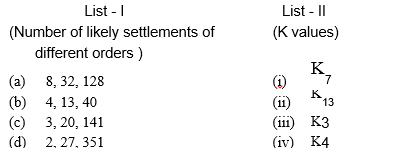
- (1) (iv) (iii) (ii) (i)
- (2) (iv) (ii) (iii) (i)
- (3) (i) (iii) (ii) (iv)
- (4) (iv) (iii) (i) (ii)
Answer: (4)
Assertion (A) : The Green Revolution contributed to aggravation of poverty rather than its solution.
Reason (R) : Wealthy and landed farmers realised that Green Revolution together with agricultural mechanisation provided great potential for self cultivation. They began to withdraw land from share cropping and rental market. As a consequence, a large number of tenants and peasants lost their jobs.
Code :- (1) Both (A) and (R) are true and (R) is the correct explanation of (A).
- (2) Both (A) and (R) are true, but (R) is not a correct explanation of (A).
- (3) (A) is true, but (R) is false.
- (4) (A) is false, but (R) is true.
Answer: (1)
- (1) Agriculture
- (2) Hydro-electricity power generation
- (3) Manufacturing industries
- (4) Urbanization
Answer: (3)
- (1) The Cape Route
- (2) North Pacific Route
- (3) South Atlantic Route
- (4) North Atlantic Route
Answer: (4)
- (1) Agglomeration economies lead to high transport and labour cost
- (2) Labour is infinitely available
- (3) Location with high transport costs may be attractive because of a cheap labour supply
- (4) Transport costs were uniform by distance and weight in any direction
Answer: (1)
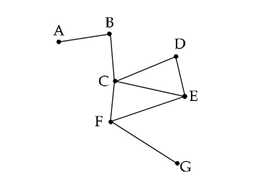
- (1) 2
- (2) 4
- (3) 3
- (4) 1
Answer: (2)
Assertion (A) : Between Durgapur-Asansol-Chittaranjan and numerous collieries and connected activities the Asansol sub-division represents one of larger industrial complexes in the world.
Reason (R) : The substantial coal reserves and output, iron and steel output and engineering industry in the Asansol sub-division outside the Calcutta Metropolitan district are found.
Code :- (1) Both (A) and (R) are true and (R) is the correct explanation of (A).
- (2) Both (A) and (R) are true , but (R) is not the correct explanation of (A).
- (3) (A) is true, but (R) is false.
- (4) (A) is false, but (R) is true.
Answer: (1)
- (1) Hartshorne
- (2) G.E. Pearcy
- (3) R.H. Fifield
- (4) George T. Renner
Answer: (1)
- (1) G.E. Pearcy
- (2) Stephen B. Jones
- (3) J.K. Wright
- (4) Hartshorne
Answer: (1)
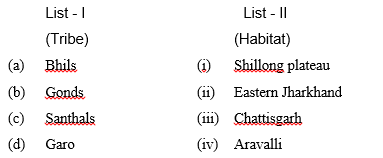
- (1) (iv) (iii) (ii) (i)
- (2) (i) (ii) (iii) (iv)
- (3) (iii) (i) (iv) (ii)
- (4) (ii) (iii) (iv) (i)
Answer: (1)
- (1) Wilber Zelinsky
- (2) Carl Sauer
- (3) Anne Buttimer
- (4) Ratzel
Answer: (2)
- (1) Tharu Tribe
- (2) Khasi Tribe
- (3) Gond Tribe
- (4) Bhil Tribe
Answer: (1)
Assertion (A) : Joint family institution is linked with the economically less developed area.
Reason (R) : Educated and well placed white collar employees go for nuclear family.
Code :- (1) Both (A) and (R) are true and (R) is the correct explanation of (A).
- (2) Both (A) and (R) are true , but (R) is not a correct explanation of (A).
- (3) (A) is true, but (R) is false.
- (4) (A) is false, but (R) is true.
Answer: (2)
Assertion (A) : Metros are emerging as efficient, viable and alternate means of transportation in metropolitan cities in our country.
Reason (R) : Old and unplanned cities with rapidly growing population are burdened with multi-mode of transportation in India.
Code :- (1) Both (A) and (R) are true and (R) is the correct explanation of (A).
- (2) Both (A) and (R) are true , but (R) is not a correct explanation of (A)
- (3) (A) is true, but (R) is false.
- (4) (A) is false but (R) is true.
Answer: (2)
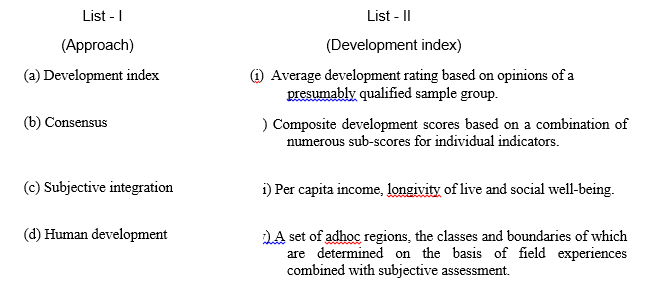
- (1) (ii) (iv) (iii) (i)
- (2) (ii) (i) (iv) (iii)
- (3) (i) (iv) (iii) (ii)
- (4) (ii) (i) (iii) (iv)
Answer: (2)
Assertion (A) : MNREGA constituted very ambitious rural development programme of India.
Reason (R) : Building basic infrastructure got linked to provide minimum number of days guaranteed employment.
Code :
- (1) Both (A) and (R) are true and (R) is the correct explanation of (A).
- (2) Both (A) and (R) are true , but (R) is not a correct explanation of (A).
- (3) (A) is true, but (R) is false.
- (4) (A) is false, but (R) is true.
Answer: (1)
Assertion (A) : Urban agglomerations and metropolitan cities are growing rapidly in India.
Reason (R) : Satellite towns are not sufficiently and significantly developed to release the pressure of urban population.
Code :- (1) Both (A) and (R) are true and (R) is the correct explanation of (A).
- (2) Both (A) and (R) are true , but (R) is not a correct explanation of (A).
- (3) (A) is true, but (R) is false.
- (4) (A) is false, but (R) is true.
Answer: (1)
- (1) Both the Growth pole and Growth centres are uniformly distanced in the region.
- (2) Lower order Growth centres are located quite far away as compared to higher order Growth centres.
- (3) Higher order Growth centres are located far away while lower order Growth centres are located closer to one and an other.
- (4) There does not exist any rule in the distance between Growth pole and Growth centres.
Answer: 3)
(1) West Bengal
(2) Maharashtra
(3) Uttar Pradesh
(4) Arunachal Pradesh
61. Which one of the following is responsible for concentration of slum population in India ?- (1) Commercial plantation activities are dominant.
- (2) Manufacturing activities in organised sector are dominant.
- (3) Service activities in organised sector are dominant.
- (4) Manufacturing and Service activities in non-formal sector are dominant.
Answer: (4)
- (1) Kerala
- (2) Karnataka
- (3) Assam
- (4)Tamil Nadu
Answer: (2)
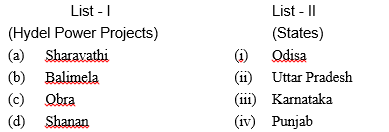
- (1) (i) (iii) (iv) (ii)
- (2) (ii) (iii) (iv) (i)
- (3) (ii) (iv) (i) (iii)
- (4) (iii) (i) (ii) (iv)
Answer: (4)
Assertion (A) : Northern part of Ganga plain has very few irrigation canals.
Reason (R) : This area receives high rainfall and has plenty of underground water.
Code :- (1) Both (A) and (R) are true and (R) is the correct explanation of (A).
- (2) Both (A) and (R) are true , but (R) is not a correct explanation of (A).
- (3) (A) is true, but (R) is false.
- (4) (A) is false, but (R) is true.
Answer: (2)
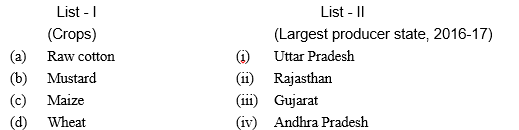
- (1) (iii) (iv) (ii) (i)
- (2) (iv) (iii) (i) (ii)
- (3) (iii) (ii) (iv) (i)
- (4) (i) (ii) (iii) (iv)
Answer: (3)
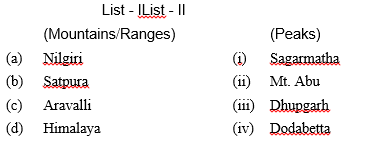
- (1) (iii) (iv) (i) (ii)
- (2) (i) (ii) (iii) (iv)
- (3) (iv) (iii) (ii) (i)
- (4) (iii) (iv) (ii) (i)
Answer: (3)
Assertion (A) : With every successive census in India, the growth of population results in greater increase in slum population.
Reason (R) : Both the area and the population of India have been increasing continuously.
Code :- (1) Both (A) and (R) are true and (R) is the correct explanation of (A).
- (2) Both (A) and (R) are true , but (R) is not a correct explanation of (A).
- (3) (A) is true, but (R) is false.
- (4) (A) is false, but (R) is true.
Answer: (3)
- (1) Temperature and absolute humidity
- (2) Rainfall and runoff
- (3) Crop production and rainfall
- (4) Crop season and weather conditions
Answer: (4)
- (1) 30,000 to 36,000 km
- (2) 2,000 to 6,000 km
- (3) 300 to 1000 km
- (4) 5,000 to 15,000 km
Answer: (3)
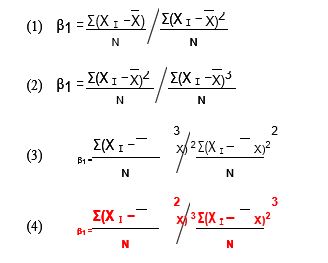
Answer: (4)
Assertion (A) : Standard Deviation of a series is the measure of its variation.
Reason (R) : Standard Deviation is needed to compare the variation between two or more series.
Code :- (1) Both (A) and (R) are true and (R) is the correct explanation of (A).
- (2) Both (A) and (R) are true , but (R) is not a correct explanation of (A).
- (3) (A) is true, but (R) is false.
- (4) (A) is false, but (R) is true.
Answer: (4)
(a) Tele-communication satellites are mostly Geostationary satellites usually placed at an altitudes of more than 30,000 km.
(b) Resource satellites are sun synchronous usually placed at an altitude of 300 - 1000 km. Which of the above statements are true ?
- (1) (a) only
- (2) both (a) and (b)
- (3) (b) only
- (4) neither (a) nor (b)
Answer: (2)
- (1) Photo Camera
- (2) Multiframe Camera
- (3) Multiband Scanner
- (4) Radar
Answer: (4)
- (1) Figure X is small-scale map and distance between A and B is 40 metres.
- (2) Figure Y is large scale map and distance between C and D is 4 km.
- (3) Figure X is large scale map and figure Y is small-scale and distance between A and B and C and D are 40 metres and 20 km, respectively.
- (4) Figure X is large scale and figure Y is small-scale. The ground distance between A and B, and C and D are equal.
Answer: (3)
Assertion (A) : Dot map is especially useful when the values are distributed unevenly and sporadically.
Reason (R) : Smaller the statistical unit, more accurate is the Dot map.
Code :- (1) Both (A) and (R) are true and (R) is the correct explanation of (A).
- (2) Both (A) and (R) are true, but (R) is not a correct explanation of (A).
- (3) (A) is true, but (R) is false.
- (4) (A) is false, but (R) is true.
Answer: (2)
Answer: (4)