UGC NET(National Eligibility Test) Public Administration - Previous Years Solved Papers | Paper II November 2017
- (1) taxing power of state is limited.
- (2) taxation should not be felt to be heavy or exclusive.
- (3) tax increase should be graduated.
- (4) tax increase should be doubled in every five years.
Answer: Option (4)
- (1) John Stuart
- (2) John Rawls
- (3) Robert Dahl
- (4) Herbert A. Simon
Answer: Option (2)
⭐ Make GKSeries Your Preferred Source on Google
Add GKSeries as Preferred SourceReason (R) : It is getting harder to run a constitution than to frame the constitution.
Code :- (1) Both (A) and (R) are correct and (R) is the correct explanation of (A).
- (2) Both (A) and (R) are correct but (R) is not the correct explanation of (A).
- (3) (A) is true, but (R) is false.
- (4) (A) is false, but (R) is true.
Answer: Option (2)
(a) High Intelligence
(b) Keen Perception
(c) Discrimination
(d) Inventiveness
- (1) (a), (b), (c)
- (2) (a), (b), (c), (d)
- (3) (b), (c), (d), (e)
- (4) (a), (b), (c), (e)
Answer: Option (2)
- (1) Webster’s Dictionary
- (2) John M. Pfiffner
- (3) Robert Merton
- (4) William Scott
Answer: Option (2)
Reason (R) : New Public Management, like many previous administrative philosophies, was presented as a framework of general applicability.
Code :- (1) Both (A) and (R) are correct and (R) is the correct explanation of (A).
- (2) Both (A) and (R) are correct but (R) is not the correct explanation of (A).
- (3) (A) is true, but (R) is false.
- (4) (A) is false, but (R) is true.
Answer: Option (2)
(a) Supportive collaborative research.
(b) Demand to maintain methodological and epistemological pluralism.
(c) Understanding western administration.
(d) Promoting boundary spanning.
Code :- (1) (a) and (b)
- (2) (a), (b), (d)
- (3) (a), (c) and (d)
- (4) (b), (c) and (d)
Answer: Option (2)
- (1) Herald Laski
- (2) Hegal
- (3) Karl Marx
- (4) Mahatma Gandhi
Answer: Option (3)
- (1) Lyndall Urwick
- (2) Luther Gullick
- (3) M.P. Follet
- (4) Henri Fayol
Answer: Option (2)
- (1) Responsibility
- (2) Supervision
- (3) Working conditions
- (4) Interpersonal relations
Answer: Option (1)
- (1) A Theory of Human Motivation - Abraham Maslow
- (2) Management and Morale - Fritz Roethlisberger
- (3) Personality and social encounter - J.S. Adams
- (4) Existence, Relatedness and - C.P. Alderfer Growth : Human Needs in organizational setting
Answer: Option (3)
- (1) 1924
- (2) 1928
- (3) 1931
- (4) 1943
Answer: Option (4)
- (1) They have a vision.
- (2) They are willing to take personal risks to achieve vision.
- (3) They are sensitive to followers needs.
- (4) They exhibit ordinary behaviour.
Answer: Option (4)
- (1) It promotes interpersonal competence.
- (2) It enhances dependence and control.
- (3) It helps in understanding effective group functioning.
- (4) It develops awareness and acceptance of self.
Answer: Option (2)
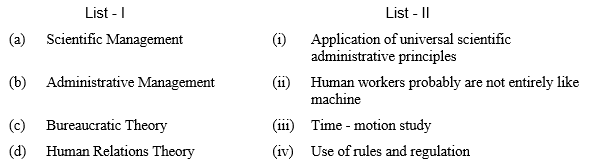
- (1) (i) (ii) (iii) (iv)
- (2) (ii) (i) (iv) (iii)
- (3) (iii) (i) (iv) (ii)
- (4) (iii) (iv) (i) (ii)
Answer: Option (3)
(a) Theory construction
(b) Development administration
(c) Administrative capacity building
(d) Administration of planned change
Code :- (1) (a) and (b)
- (2) (a), (b) and (c)
- (3) (b), (c) and (d)
- (4) (a), (b), (c) and (d)
Answer: Option (1)
(a) Article, “Agraria and Industria : Toward a Typology of Comparative Administration
(b) Prismatic Society Revisited
(c) Ecology of Public Administration
(d) Administration in Developing Countries
Code :- (1) (a), (b), (c) and (d)
- (2) (d), (c), (b) and (a)
- (3) (c), (a), (b) and (d)
- (4) (b), (c), (d) and (a)
Answer: Option (4)
Reason (R) : Present day Riggs is in fact the most blunt and harshest critic of former Riggs.
Code :- (1) Both (A) and (R) are correct and (R) is the correct explanation of (A).
- (2) Both (A) and (R) are correct but (R) is not the correct explanation of (A).
- (3) (A) is true, but (R) is false.
- (4) (A) is false, but (R) is true.
Answer: Option (2)
- (1) 9TH
- (2) 10TH
- (3) 11TH
- (4) 12TH
Answer: Option (2)
- (1) It is an unnecessary evil.
- (2) It has a class character.
- (3) It is the political expression of the division of labour.
- (4) It can be abolished only when the general interest becomes real.
Answer: Option (1)
- (1) Development Administration – Edward Weidner
- (2) Human Relations Theory – Elton Mayo
- (3) Comparative Public Administration – F.W. Riggs
- (4) Administrative Management Theory – Chester Barnard
Answer: Option (4)
- (1) Edward Weidner
- (2) F.W. Riggs
- (3) George Gant
- (4) V.A. Pai Panandikar
Answer: Option (3)
- (1) F.W. Riggs
- (2) Ferrel Heady
- (3) Comparative Administration Group of USA
- (4) Robert Jackson
Answer: Option (2)
- (1) Vishay Pati
- (2) Karori Faujdar
- (3) Subedar
- (4) Shikdar
Answer: Option (2)
- (1) Cabinet Secretariat
- (2) Prime Minister’s office
- (3) President’s Secretariat
- (4) University Grants Commission
Answer: Option (4)
Reason (R) : Promotion makes employees more sensitive to people’s aspirations.
Code :- (1) Both (A) and (R) are correct and (R) is the correct explanation of (A).
- (2) Both (A) and (R) are correct but (R) is not the correct explanation of (A).
- (3) (A) is true, but (R) is false.
- (4) (A) is false, but (R) is true.
Answer: Option (3)
- (1) 1858
- (2) 1893
- (3) 1921
- (4) 1951
Answer: Option (3)
(a) Advancement of Budget
(b) Demonetisation
(c) Good Economic Growth
(d) Merger of Rail Budget with Union Budget
Select the correct answer from the code given :- (1) (a), (b), (c), (d)
- (2) (a), (b), (c)
- (3) (a), (b), (d)
- (4) (a), (d)
Answer: Option (3)
- (1) Five members
- (2) Three members
- (3) Four members
- (4) Seven members
Answer: Option (3)
- (1) Article 245
- (2) Article 246
- (3) Article 248
- (4) Article 249
Answer: Option (2)
- (1) The commission serves as an advisory body.
- (2) The commission is given its functions under Article 320 of the Indian constitution.
- (3) Article 321 provides that additional functions may be entrusted to the commission.
- (4) Article 311 provides that additional functions may be entrusted to the commission.
Answer: Option (4)
(a) Responsiveness to challenging democratic needs.
(b) Awareness of technological, economic and social developments.
(c) Accountability to ensure high performance.
(d) Commitment to leadership.
Code :- (1) (a), (b), (c), (d)
- (2) (b), (c) and (d)
- (3) (a), (b) and (c)
- (4) (a), (c) and (d)
Answer: Option (3)
- (1) 2012
- (2) 2013
- (3) 2014
- (4) 2015
Answer: Option (1)
- (1) Second Administrative Reforms Commission
- (2) Sixth Pay Commission
- (3) 7TH Pay Commission
- (4) P.C. Hota Committee
Answer: Option (1)
- (1) Leh
- (2) Jaisalmer
- (3) Kachchh
- (4) Bikaner
Answer: Option (3)
- (1) Tax Revenue
- (2) Non-Tax Revenue
- (3) Sales Budget
- (4) Capital Receipts
Answer: Option (3)
- (1) 1991
- (2) 1993
- (3) 2000
- (4) 2003
Answer: Option (2)
- (1) Ethical neutrality
- (2) Generality
- (3) Prediction based on probability
- (4) Public methodology affording testing of conclusions
Answer: Option (4)
- (1) It should be empirically testable.
- (2) It must be specific.
- (3) It should be general and grandiose in scope.
- (4) It should be related to a body of a theory.
Answer: Option (3)
- (1) Principle of Replication
- (2) Principle of Matching
- (3) Principle of Randomization
- (4) Principle of local control
Answer: Option (2)
- (1) Census survey
- (2) Small sample
- (3) Large sample
- (4) Convenience sample
Answer: Option (1)
- (1) Self-employment scheme for Rehabilitation of Manual Scavengers (SRMS)
- (2) Pradhan Mantri Adarsh Gram Yojana (PMAGY)
- (3) Pradhan Mantri Grameen Awaas Yojana
- (4) Protection of Civil Rights and Prevention of Atrocities.
Answer: Option (3)
(a) The committee has 30 members – 20 elected from Lok Sabha and 10 elected from Rajya Sabha.
(b) The term of the committee is one year.
(c) A minister is eligible for election to the committee.
(d) The election pattern to the committee comprises of 15 members each from Lok Sabha and Rajya Sabha.
Code :- (1) (a) only
- (2) (a) and (b)
- (3) (c) and (d)
- (4) (b) and (c)
Answer: Option (3)
- (1) Nagaland
- (2) Mizoram
- (3) Jammu and Kashmir
- (4) Sikkim
Answer: Option (3)
- (1) Generation of Income
- (2) Capital Formation
- (3) Infrastructure Development
- (4) Concentration of Income and Wealth
Answer: Option (4)
- (1) In India there are 21 PSU Banks.
- (2) Union cabinet recently decided to set up a Ministerial panel to consider the mergers.
- (3) The idea of bank mergers was recommended by M. Narasimham in 1991.
- (4) In 2014, P.J. Nayak Panel suggested to drop the proposal of bank mergers.
Answer: Option (4)
- (1) Deen Dayal Upadhyay Swaniyojan Yojana
- (2) D.D. Upadhyay Gram Jyoti Yojana
- (3) D.D. Upadhyay Skill Development Yojana
- (4) D.D. Upadhyay Gram Sadak Yojana
Answer: Option (1)
- (1) Digital India Programme
- (2) INSPIRE Programme
- (3) National Social Assistance Scheme
- (4) Pradhan Mantri Kaushal Vikas Yojana
Answer: Option (4)
- (1) L.M. Singhvi Committee
- (2) Ministry of Urban Development
- (3) Second Administrative Reforms Commission
- (4) 14TH Finance Commission of India
Answer: Option (3)
(a) There are no legal provisions for punitive action.
(b) States have not enacted legislation to facilitate social audit.
(c) Feeble community participation in this process.
(d) Needed Public documents are not made available by the incurring agencies.
Select the correct answer using the code given below :- (1) (a), (b), (c), (d)
- (2) (a), (b), (c)
- (3) (a), (c), (d)
- (4) (a), (b), (d)
Answer: Option (1)