UGC NET Sociology - Previous Years Solved Papers | Paper III November 2017
- (1) P.L. Berger
- (2) Alfred Schutz
- (3) Anthony Giddens
- (4) Max Weber
Answer: Option (2)
- (1) How an actor’s meaning is constituted
- (2) Does not try to identify the unique and fundamental relations existing between self and other
- (3) Both (1) and (2)
- (4) None of the above
Answer: Option (3)
⭐ Make GKSeries Your Preferred Source on Google
Add GKSeries as Preferred Source- (1) Peter Berger
- (2) Alfred Schutz
- (3) Henri Bergson
- (4) Erving Goffman
Answer: Option (1)
- (1) Social facts as made of institutions
- (2) Treating the objectivity of social facts as accomplishment of members
- (3) Treating the objectivity of social actions
- (4) Social actions as made of values and accomplished by members
Answer: Option (2)
- (1) that they are reflexively accountable
- (2) that ethnomethodologists provide description
- (3) that for objective and subjective reality they are accountable
- (4) none of the above
Answer: Option (1)
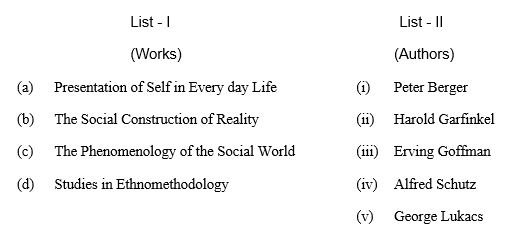
- (1) (i) (ii) (iii) (v)
- (2) (ii) (iii) (iv) (v)
- (3) (iii) (i) (iv) (ii)
- (4) (iv) (i) (iii) (v)
Answer: Option (3)
- (1) Altruism
- (2) Epistemological Break
- (3) Repressive State Apparatuses
- (4) Ideology
Answer: Option (1)
- (1) Anti-individualism
- (2) Conservatism
- (3) Integration
- (4) Idealism
Answer: Option (3)
- (1) J. Derrida
- (2) L. Althusser
- (3) M. Foucault
- (4) J. Habermas
Answer: Option (4)
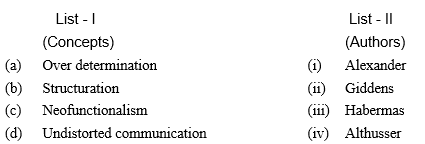
- (1) (i) (ii) (iii) (iv)
- (2) (iv) (ii) (i) (iii)
- (3) (iv) (i) (iii) (ii)
- (4) (ii) (iii) (iv) (i)
Answer: Option (2)
(a) J. Alexander
(b) L. Althusser
(c) J. Habermas
(d) A. Giddens
(e) H. Marcuse
Select the correct answer from the code given below :- (1) (a), (b)
- (2) (a), (b), (e)
- (3) (c), (e)
- (4) (c), (d)
Answer: Option ()
- (1) Discipline and Punish
- (2) Reading Capital
- (3) The Order of Things
- (4) Madness and Civilization
Answer: Option (2)
- (1) Structural Dualism
- (2) Duality of structure
- (3) Dichotomous Relationship
- (4) Binary Oppositions
Answer: Option (2)
- (1) The term ‘Deconstruction’ is particularly associated with the work of Jacques Derrida
- (2) ‘Deconstruction’ is a post structuralist intellectual movement mainly influential in France and the US since the late 1960s
- (3) ‘Deconstruction’ supports the binary conceptual systems in which one concept is privileged in the hierarchical setting
- (4) Derrida offers a critique of both Positivism and Phenomenology
Answer: Option (3)
- (1) Discourse Analysis
- (2) Industrial Archaeology
- (3) Archaeology of knowledge
- (4) Prehistory
Answer: Option (3)
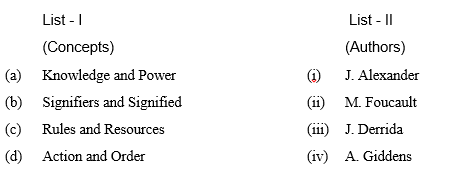
- (1) (ii) (iii) (iv) (i)
- (2) (i) (ii) (iii) (iv)
- (3) (iv) (iii) (ii) (i)
- (4) (ii) (i) (iii) (iv)
Answer: Option (1)
- (1) 3000 - 4000
- (2) 4000 - 5000
- (3) 5000 - 6000
- (4) 6000 - 7000
Answer: Option (2)
- (1) Language Commission
- (2) National Integration Commission
- (3) The State Reorganization Commission
- (4) Knowledge Commission
Answer: Option (9)
- (1) 20
- (2) 18
- (3) 22
- (4) 19
Answer: Option (3)
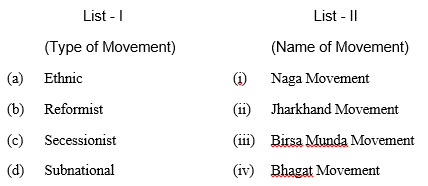
- (1) (iii) (ii) (i) (iv)
- (2) (i) (iv) (iii) (ii)
- (3) (i) (ii) (iii) (iv)
- (4) (iii) (iv) (i) (ii)
Answer: Option (4)
(a) Tribal economy often has a market system
(b) Reciprocity and redistribution create the integrative patterns prevalent in tribal economy
(c) Tribal production is contractual and voluntary
(d) A distinguishing feature of primitive life is fusion of social and economic institutions
Select the correct answer from the code given below :- (1) (a) and (d)
- (2) (b) and (d)
- (3) (a), (b) and (d)
- (4) (a), (b) and (c)
Answer: Option (2)
(a) Tribe - Caste Continuum
(b) Tribal Movements
(c) Field Studies
(d) Sociology of Religion
Select the answer using the code given below :- (1) (a), (b)
- (2) (b), (c), (d)
- (3) (a), (c), (d)
- (4) All the above
Answer: Option (4)
- (1) Indological Perspective
- (2) Civilizational Perspective
- (3) Subaltern Perspective
- (4) Conflict Perspective
Answer: Option (3)
- (1) Land Ownership
- (2) Economic Status
- (3) Purity and Pollution
- (4) Political Power
Answer: Option (3)
- (1) L. Dumont
- (2) Surajit Sinha
- (3) M.N. Srinivas
- (4) D.P. Mukerji
Answer: Option (1)
- (1) N.K. Bose
- (2) D.P. Mukerji
- (3) Surajit Sinha
- (4) G.S. Ghurye
Answer: Option (3)
- (1) Indira Gandhi
- (2) M.L. Dantwala
- (3) Thomas Gladwin
- (4) S. Bagachi
Answer: Option (2)
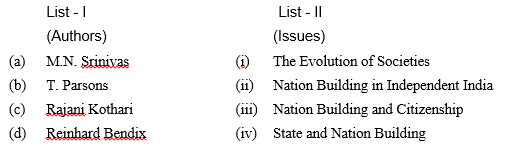
- (1) (iv) (i) (iii) (ii)
- (2) (ii) (i) (iv) (iii)
- (3) (i) (ii) (iii) (iv)
- (4) (iii) (iv) (ii) (i)
Answer: Option (2)
Assertion (A) : Regional, Ethnic and religious disharmonies act as barrier to Nation building.
Reason (R) : Political Elites are interested in creating disharmony to create vote bank.
Select the correct answer from the code given below :- (1) Both (A) and (R) are correct and (R) is the correct explanation of (A)
- (2) Both (A) and (R) are correct but (R) is not the correct explanation of (A)
- (3) (A) is true, but (R) is false
- (4) (A) is false, but (R) is true
Answer: Option (1)
- (1) Tamil nadu
- (2) West Bengal
- (3) Maharashtra
- (4) Bihar
Answer: Option (3)
- (1) Uttar Pradesh
- (2) Bihar
- (3) Madhya Pradesh
- (4) Rajasthan
Answer: Option (2)
- (1) K. Davis
- (2) David Glass
- (3) Robert Malthus
- (4) Frank Notestein
Answer: Option (3)
- (1) 35
- (2) 43
- (3) 53
- (4) 51
Answer: Option (3)
- (1) Normal
- (2) Abnormal
- (3) Legal
- (4) Illegal
Answer: Option (1)
Assertion (A) : As per census estimate about one fourth of males and one fifth of females remain unmarried in India.
Reason (R) : There is low sex ratio in India.
Select the correct answer from the code given below :- (1) Both (A) and (R) are correct and (R) is the correct explanation of (A)
- (2) Both (A) and (R) are correct but (R) is not the correct explanation of (A)
- (3) (A) is true, but (R) is false
- (4) (A) is false, but (R) is true
Answer: Option (2)
- (1) Punjab
- (2) Andhra Pradesh
- (3) Kerala
- (4) Maharashtra
Answer: Option (3)
Assertion (A) : Overwhelming majority of criminals are males in Indian Prisons.
Reason (R) : Usually, women are victims of crime and are not involved in committing the crime.
Select the correct answer from the code given below :- (1) Both (A) and (R) are correct and (R) is the correct explanation of (A)
- (2) Both (A) and (R) are correct but (R) is not the correct explanation of (A)
- (3) (A) is true, but (R) is false
- (4) (A) is false, but (R) is true
Answer: Option (3)
- (1) Sikhs
- (2) Christians
- (3) Hindus
- (4) Bhuddists
Answer: Option (2)
- (1) Both (A) and (R) are correct and (R) is the correct explanation of (A)
- (2) Both (A) and (R) are correct but (R) is not the correct explanation of (A)
- (3) (A) is true, but (R) is false
- (4) (A) is false, but (R) is true
Answer: Option (1)
- (1) Reinhard Bendix
- (2) Wendell Bell
- (3) W.J. Foltz
- (4) C.J. Freiderich
Answer: Option (1)
- (1) Milten Singer
- (2) M.N. Srinivas
- (3) S.C. Dube
- (4) Yogesh Atal
Answer: Option (1)
- (1) An eclectic and fragmentary process of acculturation
- (2) An eclectic and fragmentary process of cultural assimilation
- (3) An eclectic and fragmentary process of cultural lag
- (4) An eclectic and fragmentary process of cultural complex
Answer: Option (1)
- (1) A.R. Desai
- (2) Yogendra Singh
- (3) T.K. Oommen
- (4) M.N. Srinivas
Answer: Option (2)
- (1) Mannual Castells
- (2) Zygmunt Bauman
- (3) Jurgen Habermas
- (4) Ulrich Beck
Answer: Option (1)
- (1) Anthony Giddens
- (2) Jurgen Habermas
- (3) Zygmunt Bauman
- (4) Manuel Castells
Answer: Option (3)
- (1) Cohen, I
- (2) Cheal, D
- (3) Collins, P. Hills
- (4) Castells, Manuel
Answer: Option (4)
- (1) S.P.Q.E.M. (The Schemes for Providing Quality Education in Madarassas)
- (2) EGS/AIE (Education Guarantee Scheme/Alternative and Innovative Education)
- (3) KGBV (Kasturba Gandhi Balika Vidyalaya)
- (4) SSA (Sarva Shiksha Abhiyan)
Answer: Option (1)
- (1) S.C. Dube
- (2) M.N. Srinivas
- (3) Yogendra Singh
- (4) Ajit K. Danda
Answer: Option (3)
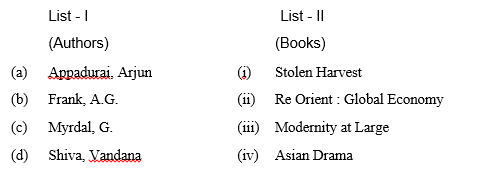
- (1) (i) (ii) (iii) (iv)
- (2) (iv) (iii) (ii) (i)
- (3) (ii) (i) (iii) (iv)
- (4) (iii) (ii) (iv) (i)
Answer: Option (4)
- (1) Paul Brass
- (2) Tom Brass
- (3) Andre Beteille
- (4) A.R. Desai
Answer: Option (2)
- (1) Naxalite Movement
- (2) Tebhaga Movement
- (3) Telangana Movement
- (4) Moplah Movement
Answer: Option (4)
- (1) Baden - Powell
- (2) F.G. Bailey
- (3) Malcolm L. Darling
- (4) I. Natrajan
Answer: Option (3)
- (1) Telangana Movement
- (2) Tebhaga Movement
- (3) Kisan Sabha Movement
- (4) Moplah Rebellion Movement
Answer: Option (2)
- (1) J. Burnham
- (2) J.K. Galbraith
- (3) Daniel Bell
- (4) R. Dahrendorf
Answer: Option (3)
Assertion (A) : In an industrial society, the rate of suicide is significantly higher than in peasant society.
Reason (R) : Autonomy of individual increases with the increasing division of labour.
Select the correct answer from the code given below :- (1) Both (A) and (R) are true and (R) is correct explanation of (A)
- (2) Both (A) and (R) are true but (R) is not the correct explanation of (A)
- (3) (A) is true, but (R) is false
- (4) (A) is false, but (R) is true
Answer: Option (2)
- (1) Push factor due to poverty
- (2) Pull factor due to affluence in urban areas
- (3) Both push and pull factors
- (4) Push factor due to affluence in rural areas
Answer: Option (3)
- (1) Urbanism
- (2) Over - Urbanistion
- (3) Cultural - Lag
- (4) Industrialism
Answer: Option (2)
- (1) The slaves and the free man
- (2) The bourgeois and the proletariat
- (3) The savages, the barbarians and the civilized
- (4) The right and the poor folk
Answer: Option (3)
- (1) Dudley Seers
- (2) David Korten
- (3) A. Gunder Frank
- (4) Amratya Sen
Answer: Option (2)
- (1) World System Theory
- (2) Liberalism
- (3) Neo - liberalism
- (4) Post Modernism
Answer: Option (1)
(a) Self development over material prosperity
(b) Development of free markets
(c) Centralised planning
(d) Development of villages and cottage industries
Select the correct answer using code given below :- (1) (a) and (d)
- (2) (b) and (c)
- (3) (d) and (c)
- (4) (b) and (d)
Answer: Option (1)
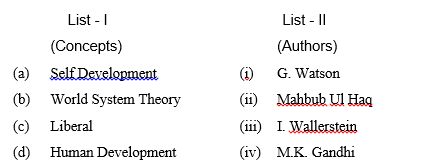
- (1) (iv) (iii) (i) (ii)
- (2) (i) (ii) (iv) (iii)
- (3) (ii) (i) (iii) (iv)
- (4) (iii) (iv) (ii) (i)
Answer: Option (1)
- (1) Both (A) and (R) are correct and (R) is the correct explanation of (A)
- (2) Both (A) and (R) are correct but (R) is not the correct explanation of (A)
- (3) (A) is true, but (R) is false
- (4) (A) is false, but (R) is true
Answer: Option (1)
- (1) K.C. Zachariah
- (2) C. Chandrasekharan
- (3) J.R. Rele
- (4) K. Davis
Answer: Option (3)
- (1) Vital registration system
- (2) National sample survey
- (3) Sample registration system
- (4) Population census
Answer: Option (3)
- (1) Gross migration
- (2) Net migration
- (3) Out migration
- (4) Migration streams
Answer: Option (4)
- (1) Raising age at marriage
- (2) Provision of incentives
- (3) Liberalisation of Abortions
- (4) Provision of contraceptives
Answer: Option (2)
- (1) 1982
- (2) 1972
- (3) 1985
- (4) 1975
Answer: Option (9)
- (1) Mexico Conference
- (2) Bucharest Conference
- (3) Cairo Conference
- (4) Copenhagen Summit
Answer: Option (2)
- (1) Cultural feminism
- (2) Liberal feminism
- (3) Radical feminism
- (4) Socialist feminism
Answer: Option (3)
- (1) F. Agnes
- (2) Poline Kolenda
- (3) I. Agnihotri
- (4) Karuna Chanana
Answer: Option (4)
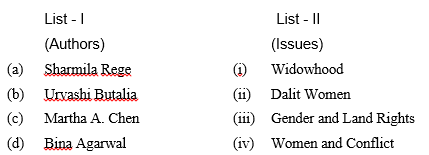
- (1) (ii) (iv) (i) (iii)
- (2) (i) (ii) (iii) (iv)
- (3) (iv) (iii) (ii) (i)
- (4) (ii) (iv) (iii) (i)
Answer: Option (1)
- (1) Reflections on the Women’s Movement in India
- (2) Women and Kinship
- (3) Anthropological Explorations in Gender
- (4) Matriliny and Islam
Answer: Option (1)
- (1) Development of Women’s Studies Year
- (2) Women and Panchayati Raj Year
- (3) Girl Children Education Year
- (4) Women’s Empowerment Year
Answer: Option (4)
- (1) A.R. Desai
- (2) D.P. Mukerji
- (3) M.N. Srinivas
- (4) Louis Dumont
Answer: Option (1)