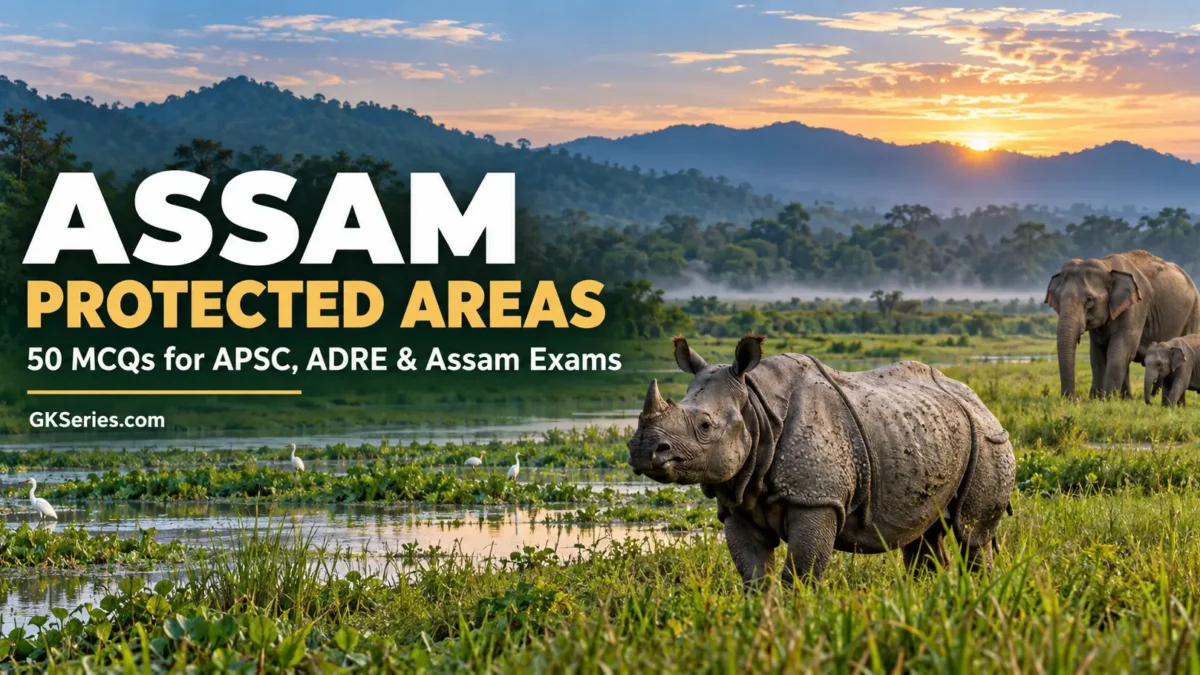
National Parks, Wildlife Sanctuaries and Biosphere Reserves of Assam: 50 MCQs with Answers and Explanations
Assam’s national parks, wildlife sanctuaries and biosphere reserves protect rich floodplain, wetland, rainforest and foothill ecosystems. Their locations, rivers, species, designations and legal safeguards are frequent subjects in APSC Prelims, ADRE, Assam Police and other state recruitment examinations. This practice set offers 50 multiple-choice questions with answers, detailed explanations, option-wise reasoning and revision points. Historical statistics and notification dates are identified by year; check the cited official source for later changes.
Overview
Assam’s protected-area network includes well-known sites such as Kaziranga, Manas, Nameri, Orang, Dibru-Saikhowa, Raimona and Dehing Patkai national parks, along with wildlife sanctuaries including Pobitora, Hollongapar Gibbon, Panidehing, Chakrasila, Laokhowa, Burachapori, Amchang and Borail. Manas and Dibru-Saikhowa are Assam’s biosphere reserves. Assam’s protected areas conserve the one-horned rhinoceros, golden langur, hoolock gibbon, white-winged wood duck, pygmy hog, migratory birds and many other species. Key exam themes include sanctuary–district matching, river and habitat geography, biosphere-reserve zoning, UNESCO recognition, eco-sensitive-zone notifications and provisions of the Wild Life (Protection) Act, 1972.

One-line Points for Quick Revision
- Kaziranga was inscribed on the UNESCO World Heritage List in 1985 under criteria (ix) and (x).
- Manas was designated a biosphere reserve in 1989; Dibru-Saikhowa was designated in 1997.
- Dibru-Saikhowa Biosphere Reserve is listed with a 340 km² core and 425 km² buffer zone.
- Nameri lies in Sonitpur, forms the core area of Nameri Tiger Reserve and adjoins Pakke Tiger Reserve in Arunachal Pradesh.
- The white-winged wood duck is Assam’s state bird and is found in Nameri.
- Raimona forms part of a regional conservation landscape with Phibsoo Wildlife Sanctuary and Buxa Tiger Reserve.
- Chakrasila is known for golden langur; Hollongapar Gibbon Wildlife Sanctuary is in Jorhat.
- Panidehing in Sivasagar lies between the Desang and Demow rivers and supports resident and migratory birds.
- Laokhowa and Burachapori form a connected ecosystem and are described as a notified buffer of Kaziranga Tiger Reserve.
- Section 26A of the Wild Life (Protection) Act covers sanctuary declarations; Section 35 concerns national parks.
MCQs on Assam’s national parks, wildlife sanctuaries, biosphere reserves, biodiversity and conservation laws
MCQ 1: Dehing Patkai—Location and Forest Type
Question: Which option correctly identifies the location and characteristic forest ecosystem of Dehing Patkai National Park?
(a) Kokrajhar and Chirang—Himalayan alpine forest
(b) Dibrugarh and Tinsukia—dipterocarp-dominated lowland rainforest
(c) Jorhat and Golaghat—tidal mangrove forest
(d) Cachar and Hailakandi—tropical thorn forest
Correct Answer: (b) Dibrugarh and Tinsukia—dipterocarp-dominated lowland rainforest
Detailed Explanation: The Tinsukia district administration places Dehing Patkai in Dibrugarh and Tinsukia districts and describes its landscape as a dipterocarp-dominated lowland rainforest. It was officially notified as a national park in 2021. This combines district geography, forest type and protected-area history.
Option-wise Explanation: (a) Incorrect: wrong district pair and ecosystem. (b) Correct: matches the official profile. (c) Incorrect: Dehing Patkai is not a tidal mangrove. (d) Incorrect: tropical thorn forest is not its characteristic vegetation.
Key Points for Revision: Dibrugarh and Tinsukia; lowland rainforest; dipterocarps; notified as a national park in 2021.
MCQ 2: Manas—International Conservation Neighbour
Question: Which protected area in Bhutan adjoins the Manas conservation landscape on its northern side?
(a) Jigme Dorji National Park
(b) Phrumsengla National Park
(c) Bumdeling Wildlife Sanctuary
(d) Royal Manas National Park
Correct Answer: (d) Royal Manas National Park
Detailed Explanation: UNESCO identifies Royal Manas National Park in Bhutan as the northern conservation neighbour of Manas Wildlife Sanctuary. The Assam site occupies a Himalayan foothill landscape associated with the Manas River. The cross-border setting makes cooperation relevant to conservation.
Option-wise Explanation: (a) Incorrect: not the adjoining protected area identified by UNESCO. (b) Incorrect: not Manas’s northern neighbour. (c) Incorrect: not the protected area named in the profile. (d) Correct: Royal Manas forms the Bhutan-side linkage.
Key Points for Revision: Manas is in Assam; Bhutan borders it to the north; Royal Manas is the neighbouring protected area; transboundary conservation is relevant.
MCQ 3: Hollongapar Gibbon Sanctuary—District
Question: Hollongapar Gibbon Wildlife Sanctuary is located in which district of Assam?
(a) Jorhat
(b) Morigaon
(c) Tinsukia
(d) Golaghat
Correct Answer: (a) Jorhat
Detailed Explanation: The Jorhat district administration places Hollongapar Gibbon Wildlife Sanctuary in Jorhat. The sanctuary’s name reflects its association with the hoolock gibbon. Its location is a common protected-area and primate-conservation fact.
Option-wise Explanation: (a) Correct: Jorhat is the official district association. (b) Incorrect: Morigaon is associated with Pobitora. (c) Incorrect: Tinsukia is not Hollongapar’s district. (d) Incorrect: Golaghat is not the district listed for it.
Key Points for Revision: Hollongapar Gibbon Wildlife Sanctuary; Jorhat district; hoolock gibbon.
MCQ 4: Dibru-Saikhowa—Designation Chronology
Question: Which order correctly gives the declaration years of Dibru-Saikhowa Biosphere Reserve and Dibru-Saikhowa National Park?
(a) Biosphere reserve 1999; national park 1997
(b) National park 1997; biosphere reserve 1999
(c) Biosphere reserve 1997; national park 1999
(d) Biosphere reserve 1985; national park 2021
Correct Answer: (c) Biosphere reserve 1997; national park 1999
Detailed Explanation: The Tinsukia district administration records Dibru-Saikhowa Biosphere Reserve as declared in 1997 and the 340 km² sanctuary area as a national park in 1999. The biosphere-reserve designation came first. These historical dates should not be confused with later webpage publication dates.
Option-wise Explanation: (a) Incorrect: years are reversed. (b) Incorrect: places national park first. (c) Correct: biosphere reserve preceded national park. (d) Incorrect: neither year matches the recorded sequence.
Key Points for Revision: Biosphere reserve—1997; national park—1999; biosphere-reserve status came first.
MCQ 5: Biosphere Reserve—Zonation
Question: Which arrangement correctly matches biosphere-reserve zones with their principal functions?
(a) Core—intensive commercial use; buffer—unrestricted settlement; transition—strict protection
(b) Core—biodiversity protection; buffer—compatible research and education; transition—sustainable community activities
(c) Core—tourism infrastructure; buffer—mining; transition—exclusion of communities
(d) Core—agriculture; buffer—urban expansion; transition—exclusive wildlife protection
Correct Answer: (b) Core—biodiversity protection; buffer—compatible research and education; transition—sustainable community activities
Detailed Explanation: UNESCO’s biosphere-reserve framework combines conservation, sustainable development and learning. Core areas prioritise protection; buffer zones accommodate compatible activities such as research and education; transition areas support sustainable human and economic activity. This is a general framework, not a claim about the precise legal boundaries of a specific Assam reserve.
Option-wise Explanation: (a) Incorrect: reverses the core’s protective role. (b) Correct: reflects the standard functions. (c) Incorrect: mining and exclusion are not defining functions. (d) Incorrect: assigns unsuitable functions to the zones.
Key Points for Revision: Core—conservation; buffer—compatible activity; transition—sustainable community use.
MCQ 6: Kaziranga—Floodplain Ecology
Question: Which explanation best describes the ecological role of flooding in Kaziranga?
(a) Flooding has only destructive effects and no habitat-maintenance role.
(b) Flooding converts its grasslands into tidal mangroves.
(c) Flooding permanently removes the influence of river processes.
(d) Flooding helps maintain a changing mosaic of grasslands, wetlands and riverine habitats.
Correct Answer: (d) Flooding helps maintain a changing mosaic of grasslands, wetlands and riverine habitats
Detailed Explanation: UNESCO links Kaziranga’s habitats with the Brahmaputra’s river processes. Flooding, erosion and sediment deposition help shape its grassland–wetland mosaic, although floods can also endanger wildlife. The question tests floodplain ecology rather than a particular year’s flood impacts.
Option-wise Explanation: (a) Incorrect: overlooks habitat maintenance. (b) Incorrect: Kaziranga is not a tidal mangrove ecosystem. (c) Incorrect: river processes remain influential. (d) Correct: describes dynamic habitat formation.
Key Points for Revision: Kaziranga is in the Brahmaputra floodplain; flooding, erosion and sedimentation shape habitats.
MCQ 7: Manas—Transboundary Conservation
Assertion (A): Cross-border cooperation is relevant to conservation in the Manas landscape.
Reason (R): The Assam protected landscape adjoins forests and a protected area in Bhutan, creating an ecological connection across the international border.
(a) Both A and R are true, and R correctly explains A.
(b) Both A and R are true, but R does not correctly explain A.
(c) A is true, but R is false.
(d) A is false, but R is true.
Correct Answer: (a) Both A and R are true, and R correctly explains A.
Detailed Explanation: UNESCO describes Manas as bounded to the north by Bhutan’s forests and linked with Royal Manas National Park. The ecological landscape therefore crosses a political boundary. That connection explains why cooperation between neighbouring jurisdictions matters; this is an inference from the verified geography.
Option-wise Explanation: (a) Correct: the international ecological connection explains the relevance of cooperation. (b) Incorrect: R directly explains A. (c) Incorrect: Bhutan-side connectivity is verified. (d) Incorrect: A is a valid conservation inference.
Key Points for Revision: Manas; Bhutan; Royal Manas National Park; transboundary habitat connectivity.
MCQ 8: Kaziranga—Landscape Connectivity
Question: A conservation plan seeks to improve animal movement between Kaziranga and the Karbi Anglong Hills during seasonal inundation. Which measure best supports that objective?
(a) Constructing continuous barriers across movement routes
(b) Restricting conservation planning to the park interior
(c) Maintaining functional movement corridors and reducing obstruction along them
(d) Replacing connecting natural habitats with dense construction
Correct Answer: (c) Maintaining functional movement corridors and reducing obstruction along them
Detailed Explanation: UNESCO identifies connectivity with the Karbi Anglong Hills as important to Kaziranga’s integrity and notes that seasonal flooding moves animals outside the park. Protecting movement routes best addresses the scenario. This is an application of verified landscape-management concerns.
Option-wise Explanation: (a) Incorrect: barriers obstruct movement. (b) Incorrect: animals move beyond the park. (c) Correct: supports functional connectivity. (d) Incorrect: construction fragments habitat.
Key Points for Revision: Kaziranga–Karbi Anglong linkage; seasonal inundation; functional corridors; landscape-scale conservation.
MCQ 9: Sanctuary–Feature Matching
Question: Consider the pairs: 1. Bornadi—protection of hispid hare and pygmy hog; 2. Garampani—hot-water spring and waterfalls; 3. Bherjan–Borajan–Padumoni—three blocks in Tinsukia. Which pairs are correctly matched?
(a) 1 and 2 only
(b) 1, 2 and 3
(c) 2 and 3 only
(d) 1 and 3 only
Correct Answer: (b) 1, 2 and 3
Detailed Explanation: The Assam Forest Department describes Bornadi as important for the hispid hare and pygmy hog, Garampani as having a hot-water spring and waterfalls, and Bherjan–Borajan–Padumoni as three separate blocks in Tinsukia. All three pairs match the department’s descriptions.
Option-wise Explanation: (a) Incorrect: pair 3 is also correct. (b) Correct: all three pairs are verified. (c) Incorrect: pair 1 is also correct. (d) Incorrect: pair 2 is also correct.
Key Points for Revision: Bornadi—hispid hare and pygmy hog; Garampani—hot spring; Bherjan–Borajan–Padumoni—three blocks, Tinsukia.
MCQ 10: Pobitora—District
Question: Pobitora Wildlife Sanctuary is situated in which district?
(a) Sonitpur
(b) Jorhat
(c) Golaghat
(d) Morigaon
Correct Answer: (d) Morigaon
Detailed Explanation: The Government of India’s India Cine Hub identifies Pobitora Wildlife Sanctuary as being in Morigaon district. The sanctuary is associated with Mayong. Proximity to Guwahati should not be confused with its district location.
Option-wise Explanation: (a) Incorrect: not Pobitora’s district. (b) Incorrect: Jorhat is associated with Hollongapar. (c) Incorrect: not the district listed for Pobitora. (d) Correct: Pobitora is in Morigaon.
Key Points for Revision: Pobitora—Morigaon; Mayong association; distinguish nearby city from administrative district.
MCQ 11: Manas—Biosphere Reserve Designation
Question: According to Assam Forest Department information, in which year was Manas designated a biosphere reserve?
(a) 1974
(b) 1985
(c) 1989
(d) 1990
Correct Answer: (c) 1989
Detailed Explanation: The Assam Forest Department records Manas as a Tiger Reserve in 1974, a UNESCO World Heritage Site in 1985, a biosphere reserve in 1989 and a national park in 1990. Candidates should match each date to the correct designation.
Option-wise Explanation: (a) Incorrect: Tiger Reserve designation. (b) Incorrect: World Heritage inscription. (c) Correct: biosphere reserve year. (d) Incorrect: national park declaration year.
Key Points for Revision: Manas: Tiger Reserve 1974; World Heritage 1985; biosphere reserve 1989; national park 1990.
MCQ 12: Assam’s Biosphere Reserves—Years
Question: Consider: 1. Manas Biosphere Reserve—1989; 2. Dibru-Saikhowa Biosphere Reserve—1997. Which are correctly matched?
(a) 1 only
(b) 2 only
(c) Neither 1 nor 2
(d) Both 1 and 2
Correct Answer: (d) Both 1 and 2
Detailed Explanation: The Ministry of Environment, Forest and Climate Change lists Manas as designated in 1989 and Dibru-Saikhowa in 1997. These are national biosphere-reserve designation years and should not automatically be treated as UNESCO network-admission dates.
Option-wise Explanation: (a) Incorrect: pair 2 is also correct. (b) Incorrect: pair 1 is also correct. (c) Incorrect: both appear in the Ministry list. (d) Correct: both are matched correctly.
Key Points for Revision: Manas—1989; Dibru-Saikhowa—1997; distinguish national designation from UNESCO network membership.
MCQ 13: Orang—Brahmaputra Bank
Question: Orang National Park is situated on which bank of the Brahmaputra?
(a) North bank
(b) South bank
(c) East bank
(d) Entirely south of the Barak River
Correct Answer: (a) North bank
Detailed Explanation: The Assam Forest Department describes Orang as lying on the northern bank of the Brahmaputra. The river setting is useful for map-based questions on protected areas in the Brahmaputra Valley.
Option-wise Explanation: (a) Correct: Orang lies on the north bank. (b) Incorrect: opposite bank. (c) Incorrect: the description is north, not east. (d) Incorrect: the Barak is not Orang’s location reference.
Key Points for Revision: Orang National Park; north bank of the Brahmaputra.
MCQ 14: Nameri—River Association
Question: Which river is associated with rafting along the south-western boundary of Nameri National Park?
(a) Manas
(b) Jia Bhoroli
(c) Dhansiri
(d) Lohit
Correct Answer: (b) Jia Bhoroli
Detailed Explanation: The Assam Forest Department identifies the Jia Bhoroli River with rafting along Nameri’s south-western boundary. The river association is a useful geographical fact for Assam examinations.
Option-wise Explanation: (a) Incorrect: associated with Manas. (b) Correct: named in the Nameri profile. (c) Incorrect: not the river identified here. (d) Incorrect: not the Nameri rafting river.
Key Points for Revision: Nameri—Jia Bhoroli River; south-western boundary.
MCQ 15: Raimona—Conservation Landscape
Question: Which combination correctly describes the larger conservation landscape associated with Raimona National Park?
(a) Manas National Park and Sundarbans Tiger Reserve
(b) Namdapha National Park and Dibru-Saikhowa National Park
(c) Phibsoo Wildlife Sanctuary and Buxa Tiger Reserve
(d) Keibul Lamjao National Park and Pobitora Wildlife Sanctuary
Correct Answer: (c) Phibsoo Wildlife Sanctuary and Buxa Tiger Reserve
Detailed Explanation: The Kokrajhar district administration describes Raimona as part of a transboundary landscape with Bhutan’s Phibsoo Wildlife Sanctuary and Buxa Tiger Reserve in West Bengal. The landscape crosses both an international and a state boundary.
Option-wise Explanation: (a) Incorrect: not the linked landscape. (b) Incorrect: these are not the named neighbours. (c) Correct: both are listed in the official profile. (d) Incorrect: neither is identified as part of the landscape.
Key Points for Revision: Raimona; Phibsoo Wildlife Sanctuary in Bhutan; Buxa Tiger Reserve in West Bengal; transboundary conservation.
MCQ 16: Chakrasila—Golden Langur
Question: Chakrasila Wildlife Sanctuary is particularly known as a protected habitat for which primate?
(a) Golden langur
(b) Lion-tailed macaque
(c) Nilgiri langur
(d) Gee’s golden langur only in Arunachal Pradesh
Correct Answer: (a) Golden langur
Detailed Explanation: The Dhubri district administration identifies Chakrasila with the golden langur and calls it the species’ second protected habitat in India. The sanctuary falls in Kokrajhar district and adjacent areas of Dhubri district.
Option-wise Explanation: (a) Correct: golden langur is the signature primate. (b) Incorrect: not the species named. (c) Incorrect: not the species named. (d) Incorrect: it does not describe Chakrasila’s association.
Key Points for Revision: Chakrasila; golden langur; Kokrajhar and adjacent Dhubri areas.
MCQ 17: Deepor Beel—Ramsar Site
Question: Which statement about Deepor Beel is correct?
(a) Saltwater lagoon in upper Assam, designated in 1997
(b) Freshwater lake southwest of Guwahati, listed under the Ramsar Convention in November 2002
(c) High-altitude lake in Karbi Anglong, listed in 1985
(d) River island in Tinsukia, designated a biosphere reserve in 1999
Correct Answer: (b) Freshwater lake southwest of Guwahati, listed under the Ramsar Convention in November 2002
Detailed Explanation: The Government of Assam describes Deepor Beel as a freshwater lake southwest of Guwahati, in Kamrup district, listed under the Ramsar Convention in November 2002. It is an important Assam example connecting urban geography, wetlands and international conservation.
Option-wise Explanation: (a) Incorrect: it is freshwater, not a saltwater lagoon. (b) Correct: matches the state profile. (c) Incorrect: wrong location and date. (d) Incorrect: not a Tinsukia island or biosphere reserve.
Key Points for Revision: Deepor Beel/Dipor Beel; southwest of Guwahati; Kamrup; Ramsar listing in November 2002.
MCQ 18: National Parks—Grazing Law
Question: Under Section 35(7) of the Wild Life (Protection) Act, 1972, which statement about grazing in a national park is correct?
(a) Freely permitted for local residents
(b) Permitted only during monsoon
(c) Generally prohibited, with a stated exception for livestock used as a vehicle by an authorised entrant
(d) The Act contains no grazing provision
Correct Answer: (c) Generally prohibited, with the stated exception
Detailed Explanation: Section 35(7) prohibits grazing of livestock in a national park, subject to the stated exception for livestock used as a vehicle by a person authorised to enter. The provision is relevant to protected-area management and statutory interpretation.
Option-wise Explanation: (a) Incorrect: local ownership alone does not create a general permission. (b) Incorrect: no monsoon allowance is specified. (c) Correct: captures the rule and exception. (d) Incorrect: Section 35(7) addresses grazing.
Key Points for Revision: Wild Life (Protection) Act, 1972; Section 35(7); general prohibition on grazing in national parks; read statutory exceptions carefully.
MCQ 19: National Park Boundaries—Statutory Safeguard
Question: Under Section 35(5) of the Wild Life (Protection) Act, 1972, alteration of national park boundaries by a State Government requires a recommendation from which body?
(a) National Board for Wildlife
(b) Central Pollution Control Board
(c) Zoological Survey of India
(d) National Biodiversity Authority
Correct Answer: (a) National Board for Wildlife
Detailed Explanation: Section 35(5) states that the State Government may not alter national park boundaries except on the recommendation of the National Board for Wildlife. This is a statutory safeguard relevant to habitat protection and protected-area administration.
Option-wise Explanation: (a) Correct: Section 35(5) names the NBWL. (b) Incorrect: not the body named. (c) Incorrect: not the body named. (d) Incorrect: not the body named.
Key Points for Revision: Section 35(5); national park boundary alteration; NBWL recommendation.
MCQ 20: Sanctuary–District Matching
Question: Consider: 1. Hollongapar Gibbon—Jorhat; 2. Pobitora—Morigaon; 3. Deepor Beel—Kamrup (Metro). Which pairs are supported by Assam Forest Department data?
(a) 1 and 2 only
(b) 2 and 3 only
(c) 1 and 3 only
(d) 1, 2 and 3
Correct Answer: (d) 1, 2 and 3
Detailed Explanation: Assam Forest Department data lists Hollongapar Gibbon in Jorhat, Pobitora in Morigaon and Deepor Beel in Kamrup (Metro). All three pairs are correct. This tests administrative geography through official department data.
Option-wise Explanation: (a) Incorrect: pair 3 is also supported. (b) Incorrect: pair 1 is also supported. (c) Incorrect: pair 2 is also supported. (d) Correct: all three pairs match the table.
Key Points for Revision: Hollongapar—Jorhat; Pobitora—Morigaon; Deepor Beel—Kamrup (Metro).
MCQ 21: Panidehing—Location
Question: Panidehing Bird Sanctuary lies between which two rivers in Sivasagar district?
(a) Brahmaputra and Subansiri
(b) Desang and Demow
(c) Barak and Jiri
(d) Manas and Beki
Correct Answer: (b) Desang and Demow
Detailed Explanation: The Sivasagar district administration places Panidehing in the northern part of the district, between the Desang and Demow rivers. It describes the site as a wetland and records its declaration as a wildlife sanctuary in 1996.
Option-wise Explanation: (a) Incorrect: not the rivers bounding Panidehing. (b) Correct: the official profile names these rivers. (c) Incorrect: not the local river pair. (d) Incorrect: these rivers are not identified with the sanctuary.
Key Points for Revision: Panidehing; Sivasagar; Desang and Demow; wetland sanctuary, 1996.
MCQ 22: Panidehing—Birdlife
Question: Which best describes Panidehing Wildlife Sanctuary’s birdlife, according to the Sivasagar district administration?
(a) Resident and migratory birds, including geese and ducks
(b) Seabirds and penguins
(c) Birds restricted to desert habitats
(d) Flamingos nesting in a salt lake
Correct Answer: (a) Resident and migratory birds, including geese and ducks
Detailed Explanation: The district administration describes Panidehing as a habitat for resident and migratory birds, including geese, ducks and storks. Wetland habitats provide feeding and resting grounds for birds and make Panidehing relevant to biodiversity questions.
Option-wise Explanation: (a) Correct: matches the sanctuary profile. (b) Incorrect: Panidehing is an inland wetland. (c) Incorrect: desert birds are not its defining feature. (d) Incorrect: it is not described as a salt lake or flamingo colony.
Key Points for Revision: Wetland in Sivasagar; resident and migratory birds; geese and ducks are notable groups.
MCQ 23: Laokhowa—Riverbank and Ecosystem
Question: Which description correctly matches Laokhowa Wildlife Sanctuary?
(a) North bank of Brahmaputra; Sonitpur; Manas landscape
(b) South bank of Brahmaputra; Nagaon; Laokhowa–Burachapori ecosystem
(c) South bank of Barak; Cachar; Borail landscape
(d) Eastern Himalayan foothills; Kokrajhar; Raimona landscape
Correct Answer: (b) South bank of Brahmaputra; Nagaon; Laokhowa–Burachapori ecosystem
Detailed Explanation: The Assam Forest Department places Laokhowa on the Brahmaputra’s southern bank in Nagaon district and identifies it as part of the Laokhowa–Burachapori ecosystem. The question combines river geography with ecosystem linkage.
Option-wise Explanation: (a) Incorrect: wrong bank, district and landscape. (b) Correct: all details match the official profile. (c) Incorrect: Laokhowa is not in Cachar on the Barak. (d) Incorrect: this is not its location.
Key Points for Revision: Laokhowa; Nagaon; south bank of Brahmaputra; linked ecosystem with Burachapori.
MCQ 24: Burachapori—Habitat Mosaic
Question: Which habitat combination is characteristic of Burachapori Wildlife Sanctuary?
(a) Alpine meadows, glaciers and coniferous forest
(b) Tidal mangroves, coral reefs and salt marshes
(c) Wet alluvial grassland, riparian and semi-evergreen forest, wetlands
(d) Thorn scrub, dunes and dry deciduous woodland
Correct Answer: (c) Wet alluvial grassland, riparian and semi-evergreen forest, wetlands
Detailed Explanation: The Assam Forest Department describes Burachapori as a mosaic of wet alluvial grassland, riparian and semi-evergreen forest, wetlands and river systems. It is in Sonitpur district on the Brahmaputra’s southern bank and belongs to the Laokhowa–Burachapori ecosystem.
Option-wise Explanation: (a) Incorrect: high-altitude habitat. (b) Incorrect: not a coastal or marine site. (c) Correct: matches the official habitat description. (d) Incorrect: these are not its stated habitats.
Key Points for Revision: Burachapori; Sonitpur; Brahmaputra floodplain; wet alluvial grassland and riparian habitats.
MCQ 25: Declaring a Wildlife Sanctuary
Question: Under Section 26A of the Wild Life (Protection) Act, 1972, which government issues the notification declaring an area to be a sanctuary?
(a) State Government
(b) District council
(c) Supreme Court
(d) State Biodiversity Board
Correct Answer: (a) State Government
Detailed Explanation: Section 26A provides for a State Government notification specifying the area’s limits and declaring it a sanctuary, subject to statutory conditions. This tests the legal authority responsible for sanctuary declaration, rather than the agency that may manage the site.
Option-wise Explanation: (a) Correct: Section 26A names the State Government. (b) Incorrect: not the declaring authority under this section. (c) Incorrect: the Supreme Court does not issue this notification. (d) Incorrect: the Board is not the statutory declaring authority.
Key Points for Revision: Wild Life (Protection) Act, 1972; Section 26A; State Government declaration by notification.
MCQ 26: Kaziranga—UNESCO Criteria
Question: Under which UNESCO natural heritage criteria was Kaziranga National Park inscribed?
(a) (vii) and (viii)
(b) (ix) and (x)
(c) (i) and (iv)
(d) (vi) only
Correct Answer: (b) (ix) and (x)
Detailed Explanation: UNESCO lists Kaziranga under criteria (ix) and (x). Criterion (ix) concerns significant ongoing ecological and biological processes; criterion (x) concerns important natural habitats for biodiversity conservation, including threatened species. Kaziranga’s river dynamics and rhino population illustrate these values.
Option-wise Explanation: (a) Incorrect: not Kaziranga’s listed criteria. (b) Correct: UNESCO records (ix) and (x). (c) Incorrect: not the listed natural criteria. (d) Incorrect: UNESCO lists two criteria.
Key Points for Revision: Kaziranga; UNESCO criteria (ix), ecological processes, and (x), biodiversity habitats.
MCQ 27: Nameri and Sonai-Rupai—Eco-Sensitive Zone
Question: Which protected areas were covered together in the final eco-sensitive zone notification issued in 2020?
(a) Kaziranga National Park and Pobitora Wildlife Sanctuary
(b) Manas National Park and Chakrasila Wildlife Sanctuary
(c) Nameri National Park and Sonai-Rupai Wildlife Sanctuary
(d) Dibru-Saikhowa National Park and Deepor Beel Wildlife Sanctuary
Correct Answer: (c) Nameri National Park and Sonai-Rupai Wildlife Sanctuary
Detailed Explanation: The Ministry’s notification listing identifies a final eco-sensitive-zone notification dated 27 October 2020 for Nameri National Park and Sonai-Rupai Wildlife Sanctuary. The notification concerns the surrounding eco-sensitive zone and does not change either site’s protected-area category.
Option-wise Explanation: (a) Incorrect: not the pair in this notification. (b) Incorrect: not the listed pair. (c) Correct: both are covered together. (d) Incorrect: not the pair in that order.
Key Points for Revision: Nameri and Sonai-Rupai; final notification dated 27 October 2020; ESZ guides activities around protected areas.
MCQ 28: Bherjan–Borajan–Padumoni—Structure
Question: Which statement correctly describes Bherjan–Borajan–Padumoni Wildlife Sanctuary?
(a) Sanctuary in Tinsukia consisting of three separate blocks
(b) Single continuous block in Morigaon
(c) Bird sanctuary in Sivasagar with two river islands
(d) National park in Kokrajhar adjoining Bhutan
Correct Answer: (a) Sanctuary in Tinsukia consisting of three separate blocks
Detailed Explanation: The Assam Forest Department describes Bherjan–Borajan–Padumoni as three separate blocks in Tinsukia district and an important habitat for primates. The three-part name reflects the sanctuary’s block structure.
Option-wise Explanation: (a) Correct: matches location and structure. (b) Incorrect: wrong district and block count. (c) Incorrect: not the Sivasagar bird sanctuary. (d) Incorrect: it is a sanctuary in Tinsukia, not a national park.
Key Points for Revision: Tinsukia; three separate blocks; primate habitat.
MCQ 29: Kaziranga—World Heritage Year
Question: In which year was Kaziranga National Park inscribed on the UNESCO World Heritage List?
(a) 1972
(b) 1981
(c) 1985
(d) 1990
Correct Answer: (c) 1985
Detailed Explanation: UNESCO records Kaziranga’s inscription in 1985. This is the World Heritage inscription year and should be distinguished from national park notifications or other protected-area designations.
Option-wise Explanation: (a) Incorrect: not the World Heritage year. (b) Incorrect: UNESCO does not list this year. (c) Correct: inscription year. (d) Incorrect: not the UNESCO inscription year.
Key Points for Revision: Kaziranga; UNESCO World Heritage inscription—1985; criteria (ix) and (x).
MCQ 30: Eco-Sensitive Zones—Purpose
Question: What is the main purpose of declaring an eco-sensitive zone around a protected area such as Nameri?
(a) Automatically convert surrounding land into a national park
(b) Guide and regulate activities around the protected area to reduce ecological pressure
(c) Transfer the protected area to district administration
(d) Remove all settlements from the entire district
Correct Answer: (b) Guide and regulate activities around the protected area to reduce ecological pressure
Detailed Explanation: Eco-sensitive-zone notifications establish a framework to regulate activities around protected areas. They do not automatically change the protected area’s legal category or require removing all residents from a district. Specific permitted and regulated activities depend on each notification.
Option-wise Explanation: (a) Incorrect: an ESZ does not create a national park. (b) Correct: describes its regulatory purpose. (c) Incorrect: no transfer of administration follows automatically. (d) Incorrect: it does not require district-wide displacement.
Key Points for Revision: ESZs regulate activities around protected areas; check the final site-specific notification for rules.
MCQ 31: Amchang—Location
Question: Amchang Wildlife Sanctuary lies on which side of Guwahati city?
(a) Western fringe
(b) Eastern fringe
(c) Southern bank of the Barak
(d) Northern foothills near Bhutan
Correct Answer: (b) Eastern fringe
Detailed Explanation: The Assam Forest Department places Amchang on Guwahati’s eastern fringe. It is an example of a protected area close to a major urban centre, raising issues of urban planning and habitat management.
Option-wise Explanation: (a) Incorrect: Amchang is on the eastern fringe. (b) Correct: matches the department profile. (c) Incorrect: not its location. (d) Incorrect: it is associated with Guwahati, not Bhutan’s foothills.
Key Points for Revision: Amchang Wildlife Sanctuary; eastern fringe of Guwahati.
MCQ 32: Borail—Districts and Forest Type
Question: Which statement correctly describes Borail Wildlife Sanctuary?
(a) Cachar and Karimganj; tropical moist evergreen and semi-evergreen forests
(b) Jorhat; wetland for migratory geese
(c) Morigaon; alluvial grassland sanctuary
(d) Kokrajhar; lowland dipterocarp rainforest
Correct Answer: (a) Cachar and Karimganj; tropical moist evergreen and semi-evergreen forests
Detailed Explanation: The Assam Forest Department places Borail across Cachar and Karimganj and describes its forests as tropical moist evergreen and semi-evergreen. Its Barak Valley location distinguishes it from Brahmaputra Valley protected areas.
Option-wise Explanation: (a) Correct: districts and forest types match. (b) Incorrect: not Borail’s district or forest type. (c) Incorrect: Morigaon is associated with Pobitora. (d) Incorrect: wrong location and forest type.
Key Points for Revision: Borail; Cachar and Karimganj; moist evergreen and semi-evergreen forests.
MCQ 33: Marat Longri—Elephant Reserve
Question: Marat Longri Wildlife Sanctuary is an important component of which elephant reserve?
(a) Chirang–Ripu
(b) Kaziranga–Karbi Anglong
(c) Dhansiri–Lungding
(d) Dehing–Patkai
Correct Answer: (c) Dhansiri–Lungding
Detailed Explanation: Assam Forest Department identifies Marat Longri as part of Dhansiri–Lungding Elephant Reserve. The sanctuary is in the Karbi Anglong Autonomous District Council area, illustrating how elephant conservation uses wider landscapes beyond individual sanctuaries.
Option-wise Explanation: (a) Incorrect: linked to the Manas region. (b) Incorrect: not the reserve named for Marat Longri. (c) Correct: official landscape linkage. (d) Incorrect: a different elephant-reserve landscape.
Key Points for Revision: Marat Longri; Dhansiri–Lungding Elephant Reserve; Karbi Anglong region.
MCQ 34: East Karbi Anglong—Landscape Link
Question: East Karbi Anglong Wildlife Sanctuary is an important component of which landscape?
(a) Dibru-Saikhowa–Dehing Patkai
(b) Karbi Anglong–Kaziranga
(c) Manas–Buxa
(d) Barail–Dampa
Correct Answer: (b) Karbi Anglong–Kaziranga
Detailed Explanation: The Assam Forest Department describes East Karbi Anglong as part of the Karbi Anglong–Kaziranga landscape. The linkage reflects landscape-level conservation planning beyond a single protected-area boundary.
Option-wise Explanation: (a) Incorrect: not the named landscape. (b) Correct: matches the department’s description. (c) Incorrect: not the identified linkage. (d) Incorrect: not the landscape stated for this sanctuary.
Key Points for Revision: East Karbi Anglong Wildlife Sanctuary; Karbi Anglong–Kaziranga landscape; landscape-level conservation.
MCQ 35: Nambor—Orchid Diversity
Question: How many rare orchid species does the Assam Forest Department report for Nambor Wildlife Sanctuary?
(a) 25
(b) 39
(c) 51
(d) 75
Correct Answer: (c) 51
Detailed Explanation: The department reports 51 rare orchid species in Nambor Wildlife Sanctuary. It also describes Nambor as contiguous with Garampani Wildlife Sanctuary. This is a direct biodiversity fact for state examinations.
Option-wise Explanation: (a) Incorrect: not the department’s figure. (b) Incorrect: not the listed number. (c) Correct: 51 species. (d) Incorrect: not supported by the profile.
Key Points for Revision: Nambor; 51 rare orchid species; contiguous with Garampani.
MCQ 36: Nambor–Doigrung—District
Question: Nambor–Doigrung Wildlife Sanctuary, known for hot-water springs, is located in which district?
(a) Golaghat
(b) Jorhat
(c) Tinsukia
(d) Udalguri
Correct Answer: (a) Golaghat
Detailed Explanation: The Assam Forest Department places Nambor–Doigrung in Golaghat district and notes its hot-water springs. The profile also describes it as spread over three blocks.
Option-wise Explanation: (a) Correct: the sanctuary is in Golaghat. (b) Incorrect: Hollongapar Gibbon is associated with Jorhat. (c) Incorrect: Bherjan–Borajan–Padumoni is in Tinsukia. (d) Incorrect: not the district listed for Nambor–Doigrung.
Key Points for Revision: Nambor–Doigrung; Golaghat; hot-water springs; three blocks.
MCQ 37: Declaring a National Park
Question: Under Section 35(1) of the Wild Life (Protection) Act, 1972, which government may notify its intention to constitute an area as a national park?
(a) State Government
(b) National Board for Wildlife
(c) District administration
(d) State Biodiversity Board
Correct Answer: (a) State Government
Detailed Explanation: Section 35(1) provides that the State Government may notify its intention to constitute an area as a national park where it considers the area important for wildlife protection, propagation or development. This is the intention stage; the Act provides for further procedures before final declaration.
Option-wise Explanation: (a) Correct: the section names the State Government. (b) Incorrect: NBWL has other statutory roles. (c) Incorrect: not the authority specified. (d) Incorrect: not the authority specified.
Key Points for Revision: Wild Life (Protection) Act, 1972; Section 35(1); State Government notification of intention; distinguish intention from final declaration.
MCQ 38: Sanctuary Entry Permits
Question: Under Section 28 of the Wild Life (Protection) Act, 1972, permits for specified activities in a sanctuary may be issued by whom?
(a) Chief Wildlife Warden or an authorised officer
(b) District Election Officer
(c) State Biodiversity Board alone
(d) Local police station in every case
Correct Answer: (a) Chief Wildlife Warden or an authorised officer
Detailed Explanation: Section 28 provides for permits for specified purposes such as study, photography, scientific research, tourism or lawful business with a person residing in a sanctuary. The permit authority is the Chief Wildlife Warden or an authorised officer, subject to applicable conditions.
Option-wise Explanation: (a) Correct: authority identified by the section. (b) Incorrect: no such role. (c) Incorrect: not the permit authority specified. (d) Incorrect: police stations are not the general permit authority.
Key Points for Revision: Section 28; specified sanctuary activities; Chief Wildlife Warden or authorised officer issues permits.
MCQ 39: Kaziranga—Ecological Criteria
Question: Which statement best links Kaziranga’s UNESCO criteria to the park’s ecological significance?
(a) Criterion (ix) concerns ongoing ecological processes; criterion (x) concerns important habitats for biodiversity conservation.
(b) Criterion (ix) concerns monuments; criterion (x) concerns cultural landscapes.
(c) Criterion (ix) concerns literary traditions; criterion (x) concerns historic buildings.
(d) Both criteria apply only to tourism facilities.
Correct Answer: (a) Criterion (ix) concerns ecological processes; criterion (x) concerns biodiversity habitats
Detailed Explanation: UNESCO inscribed Kaziranga under criteria (ix) and (x). Criterion (ix) relates to ecological and biological processes; criterion (x) concerns important natural habitats for in-situ biodiversity conservation. Kaziranga’s river processes and threatened species illustrate these values.
Option-wise Explanation: (a) Correct: accurate summary of the criteria. (b) Incorrect: not their natural criteria. (c) Incorrect: not the criteria used. (d) Incorrect: criteria concern natural heritage, not tourism facilities.
Key Points for Revision: Kaziranga criteria (ix) and (x); ongoing ecological processes; important biodiversity habitat.
MCQ 40: Assam Rhino Estimate—2018
Question: According to the Assam Forest Department table, what was the combined 2018 rhino estimate for Kaziranga, Manas, Orang and Pobitora?
(a) 2,413
(b) 2,505
(c) 2,652
(d) 2,701
Correct Answer: (c) 2,652
Detailed Explanation: The department’s historical table lists 2,413 for Kaziranga, 36 for Manas, 101 for Orang and 102 for Pobitora in 2018, totalling 2,652. This is a dated 2018 estimate, not a claim about the population as of 2026.
Option-wise Explanation: (a) Incorrect: Kaziranga’s figure alone. (b) Incorrect: listed as the combined figure for 2012. (c) Correct: total for the four named sites in 2018. (d) Incorrect: not the value in that table.
Key Points for Revision: Historical 2018 estimate; four sites; total 2,652; always retain the census/reference year.
MCQ 41: Dibru-Saikhowa—Feral Horses
Question: Which unusual mammal is specifically listed among animals found in Dibru-Saikhowa National Park?
(a) Feral horse
(b) Wild yak
(c) Asiatic lion
(d) Nilgiri tahr
Correct Answer: (a) Feral horse
Detailed Explanation: The Assam Forest Department lists feral horses among mammals recorded in Dibru-Saikhowa. The park is also a biosphere reserve in the Dibrugarh–Tinsukia area and is noted for migratory birds. Feral horses are a distinctive fauna association.
Option-wise Explanation: (a) Correct: listed in the park profile. (b) Incorrect: not characteristic of this park. (c) Incorrect: lions are not found here. (d) Incorrect: Nilgiri tahr is not associated with Dibru-Saikhowa.
Key Points for Revision: Dibru-Saikhowa; feral horses; migratory birds; biosphere reserve.
MCQ 42: Dibru-Saikhowa—Earthquake Impact
Question: Which event is stated by Assam Forest Department to have radically transformed a habitat found only in Dibru-Saikhowa?
(a) 1950 great earthquake
(b) 1897 Assam earthquake
(c) 1934 Bihar earthquake
(d) 2004 Indian Ocean tsunami
Correct Answer: (a) 1950 great earthquake
Detailed Explanation: The Assam Forest Department says a habitat unique to Dibru-Saikhowa underwent radical transformation after the great earthquake of 1950. This links Assam’s seismic history with ecological change in a protected area.
Option-wise Explanation: (a) Correct: specifically named in the department profile. (b) Incorrect: not the event cited. (c) Incorrect: unrelated to the stated transformation. (d) Incorrect: not the cause identified.
Key Points for Revision: Dibru-Saikhowa; 1950 earthquake; geological events can reshape habitats.
MCQ 43: Nameri—Assam’s State Bird
Question: Which state bird of Assam is found in Nameri National Park?
(a) Greater adjutant
(b) White-winged wood duck
(c) Bengal florican
(d) Grey peacock-pheasant
Correct Answer: (b) White-winged wood duck
Detailed Explanation: Assam Tourism identifies the white-winged wood duck as Assam’s state bird and notes its presence in Nameri. The park is known for birdlife, making this a useful species, state-symbol and protected-area connection.
Option-wise Explanation: (a) Incorrect: not Assam’s state bird. (b) Correct: the state bird found in Nameri. (c) Incorrect: not the state bird named. (d) Incorrect: not Assam’s state bird.
Key Points for Revision: Assam state bird—white-winged wood duck; found in Nameri; Nameri is in Sonitpur.
MCQ 44: Nameri—Tiger Reserve Core
Question: Which statement about Nameri National Park and Nameri Tiger Reserve is correct?
(a) Nameri lies in Sonitpur and forms the core area of Nameri Tiger Reserve.
(b) Nameri lies in Morigaon and forms the buffer of Manas Tiger Reserve.
(c) Nameri lies in Tinsukia and forms the core of Kaziranga Tiger Reserve.
(d) Nameri lies in Karbi Anglong and forms the core of Dehing-Patkai Tiger Reserve.
Correct Answer: (a) Nameri lies in Sonitpur and forms the core area of Nameri Tiger Reserve
Detailed Explanation: The Assam Forest Department places Nameri in Sonitpur district and identifies it as the core area of Nameri Tiger Reserve. National park and tiger reserve are related but distinct designations.
Option-wise Explanation: (a) Correct: district and relationship match. (b) Incorrect: not in Morigaon or Manas. (c) Incorrect: not in Tinsukia or Kaziranga. (d) Incorrect: not in Karbi Anglong or Dehing-Patkai.
Key Points for Revision: Nameri; Sonitpur; core of Nameri Tiger Reserve.
MCQ 45: Nameri and Pakke—Elephant Corridor
Question: Which protected area in Arunachal Pradesh adjoins Nameri and is linked with an important elephant corridor?
(a) Pakke Tiger Reserve
(b) Namdapha National Park
(c) Mouling National Park
(d) Kamlang Tiger Reserve
Correct Answer: (a) Pakke Tiger Reserve
Detailed Explanation: Assam Tourism states that Nameri adjoins Pakke Tiger Reserve in Arunachal Pradesh and serves as an important elephant corridor. This cross-border state linkage highlights the need for habitat connectivity beyond individual protected-area boundaries.
Option-wise Explanation: (a) Correct: identified as Nameri’s adjoining reserve. (b) Incorrect: not the reserve named in the profile. (c) Incorrect: not identified as adjoining. (d) Incorrect: not the reserve named.
Key Points for Revision: Nameri–Pakke linkage; Assam–Arunachal Pradesh; elephant corridor.
MCQ 46: Dibru-Saikhowa Biosphere Reserve—Area
Question: What core and buffer areas are listed for Dibru-Saikhowa Biosphere Reserve?
(a) Core 340 km²; buffer 425 km²
(b) Core 425 km²; buffer 340 km²
(c) Core 765 km²; buffer 340 km²
(d) Core 200 km²; buffer 565 km²
Correct Answer: (a) Core 340 km²; buffer 425 km²
Detailed Explanation: The Tinsukia district administration lists Dibru-Saikhowa’s total area as 765 km², with a 340 km² core and 425 km² buffer. The two areas sum to the listed total and illustrate biosphere-reserve zonation.
Option-wise Explanation: (a) Correct: figures match the official profile. (b) Incorrect: core and buffer reversed. (c) Incorrect: 765 km² is total reserve area. (d) Incorrect: figures do not match.
Key Points for Revision: Total 765 km²; core 340 km²; buffer 425 km².
MCQ 47: Laokhowa and Burachapori—Kaziranga Link
Question: Laokhowa and Burachapori Wildlife Sanctuaries are described as a notified buffer of which tiger reserve?
(a) Manas
(b) Kaziranga
(c) Nameri
(d) Dehing-Patkai
Correct Answer: (b) Kaziranga
Detailed Explanation: The Nagaon district administration describes Laokhowa and Burachapori as part of their shared ecosystem and as a notified buffer of Kaziranga Tiger Reserve. These protected areas contribute to a wider network of habitats and wildlife sites.
Option-wise Explanation: (a) Incorrect: not the linkage in the profile. (b) Correct: Kaziranga is named. (c) Incorrect: not the stated reserve. (d) Incorrect: not the stated reserve.
Key Points for Revision: Laokhowa–Burachapori ecosystem; notified buffer of Kaziranga Tiger Reserve.
MCQ 48: Amchang—Eco-Sensitive Zone Amendment
Question: S.O. No. 2715(E), dated 11 July 2024, amended the final eco-sensitive-zone notification around which sanctuary?
(a) Amchang
(b) Panidehing
(c) Pobitora
(d) Hollongapar Gibbon
Correct Answer: (a) Amchang
Detailed Explanation: The Assam Forest Department lists S.O. No. 2715(E), dated 11 July 2024, as an amendment to the final eco-sensitive-zone notification around Amchang Wildlife Sanctuary. It is a notification-based fact; a draft notification differs from a final notification.
Option-wise Explanation: (a) Correct: the order concerns Amchang. (b) Incorrect: Panidehing has separate ESZ records. (c) Incorrect: not the sanctuary named in this order. (d) Incorrect: Hollongapar has a separate notification.
Key Points for Revision: Amchang ESZ; S.O. 2715(E); 11 July 2024; amendment to final notification.
MCQ 49: Wildlife Sanctuary Boundaries—Legal Safeguard
Question: Under Section 26A(3) of the Wild Life (Protection) Act, 1972, alteration of sanctuary boundaries by a State Government requires a recommendation from which body?
(a) National Board for Wildlife
(b) National Biodiversity Authority
(c) Central Zoo Authority
(d) State Pollution Control Board
Correct Answer: (a) National Board for Wildlife
Detailed Explanation: Section 26A(3) says a State Government may not alter sanctuary boundaries except on the recommendation of the National Board for Wildlife. Section 35(5) contains the corresponding rule for national park boundaries, so candidates should keep the provisions distinct.
Option-wise Explanation: (a) Correct: named in Section 26A(3). (b) Incorrect: not the body specified. (c) Incorrect: not responsible for this recommendation. (d) Incorrect: not named in the provision.
Key Points for Revision: Section 26A(3); sanctuary boundary alteration; NBWL recommendation; Section 35(5) applies to national parks.
MCQ 50: Dibru-Saikhowa—Important Bird Area
Question: The Assam Forest Department identifies Dibru-Saikhowa as which of the following?
(a) Important Bird Area
(b) Marine turtle nesting reserve
(c) Alpine bird migration station
(d) Coral reef conservation zone
Correct Answer: (a) Important Bird Area
Detailed Explanation: The Assam Forest Department describes Dibru-Saikhowa as an Important Bird Area and lists numerous bird species, including the white-winged wood duck. Its habitats support notable birdlife and make ornithological conservation an important aspect of the site.
Option-wise Explanation: (a) Correct: explicitly identified in the official profile. (b) Incorrect: it is an inland protected landscape. (c) Incorrect: it is not alpine. (d) Incorrect: it has no coral reef ecosystem.
Key Points for Revision: Dibru-Saikhowa; Important Bird Area; white-winged wood duck; riverine and wetland habitats.
Frequently Asked Questions
How many questions are included in this Assam protected areas quiz?
This practice post includes 50 MCQs with answers, explanations, option-wise reasoning and revision points.
Which Assam biosphere reserves are covered?
The questions cover Manas and Dibru-Saikhowa, including their designation years and selected biosphere-reserve facts.
Which species associations should Assam exam candidates remember?
Examples in this set include the one-horned rhinoceros at Kaziranga, golden langur at Chakrasila, hoolock gibbon at Hollongapar and white-winged wood duck at Nameri.
Does the quiz include current-affairs content?
It includes dated official notifications, such as the 2024 Amchang eco-sensitive-zone amendment, and clearly marked historical information such as the 2018 rhino estimate.
Which laws are covered?
Several questions cover the Wild Life (Protection) Act, 1972, including Sections 26A, 28 and 35.
Who can use these MCQs?
They are designed mainly for APSC Prelims and can also support ADRE, Assam Police and other Assam government recruitment examinations.
Conclusion
Assam’s protected areas are important for biodiversity conservation and are a rich source of geography, ecology, law and current-affairs questions. Use these 50 MCQs to revise protected-area locations, river systems, species associations, UNESCO recognition, biosphere-reserve concepts and legal provisions. For dated figures and notifications, follow the cited official sources and note the reference year while preparing.