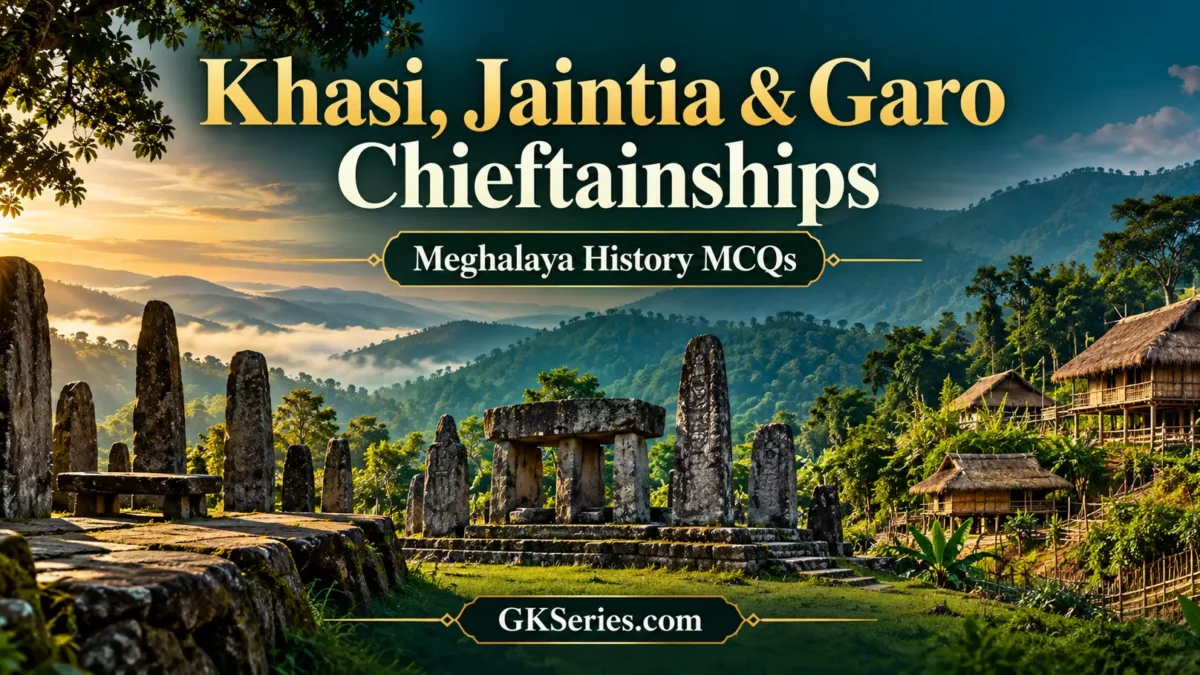
Khasi, Jaintia and Garo Kingdoms and Chieftainships: MCQs for Meghalaya Exams
The traditional political institutions of the Khasi, Jaintia and Garo Hills are an important part of Meghalaya history and governance. For competitive exams, candidates should know how the Khasi Syiemships and Durbars, sites associated with the Jaintia kings, and the Garo Nokma relate to their respective regions. They should also be able to distinguish these historical and customary institutions from present-day districts and Autonomous District Councils.
This practice set contains 10 MCQs for MCS Prelims, Meghalaya Police, LDA, MTET and other state recruitment examinations. The questions cover U Tirot Sing and Nongkhlaw, Nartiang and Jaintia heritage, A·king land, and relevant provisions of the Sixth Schedule.
Overview
The Khasi Hills historically comprised several states led by traditional chiefs assisted by Durbars; U Tirot Sing was the Syiem of Nongkhlaw. Jaintia royal history is reflected in heritage sites such as the Nartiang monoliths and Thlu Muwi stone bridge. In the Garo customary context, the Nokma is associated with A·king or clan land. The Sixth Schedule lists the Khasi Hills, Jaintia Hills and Garo Hills districts under its Meghalaya section and includes a provision concerning laws on the appointment or succession of chiefs and headmen.

Khasi, Jaintia and Garo Kingdoms and Chieftainships:
Question:
Which description best reflects the political organisation of the Khasi Hills before British rule?
(a) A single kingdom governed from Shillong
(b) Several independent Khasi states, each under a traditional chief assisted by a Durbar
(c) Villages governed exclusively by the Jaintia king
(d) A district council elected under the Sixth Schedule
Correct Answer: (b) Several independent Khasi states, each under a traditional chief assisted by a Durbar
Detailed Explanation
The Khasi Hills Autonomous District Council describes a number of independent Khasi states before British rule, each with a traditional chief assisted by an elected Durbar. A single Khasi kingdom would therefore be a misleading description. The Sixth Schedule councils belong to a much later constitutional period.
Option-wise Explanation
- (a): Incorrect; the official history describes multiple states.
- (b): Correct; it reflects the chief and Durbar arrangement.
- (c): Incorrect; it wrongly places Khasi states under the Jaintia king.
- (d): Incorrect; it describes a later constitutional institution.
Key Points for Revision
- Precolonial Khasi Hills had multiple states.
- A traditional chief was assisted by a Durbar.
- Historical chieftainships and modern district councils belong to different periods.
- “Khasi kingdom” should not be assumed to mean one unified state.
Question:
U Tirot Sing, who opposed the British in 1829, was the Syiem of which Khasi state?
(a) Mylliem
(b) Khyrim
(c) Nongkhlaw
(d) Sohra
Correct Answer: (c) Nongkhlaw
Detailed Explanation
The Eastern West Khasi Hills district administration identifies U Tirot Sing as the Syiem of Nongkhlaw and records his opposition to the British in 1829. This links a historical figure to a specific Khasi chieftainship. His memorial is located at Mairang.
Option-wise Explanation
- (a): Incorrect; Mylliem is a different Khasi Syiemship.
- (b): Incorrect; Khyrim is a different Khasi Syiemship.
- (c): Correct; Tirot Sing was Syiem of Nongkhlaw.
- (d): Incorrect; Sohra is not the Syiemship identified in the official account.
Key Points for Revision
- U Tirot Sing: Syiem of Nongkhlaw.
- He opposed the British in 1829.
- His memorial is at Mairang.
- Syiem is a title associated with Khasi traditional chiefs.
Question:
In which present-day Meghalaya district is the U Tirot Sing Memorial at Mairang located?
(a) West Khasi Hills
(b) East Khasi Hills
(c) Ri-Bhoi
(d) Eastern West Khasi Hills
Correct Answer: (d) Eastern West Khasi Hills
Detailed Explanation
The official Eastern West Khasi Hills district portal places the U Tirot Sing Memorial at Mairang. The question tests a present-day district location alongside the history of Nongkhlaw Syiemship. Historical territories and current administrative districts should not be treated as interchangeable.
Option-wise Explanation
- (a): Incorrect; the memorial is listed on the Eastern West Khasi Hills portal.
- (b): Incorrect; East Khasi Hills is a separate district.
- (c): Incorrect; Ri-Bhoi is a separate district.
- (d): Correct; Mairang is in Eastern West Khasi Hills.
Key Points for Revision
- U Tirot Sing Memorial: Mairang.
- Present-day district: Eastern West Khasi Hills.
- Historical association: Nongkhlaw Syiemship.
- Map questions may combine historical sites with current districts.
Question:
According to the West Jaintia Hills district administration, Thlu Muwi stone bridge served the Jaintia king’s journey between which two places?
(a) Jaintiapur and Nartiang
(b) Shillong and Tura
(c) Jowai and Nongkhlaw
(d) Mairang and Sohra
Correct Answer: (a) Jaintiapur and Nartiang
Detailed Explanation
The district administration states that the bridge was built under the Jaintia king’s orders because a crossing was needed on the journey from Jaintiapur to Nartiang during the monsoon. Thlu Muwi is presented as a heritage site in West Jaintia Hills. The question connects a surviving structure with the geography of the former Jaintia kingdom.
Option-wise Explanation
- (a): Correct; these are the two places named in the official account.
- (b): Incorrect; neither is the stated royal route.
- (c): Incorrect; Nongkhlaw belongs to a different historical context.
- (d): Incorrect; these are not the places identified for the bridge.
Key Points for Revision
- Thlu Muwi is a stone bridge in West Jaintia Hills.
- It is associated with a Jaintia king’s journey.
- The stated route was Jaintiapur–Nartiang.
- Historic routes can be tested through surviving heritage sites.
Question
Consider the following statements about the Nartiang monoliths:
- They are associated with the former Jaintia kings.
- The site lies in present-day West Jaintia Hills.
- The site consists only of upright stones.
Which of the statements given above are correct?
(a) 1 only
(b) 1 and 2 only
(c) 2 and 3 only
(d) 1, 2 and 3
Correct Answer: (b) 1 and 2 only
Detailed Explanation
The West Jaintia Hills district administration links the Nartiang monoliths with the erstwhile Jaintia kings. Its site description identifies both upright menhirs and horizontal dolmens, so statement 3 is false. This is a useful combination of Jaintia history, present-day location and monument terminology.
Option-wise Explanation
- (a): Incorrect; statement 2 is also correct.
- (b): Correct; statements 1 and 2 are supported.
- (c): Incorrect; statement 3 is false.
- (d): Incorrect; the collection is not limited to upright stones.
Key Points for Revision
- Nartiang is in West Jaintia Hills.
- Its monoliths are linked to Jaintia royal history.
- A menhir is an upright stone.
- A dolmen is described here as a horizontal stone structure.
Question:
In the official West Garo Hills account of Garo culture, the Nokma is associated most directly with which of the following?
(a) A Khasi Syiemship
(b) A Jaintia royal court
(c) A·king land or clan land
(d) A state legislative constituency
Correct Answer: (c) A·king land or clan land
Detailed Explanation
The West Garo Hills district administration describes the Nokma in connection with A·king land, or clan land, while discussing village arrangements for Wangala. This makes Nokma a Garo customary institution rather than a title of a Khasi chief or Jaintia king. The distinction is especially useful when comparing the three hill regions’ institutions.
Option-wise Explanation
- (a): Incorrect; a Syiemship belongs to the Khasi institutional context.
- (b): Incorrect; the cited account concerns Garo customary land.
- (c): Correct; this is the association stated by the district administration.
- (d): Incorrect; it is not an electoral constituency.
Key Points for Revision
- Nokma is a Garo customary institution.
- A·king refers to clan land in the cited official account.
- The district source also discusses the Nokma’s role in Wangala arrangements.
- Khasi, Jaintia and Garo titles should not be exchanged.
Question
Which set appears in Part II of the Sixth Schedule’s table for Meghalaya?
(a) Khasi Hills, Jaintia Hills and Garo Hills
(b) Khasi Hills, Karbi Anglong and Garo Hills
(c) Jaintia Hills, North Cachar Hills and Garo Hills
(d) Khasi Hills, Tripura Tribal Areas and Jaintia Hills
Correct Answer: (a) Khasi Hills, Jaintia Hills and Garo Hills
Detailed Explanation
Part II of the Sixth Schedule’s table lists the Khasi Hills District, Jaintia Hills District and Garo Hills District. Karbi Anglong and North Cachar Hills appear under Assam’s part of the table, while Tripura Tribal Areas has its own part. This is the constitutional link between the three hill regions and autonomous district administration.
Option-wise Explanation
- (a): Correct; all three are listed in Part II.
- (b): Incorrect; Karbi Anglong is not in Meghalaya’s Part II.
- (c): Incorrect; North Cachar Hills is not in Meghalaya’s Part II.
- (d): Incorrect; Tripura Tribal Areas is listed separately.
Key Points for Revision
- Sixth Schedule table, Part II: Meghalaya.
- Its entries are Khasi Hills, Jaintia Hills and Garo Hills.
- Autonomous districts have a constitutional basis.
- The table groups areas by state, not by similarity of names.
Question:
A District Council law concerning the appointment or succession of traditional chiefs or headmen would draw its specific law-making subject from which provision of the Sixth Schedule?
(a) Paragraph 1, concerning creation and boundaries of autonomous districts
(b) Paragraph 20, containing the table of tribal areas
(c) Paragraph 4, concerning administration of justice
(d) Paragraph 3(1)(g), concerning appointment or succession of chiefs or headmen
Correct Answer: (d) Paragraph 3(1)(g), concerning appointment or succession of chiefs or headmen
Detailed Explanation
Paragraph 3(1)(g) expressly identifies the appointment or succession of chiefs or headmen as a subject on which a District Council may make laws within its competence. Paragraph 1 deals with autonomous districts and their boundaries, while paragraph 20 contains the table of areas. This provision is especially relevant to questions connecting traditional chieftainships with modern constitutional governance.
Option-wise Explanation
- (a): Incorrect; paragraph 1 addresses autonomous districts and related boundary powers.
- (b): Incorrect; paragraph 20 contains the table.
- (c): Incorrect; paragraph 4 addresses administration of justice.
- (d): Correct; paragraph 3(1)(g) names chiefs and headmen.
Key Points for Revision
- Sixth Schedule paragraph 3 lists subjects for District Council laws.
- Paragraph 3(1)(g) concerns chiefs or headmen.
- Paragraph 20 contains the table of tribal areas.
- Traditional offices can have a constitutional law-making linkage.
Question:
The Khasi Hills Autonomous District Council lists Khyrim, Mylliem and Nongkhlaw under which shared description?
(a) Garo A·king lands
(b) Jaintia royal capitals
(c) Khasi Elakas or Himas with traditional chiefs
(d) Revenue districts created in 1972
Correct Answer: (c) Khasi Elakas or Himas with traditional chiefs
Detailed Explanation
The Khasi Hills Autonomous District Council’s register of Elakas and traditional heads includes Khyrim, Mylliem and Nongkhlaw. They are names of traditional Khasi units, not the names of present-day revenue districts. For examination purposes, the enduring fact is their institutional category; the identity of an individual office-holder can change.
Option-wise Explanation
- (a): Incorrect; A·king is associated with the Garo context.
- (b): Incorrect; these are not listed as Jaintia royal capitals.
- (c): Correct; they appear in the Khasi council’s Elaka and traditional-head register.
- (d): Incorrect; they are not revenue districts.
Key Points for Revision
- Khyrim, Mylliem and Nongkhlaw are Khasi traditional units.
- KHADC maintains a register of Elakas and traditional heads.
- An Elaka or Hima should not be confused with a revenue district.
- A Syiem is a traditional chiefly title appearing in the register.
Question:
Which town is the headquarters of present-day West Jaintia Hills district, a district containing Jaintia heritage sites such as Nartiang?
(a) Khliehriat
(b) Jowai
(c) Tura
(d) Nongpoh
Correct Answer: (b) Jowai
Detailed Explanation
The West Jaintia Hills district administration identifies Jowai as its headquarters. Nartiang’s monoliths are also presented by that district administration as a local heritage site associated with Jaintia history. This question tests present-day administrative geography while keeping the historical association clear.
Option-wise Explanation
- (a): Incorrect; Khliehriat is associated with East Jaintia Hills.
- (b): Correct; Jowai is the West Jaintia Hills headquarters.
- (c): Incorrect; Tura is in the Garo Hills region.
- (d): Incorrect; Nongpoh is the Ri-Bhoi headquarters.
Key Points for Revision
- West Jaintia Hills headquarters: Jowai.
- Nartiang is a Jaintia heritage location in the district.
- Historical kingdoms and current districts are different kinds of territorial unit.
- Headquarters questions often pair a district with a nearby heritage site.
One-line Points for Revision
- The precolonial Khasi Hills had several states, each with a traditional chief assisted by a Durbar.
- U Tirot Sing was the Syiem of Nongkhlaw and opposed the British in 1829.
- The U Tirot Sing Memorial is at Mairang in Eastern West Khasi Hills.
- Thlu Muwi stone bridge is associated with the Jaintia king’s route between Jaintiapur and Nartiang.
- The Nartiang monoliths are in West Jaintia Hills and are linked to Jaintia royal history.
- The Nartiang collection includes upright menhirs and horizontal dolmens.
- In the Garo customary context, a Nokma is associated with A·king or clan land.
- Part II of the Sixth Schedule’s table lists the Khasi Hills, Jaintia Hills and Garo Hills districts.
- Paragraph 3(1)(g) of the Sixth Schedule concerns District Council laws on the appointment or succession of chiefs or headmen.
- Jowai is the headquarters of West Jaintia Hills district.
Frequently Asked Questions
1. Was there one unified Khasi kingdom?
The Khasi Hills Autonomous District Council describes several independent Khasi states before British rule, each under a traditional chief assisted by a Durbar. The MCQs therefore use the plural Khasi states or identify a specific Syiemship.
2. Which Khasi Syiemship was associated with U Tirot Sing?
U Tirot Sing was the Syiem of Nongkhlaw. The Eastern West Khasi Hills district administration records that he opposed the British in 1829.
3. Why is Nartiang important in Jaintia history?
Nartiang has a major collection of monoliths associated with the former Jaintia kings. The site includes both upright menhirs and horizontal dolmens.
4. What is the Garo Nokma associated with?
The West Garo Hills district administration associates the Nokma with A·king, or clan land. It is a Garo customary institution.
5. How does the Sixth Schedule relate to Meghalaya’s traditional institutions?
Part II of its table lists the Khasi Hills, Jaintia Hills and Garo Hills districts. Paragraph 3(1)(g) identifies the appointment or succession of chiefs or headmen as a subject on which a District Council may make laws within its competence.
6. Are historical chieftainships the same as today’s districts?
No. A Syiemship or other customary unit is a traditional institution, while a district such as West Jaintia Hills is a present-day administrative unit. Exam questions may connect the two through a person or heritage site, so read the location and time period carefully.
Conclusion
To prepare this topic well, revise the institution, person and place together: Tirot Sing with Nongkhlaw, Jaintia royal heritage with Nartiang, and the Nokma with Garo A·king land. Then practise the constitutional link through the Sixth Schedule. These distinctions will help with both direct factual questions and the statement-based questions common in MCS Prelims.