
Basic Structure Doctrine of the Indian Constitution
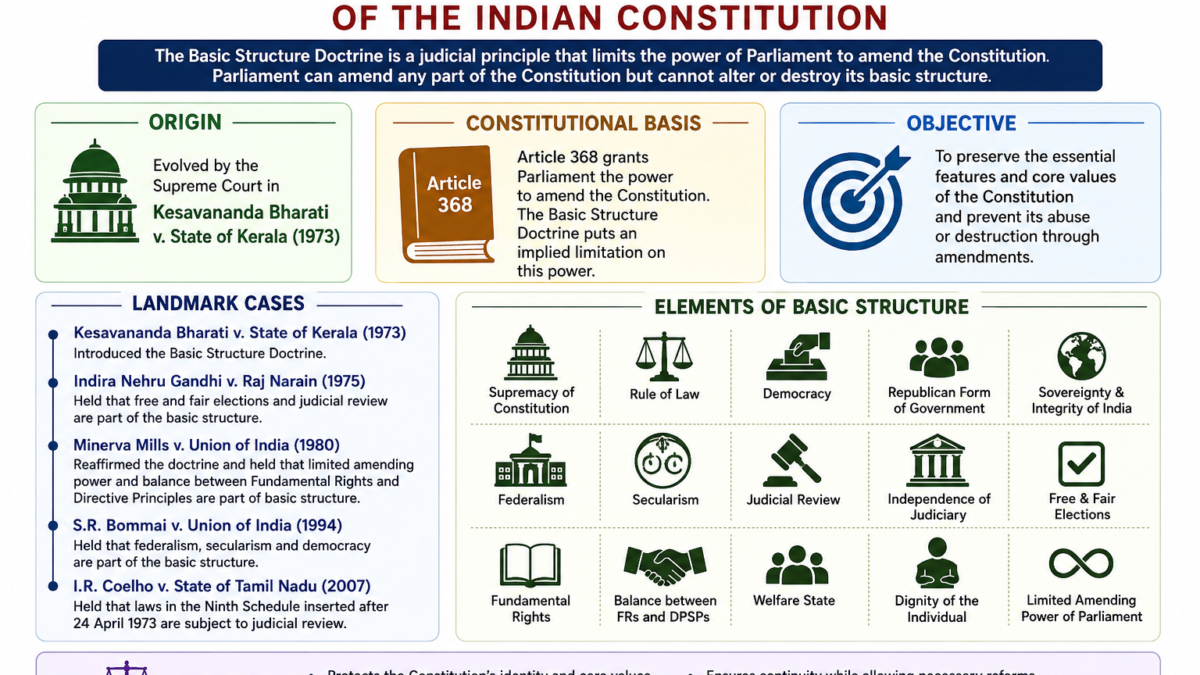
The Basic Structure Doctrine is one of the most significant judicial principles in Indian constitutional law. It ensures that while Parliament has the power to amend the Constitution under Article 368, it cannot alter or destroy its fundamental framework.
The doctrine was established by the Supreme Court in Kesavananda Bharati v. State of Kerala (1973) and remains a cornerstone of Indian democracy. It protects the Constitution’s core values such as democracy, secularism, federalism, judicial review, and the rule of law.
For UPSC Civil Services Examination, the Basic Structure Doctrine is an extremely important topic under Polity, frequently appearing in both Preliminary and Main examinations.
What is the Basic Structure Doctrine?
The Basic Structure Doctrine is a constitutional principle that limits Parliament’s power to amend the Constitution. Although Parliament can amend most constitutional provisions, it cannot destroy or alter the Constitution’s essential features.
The doctrine ensures that constitutional amendments preserve India’s democratic framework and constitutional identity.
Constitutional Basis
The Constitution empowers Parliament to amend the Constitution through:
Article 368 – Power of Parliament to amend the Constitution
However, Article 368 does not explicitly mention any limitation on amendment powers. The limitation was evolved by the Supreme Court through judicial interpretation.
Basic Structure Doctrine Cases: Landmark Supreme Court Judgments
The Basic Structure Doctrine has evolved through a series of landmark Supreme Court judgments that have shaped the constitutional framework of India. These cases define the scope of Parliament’s power to amend the Constitution while protecting its essential features. Below is a chronological overview of the most significant cases.
1. Shankari Prasad v. Union of India (1951)
The first major constitutional amendment case, Shankari Prasad v. Union of India, challenged the validity of the First Constitutional Amendment.
Key Highlights:
- The Supreme Court upheld the First Constitutional Amendment Act, 1951.
- It ruled that Parliament has the power to amend any part of the Constitution, including Fundamental Rights, under Article 368.
- Constitutional amendments were held not to be “law” under Article 13.
Significance: Established Parliament’s broad power to amend the Constitution.
2. Sajjan Singh v. State of Rajasthan (1965)
This case examined the constitutional validity of the Seventeenth Constitutional Amendment.
Key Highlights:
- The Supreme Court reaffirmed Parliament’s authority to amend Fundamental Rights.
- Some judges expressed concern that certain constitutional principles might be beyond Parliament’s amending power.
Significance: Laid the foundation for future debates on constitutional limitations.
3. Golaknath v. State of Punjab (1967)
The Golaknath judgment marked a major shift in constitutional interpretation.
Key Highlights:
- The Supreme Court ruled that Parliament could not amend Fundamental Rights.
- Constitutional amendments were considered “law” under Article 13.
- Any amendment violating Fundamental Rights could be declared unconstitutional.
Significance: Restricted Parliament’s amending power and led to the enactment of the 24th Constitutional Amendment.
4. Twenty-Fourth Constitutional Amendment Act, 1971
The 24th Amendment was enacted in response to the Golaknath judgment.
Key Highlights:
- Restored Parliament’s authority to amend any provision of the Constitution.
- Clarified that Article 13 does not apply to constitutional amendments.
- Made the President’s assent to constitutional amendment bills mandatory.
Significance: Strengthened Parliament’s constitutional amendment powers.
5. Kesavananda Bharati v. State of Kerala (1973)
This is the most important constitutional case in Indian judicial history.
Key Highlights:
- Parliament can amend any part of the Constitution.
- However, it cannot alter or destroy the Basic Structure of the Constitution.
- The Basic Structure Doctrine was introduced by a 13-judge Constitution Bench.
Significance: Created a balance between Parliament’s amending power and constitutional supremacy.
6. Indira Nehru Gandhi v. Raj Narain (1975)
The case arose from a dispute regarding the election of the Prime Minister.
Key Highlights:
- The Supreme Court struck down provisions of the 39th Constitutional Amendment that excluded election disputes from judicial review.
- Held that free and fair elections, democracy, and judicial review are part of the Constitution’s Basic Structure.
Significance: Expanded the scope of the Basic Structure Doctrine.
7. Forty-Second Constitutional Amendment Act, 1976
Often referred to as the Mini Constitution, the 42nd Amendment significantly expanded Parliament’s powers.
Key Highlights:
- Attempted to grant Parliament unlimited power to amend the Constitution.
- Sought to restrict judicial review of constitutional amendments.
Significance: Many of its controversial provisions were later struck down by the Supreme Court.
8. Minerva Mills Ltd. v. Union of India (1980)
The Minerva Mills judgment reaffirmed the Basic Structure Doctrine.
Key Highlights:
- Declared parts of the 42nd Amendment unconstitutional.
- Held that Parliament’s amending power is limited.
- Recognized judicial review and the balance between Fundamental Rights and Directive Principles as part of the Basic Structure.
Significance: Reinforced constitutional supremacy over parliamentary supremacy.
9. Waman Rao v. Union of India (1981)
This case dealt with laws placed in the Ninth Schedule.
Key Highlights:
- Laws inserted into the Ninth Schedule before 24 April 1973 remained valid.
- Laws added after the Kesavananda Bharati judgment became subject to judicial review.
Significance: Established the cut-off date for reviewing Ninth Schedule laws.
10. Indra Sawhney v. Union of India (1992)
Popularly known as the Mandal Commission Case.
Key Highlights:
- Upheld 27% reservation for Other Backward Classes (OBCs).
- Introduced the general 50% ceiling on reservations (subject to later judicial developments).
- Emphasized equality as a fundamental constitutional value.
Significance: Reinforced equality as a core constitutional principle.
11. Kihoto Hollohan v. Zachillhu (1992)
This case examined the constitutional validity of the Tenth Schedule (Anti-Defection Law).
Key Highlights:
- Upheld the constitutional validity of the Anti-Defection Law.
- Held that decisions of the Speaker are subject to judicial review.
Significance: Strengthened judicial review while preserving democratic governance.
12. S.R. Bommai v. Union of India (1994)
A landmark judgment on federalism and secularism.
Key Highlights:
- Declared Federalism, Secularism, and Democracy as part of the Basic Structure.
- Made the President’s Rule under Article 356 subject to judicial review.
Significance: Protected India’s federal and democratic framework.
13. I.R. Coelho v. State of Tamil Nadu (2007)
This judgment further strengthened the Basic Structure Doctrine.
Key Highlights:
- Laws placed in the Ninth Schedule after 24 April 1973 are subject to judicial review.
- Any law violating the Basic Structure can be declared unconstitutional.
Significance: Ensured that the Ninth Schedule cannot be used to shield unconstitutional laws.
Timeline of Major Basic Structure Doctrine Cases
| Year | Case | Major Contribution |
| 1951 | Shankari Prasad | Parliament can amend Fundamental Rights |
| 1965 | Sajjan Singh | Reaffirmed amendment power |
| 1967 | Golaknath | Restricted Parliament’s power to amend Fundamental Rights |
| 1971 | 24th Constitutional Amendment | Restored Parliament’s amendment power |
| 1973 | Kesavananda Bharati | Introduced the Basic Structure Doctrine |
| 1975 | Indira Nehru Gandhi | Free and fair elections and judicial review protected |
| 1976 | 42nd Constitutional Amendment | Attempted unlimited amendment powers |
| 1980 | Minerva Mills | Reaffirmed the Basic Structure Doctrine |
| 1981 | Waman Rao | Ninth Schedule review after 24 April 1973 |
| 1992 | Indra Sawhney | Equality reaffirmed as a constitutional value |
| 1992 | Kihoto Hollohan | Judicial review over Anti-Defection decisions |
| 1994 | S.R. Bommai | Federalism and secularism recognized as Basic Structure |
| 2007 | I.R. Coelho | Ninth Schedule laws subject to Basic Structure review |
UPSC Exam Importance
Questions on the Basic Structure Doctrine frequently appear in UPSC Prelims and Mains. Aspirants should remember:
- Kesavananda Bharati (1973) introduced the doctrine.
- Minerva Mills (1980) reaffirmed it.
- S.R. Bommai (1994) recognized federalism and secularism as Basic Structure.
- I.R. Coelho (2007) subjected post-1973 Ninth Schedule laws to judicial review.
- The doctrine is not expressly mentioned in the Constitution; it is a judicial innovation developed through Supreme Court judgments
Elements of the Basic Structure
The Supreme Court has never provided an exhaustive list. Over time, various judgments have identified several essential features.
Major elements include:
- Supremacy of the Constitution
- Rule of Law
- Sovereignty of India
- Democratic Republic
- Republican form of government
- Parliamentary system
- Separation of powers
- Federalism
- Secularism
- Judicial review
- Independence of Judiciary
- Free and fair elections
- Unity and integrity of India
- Fundamental Rights
- Limited power of Parliament
- Balance between Fundamental Rights and Directive Principles
- Welfare State
- Dignity of the individual
Importance of the Basic Structure Doctrine
Protects Democracy
Prevents any government from converting India into an authoritarian state.
Maintains Constitutional Supremacy
Ensures that the Constitution remains superior to Parliament.
Safeguards Fundamental Rights
Protects citizens from arbitrary constitutional amendments.
Preserves Judicial Review
Allows courts to examine constitutional amendments.
Maintains Federal Balance
Protects powers of both the Union and the States.
Ensures Constitutional Stability
Allows necessary reforms while protecting fundamental values.
Basic Structure Doctrine and Article 368
Article 368 grants Parliament the authority to amend the Constitution.
However:
- Parliament can amend.
- Parliament cannot destroy.
- Parliament cannot alter the Constitution’s identity.
This balance preserves constitutional continuity while allowing reforms.
Previous UPSC Trends
Questions frequently test:
- Landmark judgments
- Constitutional amendments
- Article 368
- Judicial Review
- Fundamental Rights
- Parliament’s amendment powers
- Relationship between Parliament and Judiciary
Practice MCQs
1. The Basic Structure Doctrine was evolved in which case?
A. Golaknath Case
B. Kesavananda Bharati Case
C. Minerva Mills Case
D. Shankari Prasad Case
Answer: B
2. Which Article deals with amendment of the Constitution?
A. Article 13
B. Article 32
C. Article 368
D. Article 226
Answer: C
3. Which judgment reaffirmed the Basic Structure Doctrine?
A. Golaknath
B. Minerva Mills
C. Berubari
D. Sajjan Singh
Answer: B
4. The Basic Structure Doctrine protects:
A. Parliamentary supremacy
B. Essential features of the Constitution
C. State legislatures
D. Election Commission only
Answer: B
Frequently Asked Questions
What is the Basic Structure Doctrine?
It is a judicial doctrine that prevents Parliament from destroying the Constitution’s essential features through amendments.
Which case introduced the Basic Structure Doctrine?
The Supreme Court introduced it in Kesavananda Bharati v. State of Kerala (1973).
Is the Basic Structure Doctrine mentioned in the Constitution?
No. It is a judicial innovation developed through Supreme Court judgments.
Why is it important?
It preserves India’s constitutional identity by preventing arbitrary constitutional amendments.
The Basic Structure Doctrine is one of the greatest contributions of the Indian judiciary to constitutional governance. By limiting Parliament’s amending power while preserving democratic values, it ensures that the Constitution evolves without losing its fundamental identity.
For UPSC aspirants, understanding the doctrine is essential not only for Prelims but also for Mains and interview discussions. Questions often focus on landmark judgments, constitutional amendments, and the balance between Parliament and the judiciary. A thorough understanding of this topic strengthens one’s command over Indian Polity and constitutional law.
