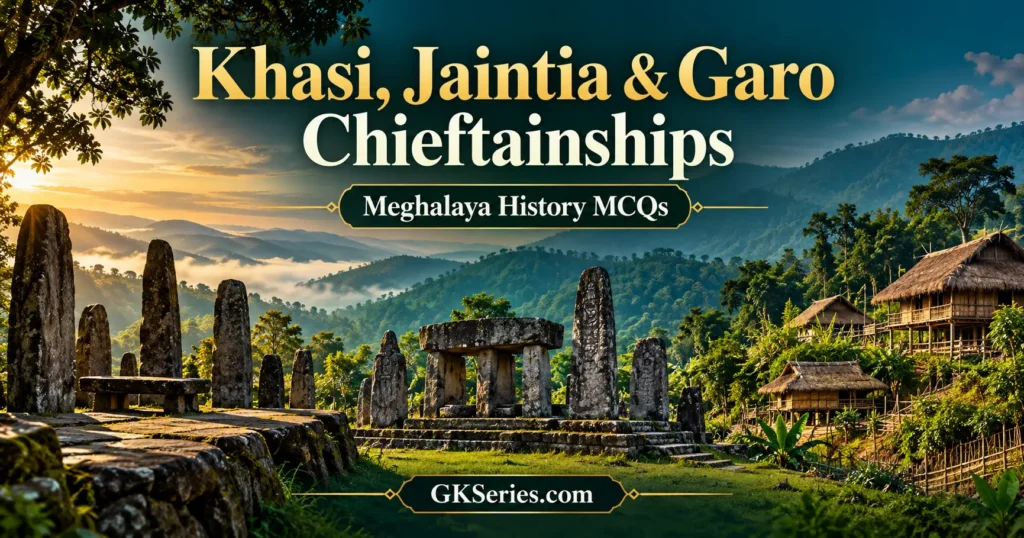
Meghalaya History MCQs are essential for candidates preparing for the Meghalaya Civil Service (MCS) Examination, LDA, Meghalaya Police, MTET, Forest Ranger and other State recruitment examinations. This practice set covers the constitutional evolution of Meghalaya, its journey from an autonomous State within Assam to full statehood, the Sixth Schedule framework, traditional Khasi, Garo and Jaintia institutions, and prominent freedom heroes such as U Tirot Sing and U Kiang Nangbah. Each question includes the correct answer, explanation and revision points for effective exam preparation.
Overview:
Meghalaya became a full-fledged State of India on 21 January 1972 under the North-Eastern Areas (Reorganisation) Act, 1971. Before statehood, it functioned as an autonomous State within Assam from 2 April 1970, enabled by Article 244A of the Constitution, inserted through the 22nd Constitutional Amendment Act, 1969. Meghalaya’s history also includes the distinctive traditional institutions of the Khasi, Garo and Jaintia communities, Sixth Schedule autonomous governance, and anti-colonial leaders such as U Tirot Sing and U Kiang Nangbah. These topics are frequently important for MCS and other Meghalaya Government examinations.
Meghalaya History MCQs: Statehood, Tribal Polity and Freedom Heroes
MCQ No. 1: Statehood Day
Question
Meghalaya attained full statehood as a separate State of India on:
(a) 2 April 1970
(b) 21 January 1972
(c) 26 January 1950
(d) 15 August 1947
Correct Answer: (b) 21 January 1972
Detailed Explanation
Meghalaya became a full-fledged State of the Indian Union on 21 January 1972 under the North-Eastern Areas (Reorganisation) Act, 1971. Before this, it functioned as an autonomous State within Assam from 2 April 1970. Meghalaya Day is therefore observed annually on 21 January. This is a very important static-GK date for MCS and other Meghalaya examinations.
Option-wise Explanation
- (a): Incorrect. This marks the beginning of Meghalaya as an autonomous State within Assam.
- (b): Correct. Meghalaya became a full State on 21 January 1972.
- (c): Incorrect. This is the date when the Constitution of India came into force.
- (d): Incorrect. India became independent on this date.
Key Points for Revision
- Meghalaya became a State on 21 January 1972.
- The legal basis was the North-Eastern Areas (Reorganisation) Act, 1971.
- Meghalaya Day is observed on 21 January.
- Meghalaya was earlier an autonomous State within Assam.
Exam Relevance
- MCS Prelims: Important chronology and Statehood Day question.
- Other Meghalaya Recruitment Exams: Direct factual question for LDA, Police, MTET and Stenographer examinations.
MCQ No. 2: Autonomous State of Meghalaya
Question
Meghalaya began functioning as an autonomous State within Assam on:
(a) 2 April 1970
(b) 21 January 1972
(c) 1 November 1966
(d) 20 January 1972
Correct Answer: (a) 2 April 1970
Detailed Explanation
The autonomous State of Meghalaya was inaugurated on 2 April 1970. It was created within the State of Assam under the Assam Reorganisation (Meghalaya) Act, 1969. This arrangement was an intermediate constitutional step before Meghalaya attained complete statehood in 1972. Candidates should distinguish clearly between autonomous-state status and full statehood.
Option-wise Explanation
- (a): Correct. Meghalaya became an autonomous State within Assam on this date.
- (b): Incorrect. This is the date of full statehood.
- (c): Incorrect. This date is associated with the formation of Haryana.
- (d): Incorrect. Meghalaya’s Statehood Day is 21 January, not 20 January.
Key Points for Revision
- Autonomous State of Meghalaya: 2 April 1970.
- Full State of Meghalaya: 21 January 1972.
- Autonomous-state arrangement was created under the Assam Reorganisation (Meghalaya) Act, 1969.
- The arrangement was constitutionally linked to Article 244A.
Exam Relevance
- MCS Prelims: Tests chronology and constitutional evolution of Meghalaya.
- Other Meghalaya Recruitment Exams: Frequently asked State-history fact.
MCQ No. 3: Constitutional Basis of Autonomous Meghalaya
Question
Which Constitutional Amendment inserted Article 244A, enabling Parliament to form an autonomous State within Assam comprising certain tribal areas?
(a) Constitution (Sixth Amendment) Act, 1956
(b) Constitution (Twenty-second Amendment) Act, 1969
(c) Constitution (Thirty-sixth Amendment) Act, 1975
(d) Constitution (Forty-second Amendment) Act, 1976
Correct Answer: (b) Constitution (Twenty-second Amendment) Act, 1969
Detailed Explanation
The Constitution (Twenty-second Amendment) Act, 1969 inserted Article 244A into the Constitution. Article 244A enabled Parliament to create an autonomous State within Assam, consisting wholly or partly of tribal areas specified in the Sixth Schedule. This constitutional provision provided the foundation for the autonomous State of Meghalaya in 1970. It is an important example of India’s flexible federal arrangements for tribal regions.
Option-wise Explanation
- (a): Incorrect. The Sixth Amendment dealt mainly with taxation-related constitutional changes.
- (b): Correct. It inserted Article 244A.
- (c): Incorrect. The Thirty-sixth Amendment is associated with Sikkim becoming a State.
- (d): Incorrect. The Forty-second Amendment made broad constitutional changes but did not insert Article 244A.
Key Points for Revision
- Article 244A was inserted by the 22nd Constitutional Amendment, 1969.
- It permitted creation of an autonomous State within Assam.
- It was the constitutional basis for the autonomous State of Meghalaya.
- Article 244A is distinct from the Sixth Schedule itself.
Exam Relevance
- MCS Prelims: Important Constitution–Meghalaya linkage; suitable for statement-based questions.
- Other Meghalaya Recruitment Exams: Useful constitutional fact for Police, LDA and departmental examinations.
MCQ No. 4: Provision of Article 244A
Question
Consider the following statements regarding Article 244A of the Constitution:
- It permits Parliament to form an autonomous State within Assam.
- The autonomous State may have a Legislature or a Council of Ministers, or both.
- It applies to all Scheduled Areas in India.
Which of the statements given above is/are correct?
(a) 1 and 2 only
(b) 2 and 3 only
(c) 1 and 3 only
(d) 1, 2 and 3
Correct Answer: (a) 1 and 2 only
Detailed Explanation
Article 244A authorised Parliament to create an autonomous State within Assam comprising specified tribal areas. It also allowed Parliament to provide for a Legislature, a Council of Ministers, or both for that autonomous State. The provision did not apply to all Scheduled Areas in India; it was specifically designed for the tribal areas of Assam described in the constitutional framework. Meghalaya’s transition from autonomous status to full statehood must be understood in this context.
Option-wise Explanation
- (a): Correct. Statements 1 and 2 are correct.
- (b): Incorrect. Statement 3 is incorrect.
- (c): Incorrect. Statement 3 is incorrect.
- (d): Incorrect. Article 244A does not apply to all Scheduled Areas in India.
Key Points for Revision
- Article 244A relates specifically to an autonomous State within Assam.
- It was inserted through the 22nd Constitutional Amendment.
- It could provide for a Legislature, Council of Ministers, or both.
- Scheduled Areas under the Fifth Schedule are different from Sixth Schedule tribal areas.
Exam Relevance
- MCS Prelims: High-value statement-based Constitution question.
- Other Meghalaya Recruitment Exams: Helps distinguish Article 244A, Fifth Schedule and Sixth Schedule provisions.
MCQ No. 5: Law Granting Full Statehood
Question
Which law granted full statehood to Meghalaya?
(a) Government of India Act, 1935
(b) Assam Reorganisation Act, 1969
(c) North-Eastern Areas (Reorganisation) Act, 1971
(d) States Reorganisation Act, 1956
Correct Answer: (c) North-Eastern Areas (Reorganisation) Act, 1971
Detailed Explanation
The North-Eastern Areas (Reorganisation) Act, 1971 created Meghalaya as a full State with effect from 21 January 1972. The Act also reorganised parts of the North-East and is associated with the creation of the Union Territories of Manipur and Tripura as States, besides the Union Territory of Mizoram and the Union Territory of Arunachal Pradesh, then called the North-East Frontier Agency-related territory. For Meghalaya, it ended the earlier autonomous-State arrangement within Assam. This law is central to Meghalaya’s constitutional history.
Option-wise Explanation
- (a): Incorrect. It was a colonial constitutional law and did not create Meghalaya.
- (b): Incorrect. It created the autonomous State of Meghalaya within Assam.
- (c): Correct. It granted Meghalaya full statehood.
- (d): Incorrect. It reorganised Indian States in 1956 but did not create Meghalaya.
Key Points for Revision
- Full statehood: North-Eastern Areas (Reorganisation) Act, 1971.
- Effective date: 21 January 1972.
- Autonomous State phase: 1970–1972.
- Meghalaya was previously part of Assam.
Exam Relevance
- MCS Prelims: Important legislation-and-statehood question.
- Other Meghalaya Recruitment Exams: Direct static-GK fact.
MCQ No. 6: First Chief Minister of Meghalaya
Question
Who was the first Chief Minister of Meghalaya?
(a) B. B. Lyngdoh
(b) Captain Williamson A. Sangma
(c) P. A. Sangma
(d) Darwin Diengdoh Pugh
Correct Answer: (b) Captain Williamson A. Sangma
Detailed Explanation
Captain Williamson A. Sangma was the first Chief Minister of Meghalaya. He was a leading figure in the Hill State movement and played a major role in the political process that led to the creation of Meghalaya. He also served as the Chief Minister of the autonomous State of Meghalaya before full statehood. His contribution is a core personality-based area in Meghalaya history.
Option-wise Explanation
- (a): Incorrect. B. B. Lyngdoh was an important Meghalaya political leader but not the first Chief Minister.
- (b): Correct. Captain Williamson A. Sangma was Meghalaya’s first Chief Minister.
- (c): Incorrect. P. A. Sangma was a prominent national political leader and former Lok Sabha Speaker.
- (d): Incorrect. D. D. Pugh was associated with the Hill State movement but was not the first Chief Minister.
Key Points for Revision
- First Chief Minister of Meghalaya: Captain Williamson A. Sangma.
- He was a key leader of the Hill State movement.
- He led Meghalaya during the autonomous-state phase and after full statehood.
- Meghalaya attained full statehood in 1972.
Exam Relevance
- MCS Prelims: Personality-based question linked with the Statehood movement.
- Other Meghalaya Recruitment Exams: Essential direct factual question for LDA, Police and MTET.
MCQ No. 7: First Governor of Meghalaya
Question
Who was the first Governor of Meghalaya after it became a full-fledged State in 1972?
(a) B. K. Nehru
(b) L. P. Singh
(c) Braj Kumar Nehru
(d) Akbar Hydari
Correct Answer: (c) Braj Kumar Nehru
Detailed Explanation
Braj Kumar Nehru, commonly referred to as B. K. Nehru, was the first Governor of Meghalaya. He was Governor when Meghalaya became a full State in January 1972. His name is important in questions on the early constitutional offices of the State. Candidates should note that “B. K. Nehru” and “Braj Kumar Nehru” refer to the same person.
Option-wise Explanation
- (a): Incorrect as written because the formal name is Braj Kumar Nehru, though B. K. Nehru is his common abbreviation.
- (b): Incorrect. L. P. Singh served as Governor of Assam and Nagaland.
- (c): Correct. Braj Kumar Nehru was Meghalaya’s first Governor.
- (d): Incorrect. Akbar Hydari was an earlier Governor of Assam.
Key Points for Revision
- First Governor of Meghalaya: Braj Kumar Nehru.
- Common name: B. K. Nehru.
- Meghalaya became a full State in 1972.
- Governor is the constitutional head of a State under the Constitution.
Exam Relevance
- MCS Prelims: Early State offices and Statehood-history question.
- Other Meghalaya Recruitment Exams: Direct factual takeaway for general awareness sections.
MCQ No. 8: Hill State Movement
Question
The All Party Hill Leaders’ Conference (APHLC) was primarily associated with the demand for:
(a) A separate Hill State for the tribal hill areas of Assam
(b) Merger of Meghalaya with East Pakistan
(c) Creation of a Union Territory of Shillong
(d) Abolition of the Sixth Schedule
Correct Answer: (a) A separate Hill State for the tribal hill areas of Assam
Detailed Explanation
The All Party Hill Leaders’ Conference, popularly known as APHLC, emerged as a major political platform for the demand for a separate Hill State. The movement reflected concerns regarding the political, cultural and administrative interests of the hill peoples of the then Assam. The demand eventually led first to the autonomous State of Meghalaya in 1970 and then to full statehood in 1972. It is central to understanding modern Meghalaya political history.
Option-wise Explanation
- (a): Correct. The APHLC strongly campaigned for a separate Hill State.
- (b): Incorrect. The movement had no such objective.
- (c): Incorrect. The demand concerned a separate State, not merely Shillong.
- (d): Incorrect. Sixth Schedule safeguards were relevant to tribal administration; the movement did not seek their abolition.
Key Points for Revision
- APHLC: All Party Hill Leaders’ Conference.
- Main demand: A separate Hill State.
- The movement was linked to the creation of Meghalaya.
- Important leaders included Captain Williamson A. Sangma and other hill leaders.
Exam Relevance
- MCS Prelims: Tests political history and causes behind Meghalaya’s formation.
- Other Meghalaya Recruitment Exams: Important basic-history fact for general awareness.
MCQ No. 9: Tribal Areas Behind Meghalaya’s Formation
Question
The autonomous State of Meghalaya was initially formed out of which of the following hill areas of Assam?
(a) Khasi Hills, Jaintia Hills and Garo Hills
(b) Naga Hills, Mikir Hills and Lushai Hills
(c) Cachar Hills, Karbi Hills and Garo Hills
(d) Khasi Hills, Mizo Hills and Naga Hills
Correct Answer: (a) Khasi Hills, Jaintia Hills and Garo Hills
Detailed Explanation
Meghalaya emerged from the Khasi Hills, Jaintia Hills and Garo Hills areas of the then State of Assam. These areas had distinct tribal populations, customary institutions and administrative arrangements under the Sixth Schedule. Their political aspirations were reflected in the Hill State movement. The historical composition explains why Khasi, Jaintia and Garo identities remain fundamental to Meghalaya’s social and political structure.
Option-wise Explanation
- (a): Correct. These three hill areas formed the historical territorial basis of Meghalaya.
- (b): Incorrect. These areas relate to present-day Nagaland and Mizoram.
- (c): Incorrect. This combination is historically inaccurate.
- (d): Incorrect. Mizo and Naga Hills were not part of Meghalaya’s formation.
Key Points for Revision
- Meghalaya historically emerged from Khasi, Jaintia and Garo Hills.
- These were tribal areas of Assam.
- The Sixth Schedule provides special administrative safeguards for tribal areas.
- Khasi, Jaintia and Garo are Meghalaya’s major indigenous communities.
Exam Relevance
- MCS Prelims: Important territorial-history and tribal-administration linkage.
- Other Meghalaya Recruitment Exams: Basic Meghalaya identity and geography-history question.
MCQ No. 10: Meghalaya Legislative Assembly
Question
How many members are elected to the Meghalaya Legislative Assembly?
(a) 40
(b) 50
(c) 60
(d) 70
Correct Answer: (c) 60
Detailed Explanation
The Meghalaya Legislative Assembly is a unicameral legislature with 60 elected members. Each Member of the Legislative Assembly represents an Assembly constituency in the State. The Assembly is an important institution for making State laws, passing the Budget and holding the Council of Ministers accountable. Questions may connect its present composition with the constitutional development of Meghalaya after statehood.
Option-wise Explanation
- (a): Incorrect. Meghalaya does not have a 40-member Assembly.
- (b): Incorrect. The Assembly strength is not 50.
- (c): Correct. Meghalaya has 60 elected Assembly members.
- (d): Incorrect. The Assembly does not have 70 members.
Key Points for Revision
- Meghalaya Legislative Assembly: 60 elected members.
- Meghalaya has a unicameral legislature.
- The State Legislature makes laws on subjects within the State’s legislative sphere.
- Shillong is the seat of the Meghalaya Legislative Assembly.
Exam Relevance
- MCS Prelims: Useful for State polity and legislature questions.
- Other Meghalaya Recruitment Exams: High-frequency direct general-awareness fact.
MCQ No. 11: Sixth Schedule Framework
Question
The administration of tribal areas in Meghalaya through Autonomous District Councils is primarily provided under:
(a) Fifth Schedule of the Constitution
(b) Sixth Schedule of the Constitution
(c) Seventh Schedule of the Constitution
(d) Tenth Schedule of the Constitution
Correct Answer: (b) Sixth Schedule of the Constitution
Detailed Explanation
The Sixth Schedule provides for the administration of tribal areas in Assam, Meghalaya, Tripura and Mizoram. In Meghalaya, it forms the constitutional basis for Autonomous District Councils and safeguards aspects of tribal self-governance. It must be distinguished from the Fifth Schedule, which applies to Scheduled Areas in other parts of India. The Sixth Schedule is central to Meghalaya’s political and constitutional history.
Option-wise Explanation
- (a): Incorrect. The Fifth Schedule applies to Scheduled Areas, not the tribal areas covered by the Sixth Schedule.
- (b): Correct. Meghalaya’s Autonomous District Councils operate under the Sixth Schedule.
- (c): Incorrect. The Seventh Schedule contains the Union, State and Concurrent Lists.
- (d): Incorrect. The Tenth Schedule deals with anti-defection provisions.
Key Points for Revision
- Sixth Schedule applies to Assam, Meghalaya, Tripura and Mizoram.
- It provides for Autonomous District Councils.
- Article 244(2) links the Sixth Schedule with tribal-area administration.
- Fifth Schedule and Sixth Schedule must not be confused.
Exam Relevance
- MCS Prelims: High-value constitutional and Meghalaya-governance question.
- Other Meghalaya Recruitment Exams: Essential direct fact for LDA, Police and departmental examinations.
MCQ No. 12: Autonomous District Councils in Meghalaya
Question
Which of the following is not an Autonomous District Council in Meghalaya under the Sixth Schedule?
(a) Khasi Hills Autonomous District Council
(b) Jaintia Hills Autonomous District Council
(c) Garo Hills Autonomous District Council
(d) Karbi Anglong Autonomous Council
Correct Answer: (d) Karbi Anglong Autonomous Council
Detailed Explanation
Meghalaya has three principal Autonomous District Councils: Khasi Hills, Jaintia Hills and Garo Hills. The Karbi Anglong Autonomous Council is located in Assam, not Meghalaya. The District Councils are important institutions of self-governance in the tribal areas of Meghalaya. This question tests the candidate’s knowledge of both Meghalaya and wider North-East constitutional geography.
Option-wise Explanation
- (a): Incorrect. It is an Autonomous District Council in Meghalaya.
- (b): Incorrect. It is an Autonomous District Council in Meghalaya.
- (c): Incorrect. It is an Autonomous District Council in Meghalaya.
- (d): Correct. It is located in Assam.
Key Points for Revision
- Meghalaya has Khasi Hills, Jaintia Hills and Garo Hills Autonomous District Councils.
- These institutions function under the Sixth Schedule.
- Karbi Anglong Autonomous Council is in Assam.
- District Councils are distinct from the State Government and municipal bodies.
Exam Relevance
- MCS Prelims: Suitable for matching and location-based questions.
- Other Meghalaya Recruitment Exams: Important general-awareness fact for Police and LDA examinations.
MCQ No. 13: Powers of District Councils
Question
Under the Sixth Schedule, Autonomous District Councils may make laws on which of the following matters, subject to constitutional limitations?
- Allotment and use of land other than reserved forests
- Management of forests other than reserved forests
- Regulation of shifting cultivation
- Conduct of elections to the Lok Sabha
Select the correct answer using the code below:
(a) 1, 2 and 3 only
(b) 1 and 4 only
(c) 2 and 4 only
(d) 1, 2, 3 and 4
Correct Answer: (a) 1, 2 and 3 only
Detailed Explanation
The Sixth Schedule authorises District Councils to make laws on specified local matters, including land other than reserved forests, management of non-reserved forests and shifting cultivation. These powers reflect the importance of customary land systems and community resource management in Meghalaya. Elections to the Lok Sabha are conducted under the constitutional and electoral framework of India, not by District Councils. This is a core application-based question on tribal self-governance.
Option-wise Explanation
- (a): Correct. Statements 1, 2 and 3 fall within the law-making sphere of District Councils.
- (b): Incorrect. Statement 4 is incorrect.
- (c): Incorrect. Statement 4 is incorrect.
- (d): Incorrect. District Councils do not conduct Lok Sabha elections.
Key Points for Revision
- District Councils can legislate on certain local and customary matters.
- Their powers include land, non-reserved forests and shifting cultivation.
- Reserved forests are excluded from this specific power.
- Lok Sabha elections are administered under national election laws.
Exam Relevance
- MCS Prelims: Important statement-based Sixth Schedule question.
- Other Meghalaya Recruitment Exams: Useful for Forest Ranger and Police examinations due to land and forest linkages.
MCQ No. 14: Khasi Traditional Polity
Question
In the traditional Khasi political system, the head of a Hima is generally known as:
(a) Nokma
(b) Syiem
(c) Dolloi
(d) Lyngdoh
Correct Answer: (b) Syiem
Detailed Explanation
A Hima is a traditional Khasi polity or chiefdom, and its head is generally known as a Syiem. Khasi governance historically involved a network of customary institutions, including councils and traditional authorities. The Syiem’s role must be understood within the wider system of customary laws and community participation. Traditional institutions continue to be important in Meghalaya’s social and political landscape.
Option-wise Explanation
- (a): Incorrect. Nokma is associated mainly with the Garo traditional system.
- (b): Correct. A Syiem is the traditional head of a Khasi Hima.
- (c): Incorrect. Dolloi is associated with the Jaintia traditional system.
- (d): Incorrect. Lyngdoh is a Khasi title linked with priestly or customary functions, depending on the context.
Key Points for Revision
- Hima: traditional Khasi polity.
- Syiem: traditional chief or head of a Hima.
- Khasi society has important customary institutions.
- Traditional governance is relevant to Sixth Schedule administration.
Exam Relevance
- MCS Prelims: Tests culture, traditional institutions and Meghalaya polity.
- Other Meghalaya Recruitment Exams: Direct static-GK question for LDA, Police and MTET.
MCQ No. 15: Garo Traditional Institution
Question
The traditional Garo village headman, particularly associated with the management of clan land and village affairs, is known as:
(a) Syiem
(b) Dolloi
(c) Nokma
(d) Raja
Correct Answer: (c) Nokma
Detailed Explanation
The Nokma is a central traditional institution in Garo society. A Nokma is associated with the administration of an A·king, which is traditionally linked with clan or community land. The institution reflects the matrilineal social organisation and customary land systems of the Garos. It is an important topic for questions on Meghalaya’s culture, customary law and land management.
Option-wise Explanation
- (a): Incorrect. Syiem is associated with Khasi traditional governance.
- (b): Incorrect. Dolloi is associated with Jaintia traditional administration.
- (c): Correct. Nokma is the traditional Garo village headman.
- (d): Incorrect. Raja is a general title and not the specific traditional Garo institution tested here.
Key Points for Revision
- Nokma is a key Garo traditional institution.
- A·king refers to the traditional Garo landholding system.
- Garo society is traditionally matrilineal.
- Customary land institutions are relevant to Meghalaya’s Sixth Schedule context.
Exam Relevance
- MCS Prelims: Important tribe–institution–land-system linkage.
- Other Meghalaya Recruitment Exams: High-yield factual question for Police, LDA and Forest Ranger examinations.
MCQ No. 16: Jaintia Traditional Administration
Question
In the traditional Jaintia system, the head of an Elaka is known as:
(a) Dolloi
(b) Nokma
(c) Syiem
(d) Gaonbura
Correct Answer: (a) Dolloi
Detailed Explanation
A Dolloi is the traditional head of an Elaka in the Jaintia social and administrative system. The institution has historical importance in the governance of Jaintia areas and continues to be relevant to customary administration. Like Khasi and Garo institutions, the Jaintia traditional system is an important part of Meghalaya’s indigenous political heritage. It is frequently tested alongside Syiem and Nokma.
Option-wise Explanation
- (a): Correct. Dolloi is the head of an Elaka in the Jaintia system.
- (b): Incorrect. Nokma is associated with the Garo system.
- (c): Incorrect. Syiem is associated with Khasi traditional governance.
- (d): Incorrect. Gaonbura is a village headman title used in several North-East contexts but is not the specific Jaintia title asked here.
Key Points for Revision
- Dolloi: traditional Jaintia head.
- Elaka: traditional Jaintia administrative unit.
- Syiem: Khasi traditional chief.
- Nokma: Garo traditional village headman.
Exam Relevance
- MCS Prelims: Suitable for match-the-following and culture-based questions.
- Other Meghalaya Recruitment Exams: Basic Meghalaya static-GK question.
MCQ No. 17: U Tirot Sing
Question
U Tirot Sing is best remembered in Meghalaya history for leading resistance against the British in the:
(a) Khasi Hills
(b) Garo Hills
(c) Naga Hills
(d) Mizo Hills
Correct Answer: (a) Khasi Hills
Detailed Explanation
U Tirot Sing Syiem was a prominent Khasi leader who resisted British expansion in the Khasi Hills during the nineteenth century. He is associated with the Anglo-Khasi conflict that emerged after disputes over British plans to construct a road through Khasi territory. His resistance has made him one of Meghalaya’s most respected historical figures. His birth anniversary is observed in Meghalaya as U Tirot Sing Day.
Option-wise Explanation
- (a): Correct. U Tirot Sing led resistance in the Khasi Hills.
- (b): Incorrect. This region is associated with Garo history and leaders.
- (c): Incorrect. The Naga Hills are historically linked to present-day Nagaland.
- (d): Incorrect. The Mizo Hills are associated with present-day Mizoram.
Key Points for Revision
- U Tirot Sing was a Khasi freedom fighter and Syiem.
- He resisted British expansion in the Khasi Hills.
- His struggle was linked to British road-building plans and territorial interference.
- He is a major personality in Meghalaya’s anti-colonial history.
Exam Relevance
- MCS Prelims: Important personality–region–colonial-resistance question.
- Other Meghalaya Recruitment Exams: Frequently asked direct fact in State-history sections.
MCQ No. 18: Death of U Tirot Sing
Question
U Tirot Sing died while in British custody at:
(a) Shillong
(b) Jowai
(c) Dhaka
(d) Tura
Correct Answer: (c) Dhaka
Detailed Explanation
After resisting the British in the Khasi Hills, U Tirot Sing was captured and imprisoned by the colonial authorities. He died in detention at Dhaka in 1835. His life and resistance symbolise the defence of Khasi autonomy against colonial intervention. Questions may test both the place of his death and his association with the Khasi Hills.
Option-wise Explanation
- (a): Incorrect. Shillong is the capital of Meghalaya but not the place of his death.
- (b): Incorrect. Jowai is closely associated with Jaintia history.
- (c): Correct. U Tirot Sing died in British custody at Dhaka.
- (d): Incorrect. Tura is the headquarters of West Garo Hills.
Key Points for Revision
- U Tirot Sing died in 1835.
- Place of death: Dhaka, while in British custody.
- He led Khasi resistance against the British.
- He is a major anti-colonial figure of Meghalaya.
Exam Relevance
- MCS Prelims: Useful for chronology and personality-based questions.
- Other Meghalaya Recruitment Exams: Direct factual question for general-awareness sections.
MCQ No. 19: U Kiang Nangbah
Question
U Kiang Nangbah is associated with the anti-British resistance of the:
(a) Khasi people
(b) Jaintia people
(c) Garo people
(d) Bodo people
Correct Answer: (b) Jaintia people
Detailed Explanation
U Kiang Nangbah was a prominent freedom fighter from the Jaintia Hills who led resistance against British rule in the nineteenth century. He opposed colonial interference, taxation and administrative control in the Jaintia region. He was captured and executed by the British at Jowai in 1862. His contribution occupies a central place in Meghalaya’s anti-colonial history.
Option-wise Explanation
- (a): Incorrect. U Tirot Sing is the major Khasi resistance figure.
- (b): Correct. U Kiang Nangbah led the Jaintia resistance.
- (c): Incorrect. Garo resistance is associated with other leaders and movements.
- (d): Incorrect. The Bodos are mainly associated with Assam.
Key Points for Revision
- U Kiang Nangbah: Jaintia freedom fighter.
- He opposed British rule in the Jaintia Hills.
- He was executed at Jowai in 1862.
- U Tirot Sing and U Kiang Nangbah must be distinguished.
Exam Relevance
- MCS Prelims: Important Meghalaya freedom-movement personality question.
- Other Meghalaya Recruitment Exams: Essential State-history fact for Police, LDA and MTET.
MCQ No. 20: Execution of U Kiang Nangbah
Question
U Kiang Nangbah was executed by the British in:
(a) 1829
(b) 1835
(c) 1862
(d) 1872
Correct Answer: (c) 1862
Detailed Explanation
U Kiang Nangbah was executed by the British on 30 December 1862 at Jowai. He is remembered for organising and inspiring resistance to colonial rule in the Jaintia Hills. The date is important in Meghalaya history because it represents the sacrifice of a major indigenous leader. It should not be confused with the 1835 death of U Tirot Sing or the 1972 formation of Meghalaya.
Option-wise Explanation
- (a): Incorrect. This does not mark U Kiang Nangbah’s execution.
- (b): Incorrect. U Tirot Sing died in British custody in 1835.
- (c): Correct. U Kiang Nangbah was executed in 1862.
- (d): Incorrect. Meghalaya attained statehood in 1972, not 1872.
Key Points for Revision
- U Kiang Nangbah was executed on 30 December 1862.
- Place: Jowai, Jaintia Hills.
- He was a major anti-British leader of the Jaintia people.
- Meghalaya statehood: 21 January 1972.
Exam Relevance
- MCS Prelims: Important personality-date-place combination.
- Other Meghalaya Recruitment Exams: Direct historical fact for general-awareness sections.
One-Liner Revision Points:
- Meghalaya attained full statehood on 21 January 1972.
- Meghalaya Day is observed every year on 21 January.
- Meghalaya was an autonomous State within Assam from 2 April 1970.
- The Assam Reorganisation (Meghalaya) Act, 1969 created the autonomous-State arrangement.
- Article 244A enabled Parliament to create an autonomous State within Assam.
- Article 244A was inserted by the 22nd Constitutional Amendment Act, 1969.
- Full statehood was granted under the North-Eastern Areas (Reorganisation) Act, 1971.
- Meghalaya’s tribal governance is closely linked with the Sixth Schedule of the Constitution.
- Khasi traditional polity is associated with institutions such as the Syiem and Dorbar.
- The Garo traditional political chief is known as the Nokma.
- The Jaintia region had a distinctive traditional monarchical system.
- U Tirot Sing was a prominent Khasi leader who resisted British expansion.
- U Kiang Nangbah led the Jaintia resistance against British rule.
- Meghalaya history combines constitutional development, indigenous institutions and anti-colonial resistance.
FAQs:
When did Meghalaya become a full State of India?
Meghalaya became a full-fledged State of India on 21 January 1972 under the North-Eastern Areas (Reorganisation) Act, 1971.
When was Meghalaya an autonomous State within Assam?
Meghalaya began functioning as an autonomous State within Assam on 2 April 1970.
Which Article of the Constitution is linked with the autonomous State of Meghalaya?
Article 244A is linked with the autonomous-State arrangement of Meghalaya within Assam.
Which Constitutional Amendment inserted Article 244A?
The Constitution (Twenty-second Amendment) Act, 1969 inserted Article 244A.
Who was U Tirot Sing?
U Tirot Sing was a Khasi chief and freedom hero who led resistance against British intervention in the Khasi Hills.
Who was U Kiang Nangbah?
U Kiang Nangbah was a Jaintia freedom fighter who led an uprising against British rule and oppressive colonial policies.
Why is the Sixth Schedule important for Meghalaya?
The Sixth Schedule provides for autonomous governance in tribal areas through Autonomous District Councils, helping protect customary laws, land rights and tribal institutions.
Conclusion:
A clear understanding of Meghalaya’s statehood movement, constitutional provisions, tribal governance and freedom struggle is vital for State-level competitive examinations. Revise the important dates, laws, Articles, traditional titles and personalities through these Meghalaya History MCQs to strengthen both factual recall and conceptual understanding for MCS Prelims and other recruitment examinations.