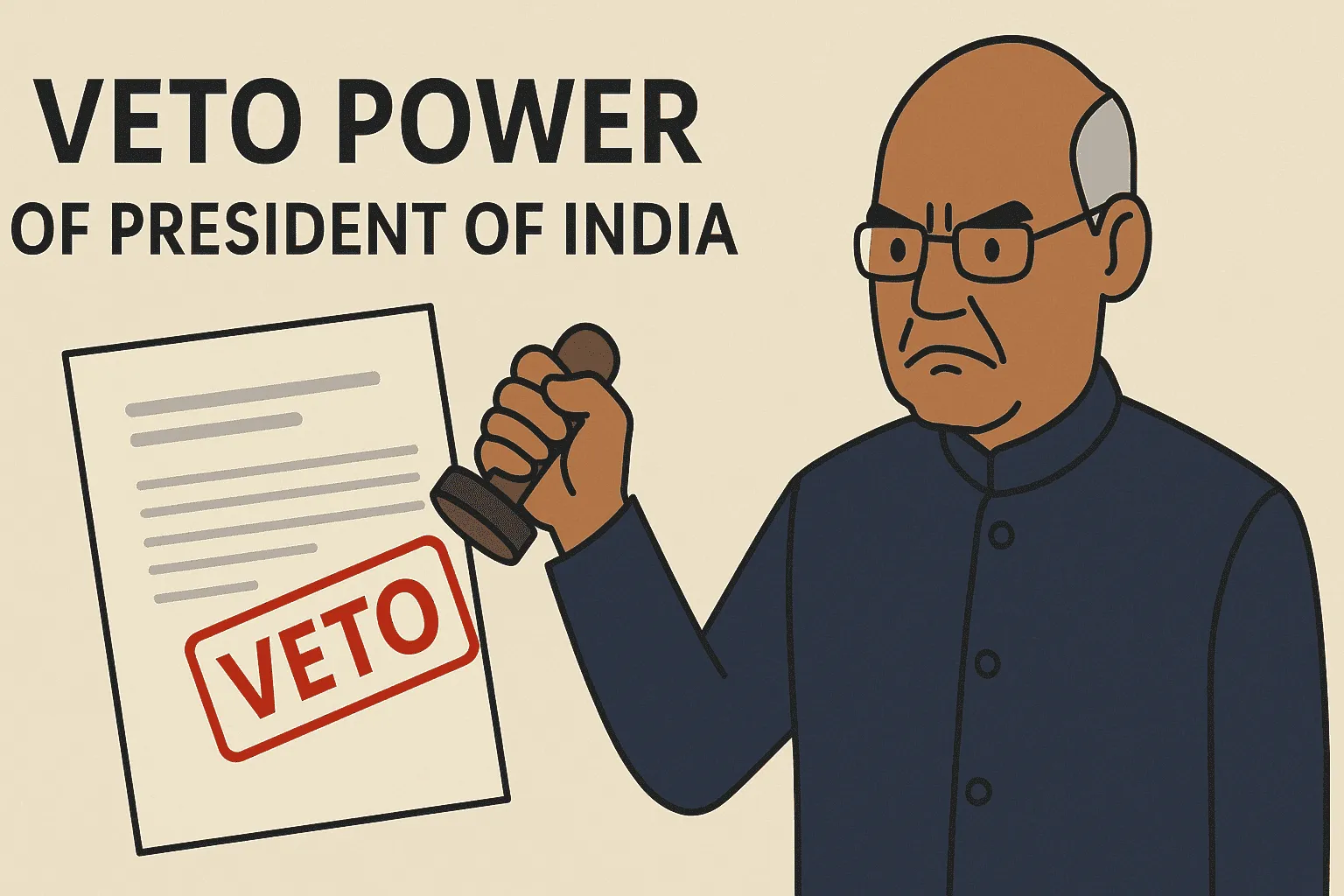
The Veto Power of President of India is an essential part of the country’s legislative process. Along with enabling the President of India to execute legislative duties, it also provides an important mechanism of maintaining constitutional integrity and ensuring that laws that are being enacted are consistent with the national interest. The scope of this article is to study in detail the Veto Power of the President of India, its meaning, purpose, types, and other related terms.
What is Veto Power?
In the realm of legislation, “Veto Power” is the power exercised by a single person or body (usually the Executive Head – President or Governor) to refuse or reject a bill that was introduced and passed by the legislature. It is a crucial safety mechanism that prevents unilateral actions of legislation by providing the executive the authority to bring back and reject proposed laws that were passed by the legislature. So, it can be understood as checks and balances between the Executive and Legislature.
Types of Veto Power of President of India
The veto power possessed by the Executive can be classified into 4 types:
- Absolute Veto- withhold assenting to the bill passed by the legislature.
- Qualified Veto- can be overwritten by the legislature with higher majority.
- Suspensive Veto- can be overwritten by the legislature with ordinary majority.
- Pocket Veto- means no action taken on the bill passed by the legislature.
Constitutional Provisions Regarding Veto Power of President of India
The constitutional provisions regarding the Veto Power of the President of India are as follows:
- Article 111: deals with the veto power of the President over a bill passed by the Parliament.
- Article 201: deals with the veto power of the President over bills passed by the State Legislatures and reserved for the President’s consideration.
Objectives of Veto Power of President
The objectives of the Veto power of the President of India are as follows: - Preventing Parliament from enacting ill-considered or unthoughtful legislation,
- Preventing legislation which may be unconstitutional,
- Maintaining the Rule of Law, by requiring that all legislation fits within the constitutional framework,
- Acting as a control for legislative errors made at the point of legislation that are resolvable before gaining assent,
- Encouraging more thorough debate and rethinking, rewording, and remaking bills in Parliament.