NTA CBSE UGC NET(National Eligibility Test) Commerce Previous Years Solved Papers | Paper II November 2017
Assertion (A) : Industrial liberalisation became an imperative condition for the growth of forces of competition leading to high efficiency and productivity in Indian industries.
Reasoning (R) : Industrial development and curbing of poverty is only possible through government intervention.
Code :- (1) (A) and (R) both are not correct.
- (2) (A) is correct but (R) is not the correct explanation of (A).
- (3) (A) is correct and (R) is correct explanation of (A).
- (4) (A) is not correct but (R) is correct.
Answer: Option (2)
- (1)Statements (I) and (III)
- (2) Statements (II) and (III)
- (3)Statements (I) and (II)
- (4) Statements (I), (II) and (III)
Answer: Option (2)
⭐ Make GKSeries Your Preferred Source on Google
Add GKSeries as Preferred Source
- (1) (ii) (iv) (i) (iii)
- (2) (i) (iii) (ii) (iv)
- (3) (iv) (ii) (iii) (i)
- (4) (iii) (i) (iv) (ii)
Answer: Option (1)
- (1) Curbing competition among private sector
- (2) Establishing predominant role of public sector
- (3) Establishing a free market economy
- (4) Regional balancing through planning and licensing
Answer: Option (3)
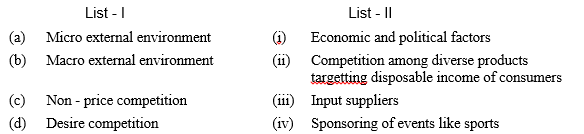
- (1) (iii) (i) (iv) (ii)
- (2) (ii) (iii) (iv) (i)
- (3) (iv) (ii) (iii) (i)
- (4) (iv) (i) (ii) (iii)
Answer: Option (1)
Reasoning (R) : It measures the ability of the company to pay off its long term liabilities.
Select the correct answer from the code given below :- (1) Both (A) and (R) are correct and (R) is the correct reason for (A).
- (2) Both (A) and (R) are correct but (R) does not explain (A) correctly.
- (3) (A) is correct but (R) is wrong.
- (4) (A) is wrong but (R) is correct.
Answer: Option (1)
- (1) ` 3,000
- (2) ` 7,000
- (3) ` 10,000
- (4) ` 15,000
Answer: Option (3)
- (1)` 3,000
- (2) ` 4,500
- (3) ` 7,500
- (4) ` 10,500
Answer: Option (3)
- (1) 40
- (2) 44
- (3) 48
- (4) 52
Answer: Option (3)
- (1) Amount realised from the sale of investments
- (2) Dividend received on investment
- (3) Amount borrowed from a bank
- (4) Compensation received from municipal corporation for the acquisition of land for the construction of road.
Answer: Option (2)
Statement (II) : Even without application of economic logic and tools of analysis, business decisions are always rational and real and are not counter productive.
Code :- (1) Both the statements are correct.
- (2) Both the statements are incorrect.
- (3) Statement (I) is correct while statement (II) is incorrect.
- (4) Statement (I) is incorrect while statement (II) is correct.
Answer: Option (3)
- (1) Pure profit is the return in excess of the opportunity cost
- (2) Accounting profit is the excess of total revenue over and above the explicit and implicit costs
- (3) Profit maximization is the sole objective of the modern firms
- (4) Profit is maximum when the difference between marginal revenue and marginal cost is maximum
Answer: Option (1)
- (1) Rationality
- (2) Constant marginal utility from successive units
- (3) Constant marginal utility of money
- (4) Utility is measurable
Answer: Option (2)
AR
-----------AR−MR
Statement (II) : The point price elasticity of demand is the product of the slope of the demand function and the ratio between corresponding price and quantity.
- (1) Both the statements are correct.
- (2) Both the statements are incorrect.
- (3) Statement (I) is correct while statement (II) is incorrect.
- (4) Statement (I) is incorrect while statement (II) is correct.
Answer: Option (1)
- (1) Negative slope
- (2) Indifference curves of two imperfect substitutes are concave to the point of origin
- (3) The indifference curves do not intersect nor are they tangent to one another
- (4) Upper indifference curves indicate a higher levels of satisfaction
Answer: Option (2)
- (1) Nominal scale
- (2) Ordinal scale
- (3) Interval scale
- (4) Ratio scale
Answer: Option (1)
- (1) K=1+3.322(log N)
- (2) K=(log N)1.322 1 + 3.322
- (3) K = (log N) 3.322
- (4) K = (log N) + 1 Where : K = Number of classes N = Total number of observations (log N) = Logarithm of the total number of observations
Answer: Option (1)
- (1) Bell - shaped and symmetric
- (2) Mean, Median and Mode of the distribution are equal
- (3) The total area under the curve for the normal probability distribution is one
- (4) The two tails of the distribution in both the directions touches the horizontal axis
Answer: Option (4)
Reasoning (R) : The theory of sampling is based on the two important laws of statistics, viz., Law of statistical Regularity and law of inertia of large numbers.
Code :- (1) Both (A) and (R) are correct and (R) is the complete explanation of (A)
- (2) Both (A) and (R) are correct but (R) is not the complete explanation of (A).
- (3) (A) is not correct while (R) is correct.
- (4) Both (A) and (R) are not correct.
Answer: Option (1)
Statement (II) : The mean of the sampling distribution of mean is not equal to the parametric value of mean.
Code :- (1) Both the statements are true.
- (2) Both the statements are false.
- (3) Statement (I) is true, while statement (II) is false.
- (4) Statement (I) is false, while statement (II) is true.
Answer: Option (3)
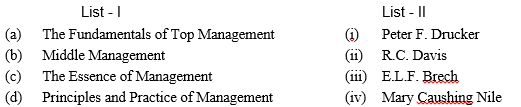
- (1) (ii) (iv) (iii) (i)
- (2) (ii) (iv) (i) (iii)
- (3) (ii) (iii) (i) (iv)
- (4) (iii) (iv) (i) (ii)
Answer: Option (9)
Statement (II) : He who can manage, can manage anything.
- (1) Statement (I) is correct but (II) is incorrect
- (2) Statement (II) is correct but (I) is incorrect.
- (3) Both the statements (I) and (II) are incorrect. (4)Both the statements (I) and (II) are correct.
Answer: Option (4)
Reasoning (R) : Management succeeds or fails as human relations in business are intelligently or unintelligently handled.
Code :- (1) Both (A) and (R) are correct and (R) is the right explanation of (A).
- (2) Both (A) and (R) are correct but (R) is not the right explanation of (A).
- (3) (A) is correct but (R) is not correct.
- (4) (R) is correct but (A) is not correct
Answer: Option (2)
- (1) A.H. Maslow
- (2) Cris Argyris
- (3) Frederick Herzberg
- (4) Peter F. Drucker
Answer: Option (4)
- (1) Recognition
- (2) Working Conditions
- (3) Responsibility
- (4) Achievements
Answer: Option (2)
- (1) Services
- (2) Events
- (3) Experiences
- (4) Ideas
Answer: Option (3)
- (1) The consumers who are primarily motivated by ideals are guided by knowledge and principles.
- (2) The consumers who are motivated by achievement look for knowledge and principles.
- (3) The consumers who are motivated by self expression don’t desire social or physical activity, variety, and risk.
- (4) The consumers who are motivated by achievement desire social or physical activity, variety, and risk.
Answer: Option (1)
Assertion (A) : A transformational appeal of communication elaborates on a non-product related benefit or image.
Reasoning (R) : Transformational appeals often do not attempt to stir up emotions that will motivate purchase.
Code :- 1) (A) and (R) both are correct.
- (2) (A) is correct (R) is not correct.
- (3) (A) is not correct (R) is correct.
- (4) (A) and (R) both are incorrect
Answer: Option (2)
- (1) Awareness→ Knowledge → Liking → Preference→ Conviction → Purchase
- (2) Knowledge → Awareness → Liking → Conviction → Preference → Purchase
- (3) Awareness → Liking → Knowledge → Conviction → Preference → Purchase
- (4) Liking → Awareness → Knowledge → Preference → Conviction → Purchase
Answer: Option (1)

- (1) (iii) (iv) (i) (ii)
- (2) (i) (iii) (iv) (ii)
- (3) (i) (iv) (iii) (ii)
- (4) (iv) (i) (iii) (ii)
Answer: Option (4)
- (1) The opportunity cost of an input is considered in capital budgeting
- (2) Capital budgeting decisions are reversible in nature
- (3) Cash flows and accounting profits are different
- (4) An expansion decision is a capital budgeting decision
Answer: Option (2)
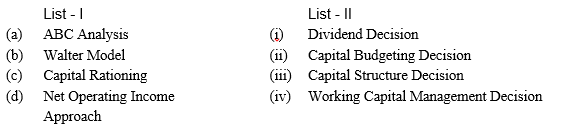
- (1) (i) (iii) (ii) (iv)
- (2) (ii) (i) (iii) (iv)
- (3) (iv) (i) (ii) (iii)
- (4) (iii) (i) (ii) (iv)
Answer: Option (3)
- (1) Reduce the risk associated with profits
- (2) Maintain the stability in profits
- (3) Decrease the cost of debt capital
- (4) Magnify the return on equity share capital
Answer: Option (4)
- (1) Dividend yield method
- (2) Dividend yield plus growth method
- (3) Yield to maturity method
- (4) Earnings yield method
Answer: Option (3)
- (1) Net Present Value
- (2) Internal Rate of Return
- (3) Pay back Period
- (4) Accounting Rate of Return
Answer: Option (2)
- (1) Material resources are subject to laws of mechanics and they cannot have an output greater than the input.
- (2) Human resources are capable of exponential growth and development.
- (3) Human resources cannot yield an output that may be far greater than what the value of their input warrants.
- (4) In current scenario, gradually, the emphasis has shifted from muscle power to use of mind power.
Answer: Option (3)
- (1) That conflict occurs when the tendency of industrial society is to treat worker as an isolated individual and deprive him of all control over his environmen
- (2) That an enterprise contain people with coalition of different interests
- (3) That industrial conflict is a part of the broader social conflict between classes
- (4) That no consensus is possible, in case of conflicts, because people are with different socio - cultural backgrounds.
Answer: Option (2)
- (1) Job attitudes
- (2) Job descriptions/definitions
- (3) Job analysis records
- (4) Job skill requirements
Answer: Option (1)
Assertion (A) : Development in HRM is a short-term educational process with temporary intervention.
Reasoning (R) : It is a educational process utilizing a systematic and organized procedure for development of operative employees performance in current jobs.
Code :- (1) (A) is correct and (R) is correct explanation of (A).
- (2) (A) is correct, but (R) is not correct explanation of (A).
- (3) (A) is not correct, but (R) is correct.
- (4) (A) and (R) both are not correct.
Answer: Option (4)
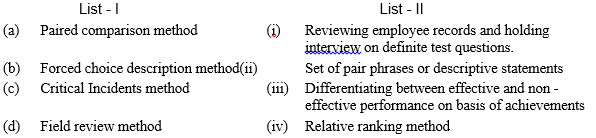
- (1) (iv) (ii) (iii) (i)
- (2) (ii) (iii) (iv) (i)
- (3) (iii) (i) (iv) (ii)
- (4) (ii) (iv) (i) (iii)
Answer: Option (1)
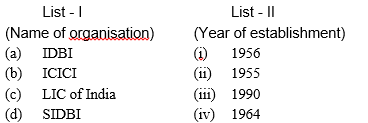
- (1) (iii) (i) (ii) (iv)
- (2) (iii) (i) (iv) (ii)
- (3) (iv) (ii) (i) (iii)
- (4) (i) (ii) (iii) (iv)
Answer: Option (3)
Statement (II) : Capital adequacy norms help banks in sanctioning more loans.
Code :- (1) Both the Statements (I) and (II) are correct.
- (2) Both the Statements (I) and (II) are incorrect.
- (3) Statement (I) is correct but (II) is incorrect.
- (4) Statement (I) is incorrect but (II) is correct.
Answer: Option (3)
- (1) Tax evasion
- (2) Illegal trading in stock exchanges
- (3) Bank robbery
- (4) Illegal transactions of foreign exchange
Answer: Option (4)
(i) Capital adequacy norms for commercial banks
(ii) Establishment of IDBI
(iii) Allowing convertibility of rupee at the market rate in the current account.
(iv) Nationalisation of general insurance business
- (1) (i), (ii), (iii), (iv)
- (2) (iv), (iii), (ii), (i)
- (3) (iv), (ii), (i), (iii)
- (4) (i), (ii), (iv), (iii)
Answer: Option (9)
Reasoning (R) : RBI is encouraging e-banking.
Code :- (1) (A) is true but (R) is false.
- (2) (A) is false but (R) is true.
- (3) Both (A) and (R) are true and (R) is the correct explanation of (A).
- (4) Both (A) and (R) are true but (R) does not support (A).
Answer: Option (3)
Statement (II) : The Extended Fund Facility (EFF) was created in 1984 to help the developing countries over longer period upto 3 years.
Code :- (1) Statement (I) is correct but (II) is not correct.
- (2) Statement (II) is correct but (I) is not correct.
- (3) Both the statements (I) and (II) are correct.
- (4) Both the statements (I) and (II) are not correct.
Answer: Option (1)
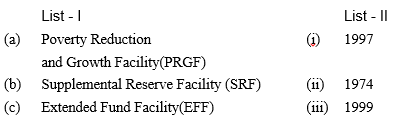
- (1) (iii) (i) (ii)
- (2) (iii) (ii) (i)
- (3) (ii) (i) (iii)
- (4) (i) (iii) (ii)
Answer: Option (1)
- (1) Adam Smith
- (2) David Recardo
- (3) Hackscher Ohlin
- (4) William Petty
Answer: Option (1)
- (1) IMF
- (2) IBRD
- (3) ADB
- (4) IFRS
Answer: Option (4)
Reasoning (R) : The important way to reduce imports and thereby reduce deficit in balance of payments is to adopt monetary and fiscal policies that aims at reducing aggregate expenditure in the economy.
Code :- (1) (A) and (R) both are correct and (R) supports (A).
- (2) (A) and (R) both are correct but (R) does not support (A).
- (3) (A) is correct but (R) is incorrect.
- (4) (R) is correct but (A) is incorrect.
Answer: Option (1)