NTA CBSE UGC NET(National Eligibility Test) Commerce Previous Years Solved Papers | Paper III November 2017
Reasoning (R) : They have different degrees of bargaining power.
Code :- (1) (A) and (R) are correct and (R) is the correct reasoning of (A).
- (2) (A) and (R) are correct but (R) is not the correct reasoning of (A).
- (3) (A) is incorrect while (R) is a correct statement.
- (4) Both (A) and (R) are incorrect.
Answer: Option (1)
- (1) Area of sale of goods and services
- (2) Type of goods and services sold
- (3) The choice of the consumer
- (4) The value of goods and services sold
Answer: Option (4)
⭐ Make GKSeries Your Preferred Source on Google
Add GKSeries as Preferred Source
- (1) (iv) (ii) (i) (iii)
- (2) (iii) (i) (iv) (ii)
- (3) (iii) (iv) (ii) (i)
- (4) (i) (iii) (iv) (ii)
Answer: Option (3)
- (1) Collusion and dominance have potential for unfair competition.
- (2) The appeal against decisions of Competition Commission of India can be made to the Competition Appellate Tribunal.
- (3) State monopolies, government’s business policies and functioning of Regulatory Authorities cannot be scrutinized under this law.
- (4) Abuse of dominance rather than dominance should be the key for Competition Policy/ Law.
Answer: Option (3)
- (1) Collusion and dominance have potential for unfair competition.
- (2) The appeal against decisions of Competition Commission of India can be made to the Competition Appellate Tribunal.
- (3) State monopolies, government’s business policies and functioning of Regulatory Authorities cannot be scrutinized under this law.
- (4) Abuse of dominance rather than dominance should be the key for Competition Policy/ Law.
Answer: Option (3)
- (1) Margin of Safety = PROFIT P/V RATIO Change in Contribution
- (2) P/V Ratio = × 100 Change in sales
- (3) Break-even point in units = Fixed cost Contribution per unit
- (4) Required sales to earn desired profits = Desired profit P/V ratio
Answer: Option (4)
- (1) Format of Balance Sheet
- (2) Format of Profit and Loss Account
- (3) Format of Trading Account
- (4) Format of Cash Flow
Answer: Option (2)
- (1) When there is one liquidation and one formation it is known as external construction
- (2) Goodwill or Capital reserve arises only when the amalgamation is in the nature of merger
- (3) Under the pooling of interest method, the transferee company incorporates the assets and liabilities of the transferor company at book value
- (4) The vendor company transfers preliminary expenses (at the time of absorption) to equity shareholders’ account
Answer: Option (2)
Statement - II : In a hypothetical production function of the following form Q=−L3+15 L2+10 L Where, Q=Quantity of the product and L=No. of variable input (labour), the marginal physical productivity of labour is −L2+15 L+10.
Code :- (1) Both the statements are true.
- (2) Both the statements are false.
- (3) Statement - I is true while statement - II is false.
- (4) Statement - I is false while statement - II is true.
Answer: Option (3)
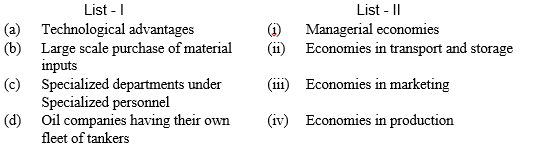
- (1) (iv) (iii) (i) (ii)
- (2) (iii) (iv) (ii) (i)
- (3) (iii) (i) (ii) (iv)
- (4) (iv) (ii) (iii) (i)
Answer: Option (1)
- (1) Monopolistic competition
- (2) Perfect competition
- (3) Monopoly
- (4) Oligopoly
Answer: Option (1)
Statement - II : Pricing below the market price has been found to be more successful when a seller intends to achieve a prestigious position among the sellers in the locality for selling prestigious goods of much superior quality.
Code :
- (1) Both the statements are correct
- (2) Both the statements are incorrect
- (3) Statement - I is correct while Statement - II is incorrect
- (4) Statement - I is incorrect while Statement - II is correct
Answer: Option (3)
- (1) (a), (b) and (c)
- (2) (a), (c) and (d)
- (3) (c), (d) and (e)
- (4) (b), (c) and (e)
(a) The coefficient of rank correlation has the same limits as the Karl Pearson’s coefficient of correlation
.(b) The coefficient of correlation is independent of the change of origin but not of scale.
(c) The covariance between X and Y is defined as ΣXY where X = (X − X) , Y = (Y − Y) and n = no. of paired observations.
(d) bXY is called regression coefficient of X variable on Y variable.
(e) If bXY is 0.4 and bYX is 1.6, coefficient of determination would be 0.8.
Answer: Option (2)
- (1) Test of independence of attributes
- (2) Test of goodness of fit of a specific type of distribution
- (3) Test for population variance on the basis of small sized sample variance
- (4) Test of homogeneity of several populations with respect to some characteristic of interest
Answer: Option (3)
- (1) Testing the significance of coefficient of correlation between paired observations of small sized sample
- (2) Testing the significance of coefficient of correlation between paired observations of large sized sample
- (3) Comparing variances of two small sized samples
- (4) Testing the significance of the difference among mean values of more than two samples groups
Answer: Option (1)
- (1) Chain
- (2) Stack
- (3) List
- (4) Tree
Answer: Option (1)
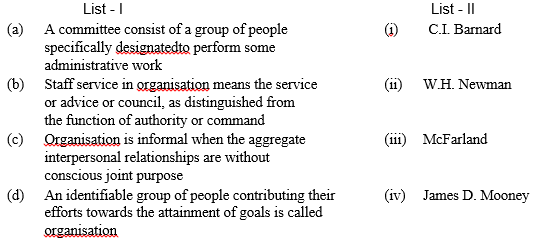
- (1) (ii) (iv) (i) (iii)
- (2) (iv) (ii) (iii) (i)
- (3) (iv) (iii) (i) (ii)
- (4) (i) (ii) (iv) (iii)
Answer: Option (1)
- (1) Poor vocabulary
- (2) Noise
- (3) Improper time
- (4) Overload information
Answer: Option (1)
Statement - II : Controlling is determining what is motivational to the employees of the organization.
Code :- (1) Statement - I is correct but II is incorrect
- (2) Statement - II is correct but I is incorrect
- (3) Both the statements I and II are correct
- (4) Both the statements I and II are incorrect
Answer: Option (1)
and programmes from among alternatives.
Code :
- (1) Both (A) and (R) are correct and (R) is the right explanation of (A).
- (2) Both (A) and (R) are correct but (R) is not the right explanation of (A).
- (3) Both the statements (A) and (R) are incorrect.
- (4) (A) is correct but (R) is incorrect.
Answer: Option (1)
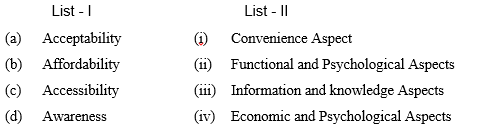
- (1) (i) (iii) (ii) (iv)
- (2) (iii) (ii) (i) (iv)
- (3) (ii) (iv) (i) (iii)
- (4) (iv) (ii) (i) (iii)
Answer: Option (3)
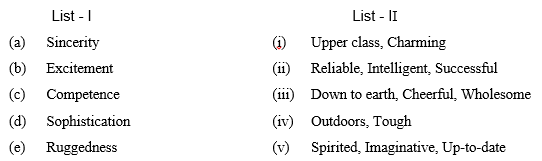
- (1) (v) (ii) (i) (iii) (iv)
- (2) (i) (iv) (iii) (ii) (v)
- (3) (iii) (v) (ii) (i) (iv)
- (4) (ii) (i) (iii) (v) (iv)
Answer: Option (3)
- (1) Attribute Listing
- (2) Forced Relationship
- (3) New Contexts
- (4) Mind Mapping
Answer: Option (4)
Statement - II : The difference due to some intervention occurred at either point of time motivates us to search a newer option and thus satisfies our mind/ anxiety.
Code :- (1) Statement - I is correct, Statement - II is not correct.
- (2) Statement - II is correct, Statement - I is not correct.
- (3) Both statements are correct.
- (4) Both statements are incorrect.
Answer: Option (1)
- (1) 18%
- (2) 12%
- (3) 36%
- (4) 30%
Answer: Option (3)
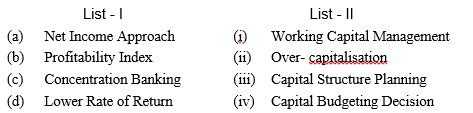
- (1) (iii) (iv) (i) (ii)
- (2) (iii) (iv) (ii) (i)
- (3) (iv) (ii) (iii) (i)
- (4) (ii) (iii) (i) (iv)
Answer: Option (1)
Statement - II : Sensitivity Analysis helps in calculation of net present value of the proposal.
Code :- (1) Statement - I is correct, but statement - II is wrong
- (2) Statement - I is wrong, but statement - II is correct
- (3) Statement - I and statement - II, both are correct
- (4) Statement - I and statement - II, both are wrong
Answer: Option (1)
- (1) Hedging
- (2) Issue of Debentures
- (3) Liquidity
- (4) Arbitrage
Answer: Option (4)
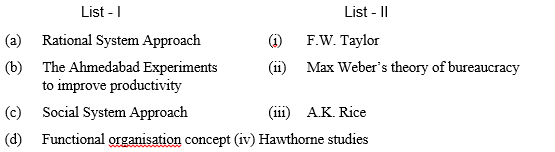
- (1) (ii) (iv) (iii) (i)
- (2) (iii) (ii) (iv) (i)
- (3) (iv) (iii) (i) (ii)
- (4) (iii) (i) (ii) (iv)
Answer: Option (1)
- (1) Regiocentric approach
- (2) Split half method
- (3) Test related method
- (4) Expectancy diagrams
Answer: Option (1)
(a) Preliminary interview
(b) Completion of application blank
(c) Background investigation
(d) Physical examination
(e) Employment tests
(f) Comprehensive interview
(g) Final employment decision
Code :- (1) (b), (a), (c), (d), (e), (f), (g)
- (2) (b), (a), (e), (f), (c), (d), (g)
- (3) (a), (b), (e), (f), (c), (d), (g)
- (4) (a), (b), (d), (c), (e), (f), (g)
Answer: Option (3)
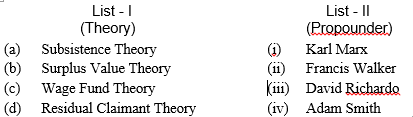
- (1) (ii) (iv) (i) (iii)
- (2) (iv) (i) (ii) (iii)
- (3) (iii) (i) (iv) (ii)
- (4) (iv) (ii) (iii) (i)
Answer: Option (3)
- (1) 1542
- (2) 1611
- (3) 1705
- (4) 1801
Answer: Option (9)
- (1) Risk Withdrawal Adjustments
- (2) Risk Withdrawal Arrangements
- (3) Risk Weighted Assets
- (4) Risk-free Weighted Assets
Answer: Option (3)
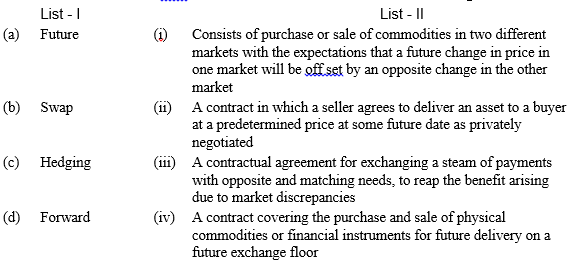
- (1) (iv) (iii) (ii) (i)
- (2) (i) (ii) (iii) (iv)
- (3) (ii) (i) (iii) (iv)
- (4) (iv) (iii) (i) (ii)
Answer: Option (4)
- (a) Telephone Banking
- (b) Electronic Cheque Conversion
- (c) Electronic Bill Payment
- (d) Direct Fund Transfer Through RTGS
Answer: Option (4)
- (1) Agriculture and Allied Commodity (2)Gems and Jewellery
- (3) Handicrafts
- (4)Electronic Goods
Answer: Option (2)
- (1) Industrial Design
- (2) Geographical Indications
- (3) Interior Design
- (4) Layout Designs of Integrated Circuits
Answer: Option (3)
- (1) IMF’s headquarters is in Washi
- (2) IMF has 198 countries as its members.
- (3) IMF is an outcome of the Bretton Woods Conference.
- (4) IMF was found on July 7, 1944.
Answer: Option (2)
Statement - II : The rate of reward under SEIS would be based on net foreign exchange earned.
Code :- (1) Statement - I is correct but statement - II is incorrect.
- (2) Statement - II is correct but statement - I is incorrect.
- (3) Both the statements - I and II are incorrect.
- (4) Both the statements - I and II are correct.
Answer: Option (4)
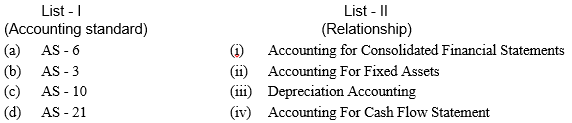
- (1) (ii) (iv) (iii) (i).
- (2) (iii) (iv) (ii) (i).
- (3) (iv) (iii) (i) (i .
- (4) (i) (ii) (iii) (iv).
Answer: Option (2)
(a) RBI has prescribed guidelines for the operations of credit rating agencies in India.
(b) All venture capital funds in India have been promoted by Government.
(c) A mutual fund can operate as venture capital fund.
(d) Credit rating is an authoritative guarantee regarding the credit position of a person.
- (1) (a), (b), (c) and (d)
- (2) (a), (b) and (d)
- (3) (a), (b) and (c)
- (4) (a) and (c)
Answer: Option (2)
(a) Elimination of Government Subsidy
(b) Increase in Bank Rate
(c) Labour Problem
(d) High Levered Fund
Code :- (1) (a), (b) and (c)
- (2) (a), (b) and (d)
- (3) (a) and (b)
- (4) (a) and (d)
Answer: Option (3)
(a) It facilitates the centralisation of decision taking.
(b) It provides a system of closer control.
(c) It measures the performance of individuals in an objective manner.
(d) It develops a sense of cost consciousness among managers and their subordinates.
Code :- (1) (a), (b) and (c)
- (2) (b), (c) and (d)
- (3) (a), (b) and (d)
- (4) (a), (c) and (d)
Answer: Option (2)
(a) Tax-shield on depreciation and interest is an important variable both for lessor and lessee.
(b) A lessee may evaluate the lease options as against the buying option.
(c) Sale and Lease-back, and leveraged lease are types of financial lease.
(d) Lease financing is a type of capital budgeting decision from the point of view of the lessee.
Code :- (1) (a), (b) and (d)
- (2) (b), (c) and (d)
- (3) (a), (c) and (d)
- (4) (a), (b) and (c)
Answer: Option (4)
- (1) General Price Level Method
- (2) Specific Price Level Method
- (3) Current Cost Accounting Method
- (4)Generally Accepted Accounting Principles
Answer: Option (3)
(a) To gain the economies of scale.
(b) To utilise under - utilised resources.
(c) To break the monopoly.
(d) To reduce the tax liability.
Code :- (1) (a), (c) and (d)
- (2) (a), (b) and (d)
- (3) (b), (c) and (d)
- (4) (a), (b) and (c)
Answer: Option (2)
- (1) Consumer Jury
- (2) Projective Technique
- (3) Mystery Shopping
- (4) Semiotic Research
Answer: Option (3)
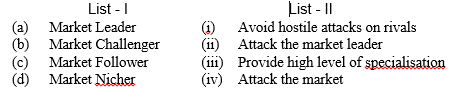
- (1) (iv) (ii) (i) (iii)
- (2) (ii) (iv) (iii) (i)
- (3) (iii) (i) (iv) (ii)
- (4) (i) (iii) (iv) (ii)
Answer: Option (1)
Reasoning (R) : The important way to reduce imports and thereby reduce deficit in balance of payments is to adopt monetary and fiscal policies that aims at reducing aggregate expenditure in the economy.
Code :- (1) (A) and (R) both are correct and (R) supports (A).
- (2) (A) and (R) both are correct but (R) does not support (A).
- (3) (A) is correct but (R) is incorrect.
- (4) (R) is correct but (A) is incorrect.
Answer: Option (2)
- (1) Jurisdiction
- (2) Ownership
- (3) Security
- (4) Entertainment
Answer: Option (4)
Statement (I) : Horizontal conflict between channel members is caused due to channel members impinge on the market territory of other intermediaries at different level.
Statement (II) : Vertical conflict is caused due to intense price competition, disagreement about promotional activities, attempts to bypass intermediary and distribute direct, differing expectations as to channel or intermediary performance.
Statement (III) : Hybrid channel conflict arises due to grey marketing.
Code :- (1) (I) and (III)
- (2) (I) and (II)
- (3)(II) and (III)
- (4) (I), (II) and (III)
Answer: Option (3)
Statement (I) : As consumer’s income increases, the percentage of income spent for food items decreases, for rent, fuel and light remains the same, for clothing remains the same and for sundries increases.
Statement (II) : Societal marketing period was from 1960 onwards.
Statement (III) : Our debt to social anthropology decreases more and more as we use qualitative market research approaches.
Statement (IV) : The economic concepts of perfect competition and matching of supply and demand underlie the marketing concept, particularly in relation to the concepts of the price at which goods are sold and quantity distributed.
Code :- (1) (I) and (II)
- (2) (II) and (III)
- (3) (II) and (IV)
- (4) (I) and (IV)
Answer: Option (2)
Statement (I) : Virtue ethics is a form of ethical approach associated with Aristotle which stresses the importance of developing virtuous principles, ‘right’ character and the pursuit of a virtuous life.
Statement (II) : Utilitarianism is an ethical approach where an action is right if, and only if, it conforms to the principle of utility, whereby utility is minimised and pain and unhappiness minimised more than any alternative.
Statement (III) : ‘Deontological Ethics’ is an ethical approach where rightness or wrongness of an action or decision is not judged to be based exclusively on the consequences of that action or decision.
Code :- (1) (I), (II) and (III)
- (2) (I) and (II)
- (3) (I) and (III)
- (4) (II) and (III)
Answer: Option (3)
Reasoning (R) : The succession charts need utmost confidentiality.
Code :- (1) (A) is correct and (R) is right reasoning of it.
- (2) (A) is correct but (R) is not the correct reasoning of it.
- (3) (A) is correct but (R) is not correct statement.
- (4) (A) is not correct while (R) is a correct statement.
Answer: Option (2)
- (1) Transactional Analysis
- (2) Business Games
- (3) Critical Incident Technique
- (4) T-group
Answer: Option (4)
Statement (I) : The MBO program is built on the assumption that individuals always need not be responsible and self - directed and thus need to be motivated to work towards objectives.
Statement (II) : Forced distribution method was developed by Karl Marx.
Statement (III) : Peer evaluation and self - appraisal need to be done on well - defined parameters in check-list method.
Statement (IV) : Forced choice method consists of seven main factors on three point rating scale.
Code :- (1) Statements (I) and (II)
- (2) Statements (III) and (IV)
- (3) Statements (I), (II) and (III)
- (4) Statements (I), (II), (III) and (IV)
Answer: Option (4)
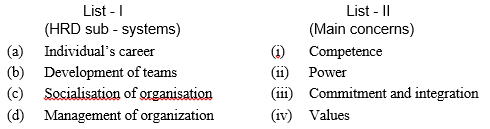
58. Match the main concerns of HRD sub-systems given in List - I with List - II and choose the correct code of matching :
Code :
- (1) (ii) (iv) (i) (iii)
- (2) (iv) (ii) (iii) (i)
- (3) (iii) (i) (iv) (ii)
- (4) (ii) (iii) (i) (iv)
Answer: Option (3)
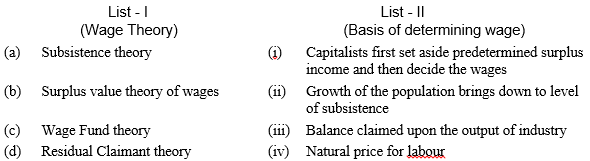
- (1) (iv) (ii) (i) (iii)
- (2) (ii) (iv) (i) (iii)
- (3) (iii) (i) (ii) (iv)
- (4) (i) (iii) (iv) (ii)
Answer: Option (1)
Statement (II) : Generally the evaluator becomes more critical about performance evaluation technique rather than which criteria need to be evaluated.
Code :- (1) Both the statements are correct.
- (2) Both the statements are incorrect.
- (3) Statement - I is correct while statement - II is incorrect.
- (4) Statement - I is incorrect while statement - II is correct.
Answer: Option (1)
- (1) (I) and (II)
- (2) (II) and (III)
- (3) (I) and (IV)
- (4) (III) and (IV)
Answer: Option (3)
- (1) Leontief Paradox Trade Theory
- (2) Fisher Effect Economic Theory
- (3) Purchasing Power Parity Theory
- (4) Combined Equilibrium Theory
Answer: Option (2)
- (1) Domestic Price level (P) divided by foreign price level (P*)
- (2) P*−P
- (3) P−P*
- (4) P*/P
Answer: Option (1)
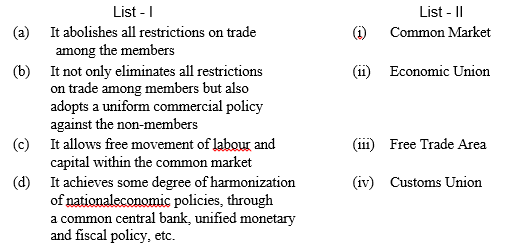
- (1) (iv) (ii) (i) (iii)
- (2) (iv) (iii) (i) (ii)
- (3) (iii) (iv) (i) (ii)
- (4) (ii) (i) (iv) (iii)
Answer: Option (3)
Reasoning (R) : By restricting the areas of operations and growth, the government policy seriously constrained the potential of Indian companies to make a foray into the foreign countries.
Code :- (1) Both (A) and (R) are correct and (R) is the right explanation of (A).
- (2) Both (A) and (R) are correct but (R) is not the right explanation of (A).
- (3) Both (A) and (R) are incorrect.
- (4) (A) is correct but (R) is incorrect.
Answer: Option (2)
- (1) Statement (I) is correct but (II) is incorrect.
- (2) Statement (II) is correct but (I) is incorrect.
- (3) Both the statements (I) and (II) are incorrect.
- (4) Both the statements (I) and (II) are correct.
Answer: Option (1)
- (1) Designated bank refers to any bank in India, which has been authorised by the RBI to act as banker to FII.
- (2) Domestic custodian includes any person carrying on the activities of providing custodial services in respect of securities.
- (3) Sub-account includes those institutions, established or incorporated in India, whether incorporated or not, on whose behalf investments are proposed to be made in India by FIIs.
- (4) A domestic portfolio manager or domestic asset management company shall also be eligible to be registered as FII to manage the funds of sub-accounts.
Answer: Option (3)
- (1) Broken-date contract is a full - month forward contract.
- (2) Currency arbitrage refers to making profit by buying a currency cheap in one market and selling it dear in the other market at a particular point of time.
- (3) Currency Futures Market refers to organised foreign exchange market where a fixed amount of a currency is exchanged on a fixed maturity date in the pit.
- (4) Currency Options Market refers to market for the exchange of currency where the option buyer enjoys the privilege of not exercising the option if the rate is not favourable.
Answer: Option (1)
- (1) Fully exempt in the hands of unit holders
- (2) Fully taxable in the hands of unit holders
- (3) Fully exempt in the hands of individual unit holders and fully taxable in the hands of institutional unit holders
- (4) Included in the gross total income but a deduction is allowed under section 80 L
Answer: Option (1)
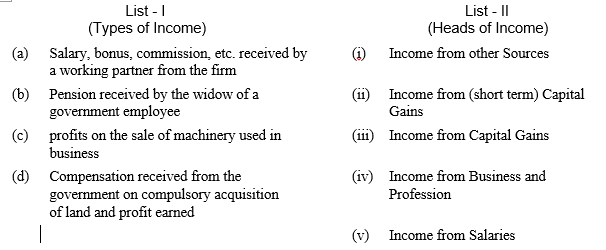
- (1) (v) (ii) (i) (iii)
- (2) (iv) (ii) (iii) (v)
- (3) (v) (iv) (iii) (ii)
- (4) (iv) (i) (ii) (iii)
Answer: Option (4)
- (a) Mr. A purchased a house for self residence of ` 80 lacs by taking a loan of ` 60 lacs from SBI at 10% interest, instead of using his own funds.
- (b) Mr. A made investment in purchasing 12% redeemable debentures of TISCO worth ` 1.50 lac
- (c) Mr. A purchased 100 gram gold biscuits of ` 2.5 Lac from SBI on the occasion of Diwali.
- (d) Mr. A invested ` 1 crore in purchasing 5 acres of agricultural land in his native village in Gaya.
Answer: Option (3)
Reason (R) : If tax has not been deducted at source, the amount paid as interest will not be allowed as a deduction in computing business income.
Select the correct answer from the code given below :- (1) Both (A) and (R) are correct and (R) is the correct explanation of (A).
- (2) (A) and (R) both are correct but (R) is not the correct explanation of (A).
- (3) (A) is correct but (R) is wrong.
- (4) (A) is wrong but (R) is correct.
Answer: Option (1)
- (1) Income Tax
- (2) Income Tax Plus surcharge (if any )
- (3) Gross total Income
- (4) Taxable Income
Answer: Option (2)
- (1) Any residential house
- (2) A residential house which is let out
- (3) A house which is self occupied
- (4) More than one residential house
Answer: Option (4)
- (1) Income from business and profession
- (2) Short-term capital gain
- (3) Long-term capital gain
- (4) Income from other sources
Answer: Option (2)