UGC NET(National Eligibility Test) Indian Culture - Previous Years Solved Papers | Paper III November 2017
- (1) Anatomically modern humans
- (2) Archaic Homo Sapiens
- (3) Denisovans
- (4) Homo Erectus
Answer: (1)
- (1) Bhimbetka
- (2) Chaturbhuj Nala
- (3) Chirand
- (4) Patne
Answer: (4)
⭐ Make GKSeries Your Preferred Source on Google
Add GKSeries as Preferred Source- (1) Allahdino
- (2) Banawali
- (3) Kuntasi
- (4) Rakhigarhi
Answer: (2)
- (1) Dholavira
- (2) Kalibangan
- (3) Lothal
- (4) Rangpur
Answer: (1)
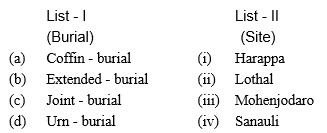
- (1) (i) (iii) (iv) (ii)
- (2) (iv) (ii) (iii) (i)
- (3) (i) (iv) (ii) (iii)
- (4) (iii) (i) (iv) (ii)
Answer: (3)
- (1) Atranjikhera
- (2) Bhagwanpura
- (3) Hastinapur
- (4) Ropar
Answer: (2)
- (1) Nirriti
- (2) Pushan
- (3) Rudra
- (4) Varuna
Answer: (3)
- (1) Agni
- (2) Indra
- (3) Mitra
- (4) Soma
Answer: (4)
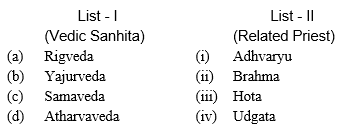
- (1) (i) (iii) (iv) (ii)
- (2) (iii) (iv) (i) (ii)
- (3) (iv) (ii) (iii) (i)
- (4) (iii) (i) (iv) (ii)
Answer: (4)
- (1) Aryabhata
- (2) Brahmagupta
- (3) Lagadha
- (4) Varahamihira
Answer: (3)
- (1) Rigveda
- (2) Yajurveda
- (3) Samaveda
- (4) Atharvaveda
Answer: (4)
- (1) Ajatasatru
- (2) Brahmadatta
- (3) Pravahana Jaivali
- (4) Svetaketu
Answer: (1)
(a) Jodhpura
(b) Gilund
(c) Jhinjhana
(d) Saipai
Code : ul>Answer: (3)
- (1) Adinatha
- (2) Neminatha
- (3) Mallinatha
- (4) Santinatha
Answer: (2)
(a) Ahichchhatra
(b) Ayodhya
(c) Hastinapur
(d) Sisupalgarh
Code :- (1) (a) and (b)
- (2) (b) and (c)
- (3) (a) and (d)
- (4) (c) and (d)
Answer: (4)
- (1) Avanti
- (2) Malla
- (3) Sakya
- (4) Vatsa
Answer: (2)
(a) Alara Kalama
(b) Kasyapa
(c) Makkhali Gosala
(d) Udraka Ramaputra
Code :- (1) (a) only
- (2) (a) and (c)
- (3) (a) and (d)
- (4) (b) and (d)
Answer: (3)
- (1) Badami
- (2) Bhilsa
- (3) Ellora
- (4) Mathura
Answer: (4)
Assertion (A) : Buddha denied the authority of the Vedas and the Vedic gods.
Reason (R) : He was against the Brahmanas.
In the context of the above two statements which of the following is correct ?- (1) Both (A) and (R) are true and (R) is the correct explanation of (A).
- (2) Both (A) and (R) are true, but (R) is not the correct explanation of (A).
- (3) (A) is true, but (R) is false.
- (4) (A) is false, but (R) is true.
Answer: (3)
- (1) Ajivikas
- (2) Charvakas
- (3) Jatilas
- (4) Niganthas
Answer: (1)
(a) Kanchipuram
(b) Kapatapuram
(c) Madura
(d) Tanjavur
Code :- (1) (a) and (b)
- (2) (b) and (c)
- (3) (a) and (c)
- (4) (c) and (d)
Answer: (2)
- (1) Cultivable Land
- (2) Uncultivable Land
- (3) Demarcated Land
- (4) Donated Land
Answer: (2)
Assertion (A) : Megasthanes, the Greek envoy to the Mauryan court, who wrote a detailed account of the then India, declared that there were no slaves in India.
Reason (R) : He was certainly wrong. Different types of slavery are recognised in ancient Indian Smriti literature and other works.
In the context of the above two statements which of the following is correct ?- (1) Both (A) and (R) are true and (R) is the correct explanation of (A).
- (2) Both (A) and (R) are true, but (R) is not the correct explanation of (A).
- (3) (A) is true, but (R) is false.
- (4) (A) is false, but (R) is true.
Answer: (4)
- (1) Buddhism
- (2) Jainism
- (3) Saivism
- (4) Vaisnavism
Answer: (2)
(a) Buddhacharita
(b) Harshacharita
(c) Mahaviracharita
(d) Ramcharita
Code :- (1) (a), (c), (b), (d)
- (2) (a), (b), (c), (d)
- (3) (d), (a), (b), (c)
- (4) (d), (a), (c), (b)
Answer: (2)
- (1) Aphasad inscription of Aditysena
- (2) Gwalior inscription of Mihira Bhoja
- (3) Hathigumpha inscription of Kharavela
- (4) Nasik inscription of Gautamiputra Satakarni
Answer: (2)
- (1) Kujula Kadphises
- (2) Kanishk I
- (3) Menander
- (4) Vasudeva
Answer: (2)
(a) Kali Era
(b) Saka Era
(c) Valabhi Era
(d) Vikrama Era
Code :- (1) (a), (d), (b), (c)
- (2) (a), (b), (c), (d)
- (3) (d), (b), (c), (a)
- (4) (d), (c), (b), (a)
Answer: (1)
- (1) Asvamedha type of Kumaragupta I
- (2) Chakravikram type of Chandragupta II
- (3) Standard type of Samudragupta
- (4) Tiger - slayer type of Samudragupta
Answer: (2)
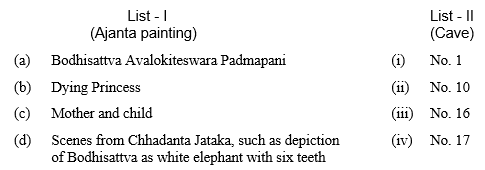
- (1) (ii) (iv) (i) (iii)
- (2) (i) (iii) (ii) (iv)
- (3) (ii) (i) (iv) (iii)
- (4) (i) (iii) (iv) (ii)
Answer: (4)
- (1) Aparajitaprichchha - Philosophy
- (2) Ashtangasangrha - Yoga
- (3) Brahma Siddhanta - Astronomy
- (4) Lilavati - Drama
Answer: (3)
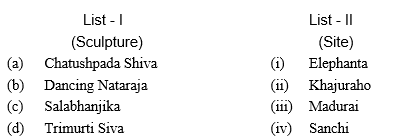
- (1) (ii) (iii) (iv) (i)
- (2) (i) (ii) (iii) (iv)
- (3) (iii) (iv) (ii) (i)
- (4) (ii) (i) (iv) (iii)
Answer: (1)
- (1) Basalt
- (2) Granite
- (3) Sandstone
- (4) Schist
Answer: (2)
(a) Dashavatara temple Deogarh
(b) Lingaraja temple Bhubaneshwar
(c) Mahabodhi temple Bodhagaya
(d) Sun temple Modhera
Code :- (1) (a), (b), (c), (d)
- (2) (a), (c), (b), (d)
- (3) (c), (a), (d), (b)
- (4) (c), (b), (d), (a)
Answer: (2)
- (1) Baudhayana
- (2) Manu
- (3) Parasara
- (4) Yajnavalkya
Answer: (4)
(a) Asanga
(b) Dignaga
(c) Dharmakirti
(d) Vasubandhu
Code :- (1) (a) and (d) only
- (2) (a), (b) and(c) only
- (3) (b), (c) and(d) only
- (4) (a), (b), (c) and (d)
Answer: (4)
- (1) Basava
- (2) Madhva
- (3) Ramanuja
- (4) Sankara
Answer: (3)
(a) Bhitargaon brick temple
(b) Lad Khan temple, Aihole
(c) Parsvanatha temple, Khajuraho
(d) Pujashila-prakara, Madhyamika
Code :- (1) (a), (d), (b), (c)
- (2) (d), (a), (b), (c)
- (3) (d), (b), (c), (a)
- (4) (a), (b), (c), (d)
Answer: (2)
(a) Kaveripattinam
(b) Korkai
(c) Musiri
(d) Tondi
Code :- (1) (a) and (b)
- (2) (b) and (c)
- (3) (a) and (d)
- (4) (c) and (d)
Answer: (1)
- (1) Himvat Khanda of Skanda Purana
- (2) Matsya Purana
- (3) Nilmata Purana
- (4) Vishnudharmottara Purana
Answer: (3)
- (1) Sultan Qutbuddin Aibek
- (2) Sultan Iltutmish
- (3) Sultan Balban
- (4) Sultan Jalaluddin Khalji
Answer: (2)
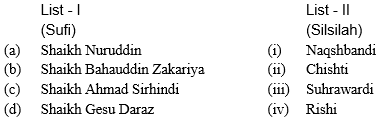
- (1) (i) (iv) (ii) (iii)
- (2) (iv) (iii) (i) (ii)
- (3) (iii) (ii) (iv) (i)
- (4) (ii) (iii) (i) (iv)
Answer: (2)
- (1) Ibn al - Arabi
- (2) Bayazid
- (3) Shaikh Mubarak
- (4) Saiyid Muhammad
Answer: (1)
- (1) Miftahul Futuh
- (2) Naat-i Muhammadi
- (3) Matlaul Anwar
- (4) Qiranus Sadain
Answer: (2)
- (1) Amir Khusrau
- (2) Isami
- (3) Ibn Battuta
- (4) Hasan Nizami
Answer: (2)
- (1) Shihabuddin
- (2) Sikander
- (3) Zain-ul Abidin
- (4) Haider Shah
Answer: (3)
- (1) Alai Darwaza
- (2) Humayun’s Tomb
- (3) Tomb of Abdur Rahim Khan i Khanan
- (4) Gol Gumbaz, Bijapur
Answer: (4)
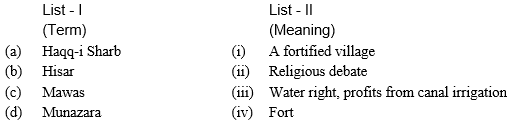
- (1) (iii) (iv) (i) (ii)
- (2) (ii) (iii) (iv) (i)
- (3) (i) (iii) (ii) (iv)
- (4) (iv) (ii) (i) (iii)
Answer: (1)
(a) Raja Krishna Deva Raya of Vijayanagar Empire was a gifted scholar both in Telugu and Sanskrit.
(b) He was also a voluminous writer, although only two of his works are extant.
(c) According to tradition, his court was adorned by eight celebrated poets, who were known as the astha-diggajas.
(d) He extended his patronage to Telugu, Kannada and Tamil poets alike.
Select the correct answer from the code given below :- (1) Only (a) and (b)
- (2) Only (c) and (d)
- (3) Only (b), (c) and (d)
- (4) (a), (b), (c) and (d)
Answer: (4)
- (1) Harihara I
- (2) Bukka I
- (3) Harihara II
- (4) Deva Raya I
Answer: (2)
- (1) Mir Murtaza
- (2) Mir Muhammad Ibrahim
- (3) Mir Fathullah Shirazi
- (4) Mir Muhammad Sa‘id
Answer(3)
- (1) Whatever on the routes there occur cases of theft and robbery, and the place is at some distance from inhabited sites, let the jÂgirdars of the area layout a serai and mosque and dig a well, so that people settle there; if the spot is near khalisa territory, let its officers do the same.
- (2) 18 Rabi I, which is my birthday, for a period of days equal to the years of my life, no animals should be slaughtered; and a prohibition of animal slaughter was likewise made for two days in every week.
- (3) Prophet’s law (Shari’at-i Nabawi) which had withered like a red flower by the winter wind should be renewed.
- 4) A government collector or a jagirdÂr should not without permission inter-marry with the people of the pargana in which he might be.
Answer: (3)
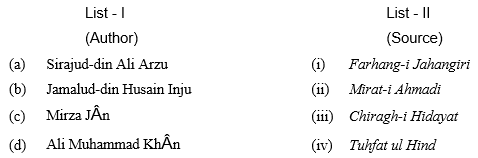
- (1) (ii) (iv) (i) (iii)
- (2) (iii) (i) (iv) (ii)
- (3) (i) (iii) (ii) (iv)
- (4) (iv) (ii) (iii) (i)
Answer: (2)
- (1) Paramartha-Guru-Kathai
- (2) Vaman Kathai
- (3) Kiristhava Vedopadesam
- (4) Virama-Muni
Answer: (3)
- (1) Zakhirat - ul Khawanin
- (2) Tazkirat-ul Umara
- (3) Mirat-i Ahmadi
- (4) Maasir-ul Umara
Answer: (3)
Assertion (A) : The movement of painters from Shiraz brought about the cross-fertilisation of Shirazi and Indian art techniques which upset the rigid application of theoretical rules to contemporary Indian painting.
Reason (R) : A major watershed in Indo-Persian painting is the Nimat-Nama illustrated in Malwa in the early sixteenth century.
In the context of the above two statements which of the following is correct ?- (1) Both (A) and (R) are true and (R) is the correct explanation of (A).
- (2) Both (A) and (R) are true, but (R) is not the correct explanation of (A).
- (3) (A) is true, but (R) is false.
- (4) (A) is false, but (R) is true.
Answer: (1)
Assertion (A) : By the sixteenth century Hindu Service castes - Khatris, Kayasths, Brahmins and others became indispensable in the operation of government.
Reason (R) : They supplied young recruits to serve as apprentices who already, through training in the family, had been schooled in official Persian terminology, accounting, and reporting methods as well as the difficult chancery script.
In the context of the above two statements which of the following is correct ?- (1) Both (A) and (R) are true and (R) is the correct explanation of (A).
- (2) Both (A) and (R) are true, but (R) is not the correct explanation of (A).
- (3) (A) is true, but (R) is false.
- (4) (A) is false, but (R) is true.
Answer: (1)
- (1) Abdul Haq
- (2) Shaikh Jalal Hisari
- (3) Muhammad Ghaus Shattari
- (4) Shaikh Munawwar
Answer: (2)
Assertion (A) : It was the college of Fort William that made printing and publishing in the classical and vernacular languages possible in India on a large scale.
Reason (R) : Like James Mill, Cornwallis distrusted oriental despotism and sought legal solutions to socio-cultural problems of India.
In the context of the above two statements which of the following is correct ?- (1) Both (A) and (R) are true and (R) is the correct explanation of (A).
- (2) Both (A) and (R) are true but (R) is not the correct explanation of (A).
- (3) (A) is true, and (R) is false.
- (4) (A) is false, but (R) is true.
Answer: (2)
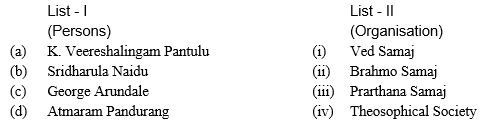
- (1) (ii) (iv) (iii) (i)
- (2) (iv) (iii) (i) (ii)
- (3) (ii) (i) (iv) (iii)
- (4) (i) (ii) (iv) (iii)
Answer: (3)
- (1) Keshub Chandra Sen
- (2) Swami Vivekanand
- (3) Rabindranath Tagore
- (4) Mrs. Annie Besant
Answer: (3)
- (1) Dinabandu Mitra
- (2) Girish Chandra Ghosh
- (3) Rasik Krishna Malik
- (4) Madusudhan Dutt
Answer: (3)
- (1) Punjab University - 1882
- (2) Allahabad University - 1887
- (3) Osmania University - 1897
- (4) Jamia Milia Islamia University - 1920
Answer: (3)
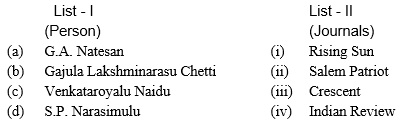
- (1) (i) (ii) (iii) (iv)
- (2) (iv) (iii) (i) (ii)
- (3) (ii) (iv) (i) (iii)
- (4) (iii) (i) (iv) (ii)
Answer: (2)
- (1) Lala Lajpat Rai
- (2) Lokmanya B.G. Tilak
- (3) Mahatma Gandhi
- (4) Bhagat Singh
Answer: (2)
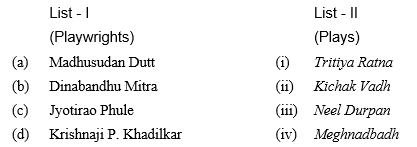
- (1) (i) (ii) (iii) (iv)
- (2) (ii) (iv) (i) (iii)
- (3) (iii) (i) (ii) (iv)
- (4) (iv) (iii) (i) (ii)
Answer: (4)
- (1) Bengal
- (2) Tamil Nadu
- (3) Andhra Pradesh
- (4) Maharashtra
Answer: (4)
- (1) Pune
- (2) Baroda
- (3) Karachi
- (4) Lahore
Answer: (4)
- (1) Ebenezer Howard
- (2) William Emerson
- (3) Charles Mant
- (4) F.L. Wright
Answer: (1)
- (1) Western Music
- (2) Ghazal Sangit
- (3) Carnatik Music
- (4) Rabindra Sangeet
Answer: (3)
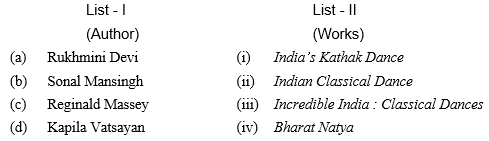
- (1) (ii) (i) (iv) (iii)
- (2) (iv) (iii) (i) (ii)
- (3) (iii) (iv) (i) (ii)
- (4) (iv) (i) (ii) (iii)
Answer: (2)
- (1) Charles Wyatt
- (2) George Gilbert Scott
- (3) Swinton Jacob
- (4) Herbert Baker
Answer: (3)
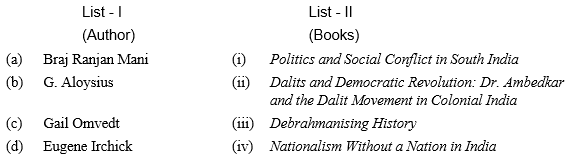
- (1) (i) (iv) (ii) (iii)
- (2) (iii) (iv) (ii) (i)
- (3) (ii) (i) (iv) (iii)
- (4) (iv) (iii) (i) (ii)
Answer: (2)
- (1) Henry David Thoreau
- (2) John Ruskin
- (3) Leo Tolstoy
- (4) John Stuart Mill
Answer: (4)
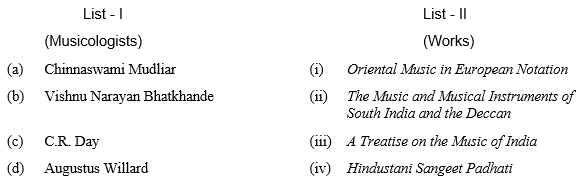
- (1) (iv) (ii) (i) (iii)
- (2) (ii) (i) (iii) (iv)
- (3) (i) (iv) (ii) (iii)
- (4) (ii) (iv) (i) (iii)
Answer: (3)