UGC NET Political Science - Previous Years Solved Papers | Paper II November 2017
- (1) Weber
- (2) Morgenthau
- (3) Waltz
- (4) Kissinger
Answer: Option (1)
- (1) Distribution of goods and services
- (2) Burdens and Benefits
- (3) Punishment and retribution
- (4) One man one work, one class one duty
Answer: Option (4)
⭐ Make GKSeries Your Preferred Source on Google
Add GKSeries as Preferred SourceAssertion (A) : Oakeshott says Hobbes is the greatest political thinker produced by the English speaking people.
Reason (R) : No other thinker can match his philosophical foundations and clarity of thought.
Code :- (1) Both (A) and (R) are true and (R) is the correct explanation of (A)
- (2) Both (A) and (R) are true, but (R) is not the correct explanation of (A)
- (3)(A) is true, but (R) is false
- (4)(A) is false, but (R) is true
Answer: Option (1)
- (1) to build a science of politics
- (2) to accept the Enlightenment’s philosophical method
- (3) to assert that the methods of natural sciences and those of social sciences were identical
- (4) to solve the problem of contradiction
Answer: Option (4)
- (1) Althusser
- (2) Lenin
- (3) Miliband
- (4) Miliband
Answer: Option (1)
- (1) Hegemonic revolution
- (2) Passive revolution
- (3) Passive revolution
- (4) Petit Bourgeois revolution
Answer: Option (2)
Assertion (A) : Gandhi was critical of the material civilisation and particularly detested the Industrial Revolution.
Reason (R) : He believed that Industrial Revolution was destroying deeper values. Code :
- (1) Both (A) and (R) are true and (R) is the correct explanation of (A)
- (2) Both (A) and (R) are true, but (R) is not the correct explanation of (A).
- (3) (A) is true, but (R) is false.
- (4) (A) is false, but (R) is true.
Answer: Option (1)
- (1) Dialectical Materialism
- (2) Marxist Theory of History
- (3) The Theory of Surplus Value
- (4) Colonial Question
Answer: Option (4)
- (1) A theory that champions exclusively Human Rights.
- (2) A theory that puts forward environment as the most important agenda.
- (3) A theory that concentrates on refining the familiar framework of liberal democracy.
- (4) A theory that wants to usher in socialism by democratic means.
Answer: Option (3)
- (1) Inability to evolve consensus
- (2) Too much dogmatism
- (3) It was a localised event
- (4) Coloured by Cold War prejudices
Answer: Option (1)
Assertion (A) : According to Weber, comparative politics could be comprehended within the larger framework of culture, which he did by demolishing Marx’s theory of economic determinism.
Reason (R) : As without this rejection, his theory was totally untenable. Code :
- (1) Both (A) and (R) are true and (R) is the correct explanation of (A).
- (2) Both (A) and (R) are true, but (R) is not the correct explanation of (A).
- (3) (A) is true, but (R) is false.
- (4) (A) is false, but (R) is true.
Answer: Option (1)
Assertion (A) : Institutional approach can help in mapping the landscape of politics.
Reason (R) : The goal of institutional approach is to reconcile the competing values of individual freedom and collective equality. Code :
- (1) Both (A) and (R) are true and (R) is the correct explanation of (A).
- (2) Both (A) and (R) are true, but (R) is not the correct explanation of (A).
- (3) (A) is true, but (R) is false.
- (4) (A) is false, but (R) is true.
Answer: Option (1)
- (1) Seventeenth Century
- (2) Eighteenth Century
- (3) Nineteenth Century
- (4) Twentieth Century
Answer: Option (3)
- (1) who rules and who benefits from the rule
- (2) ways and means of perpetuating in power
- (3) accepting the basic formulations of Plato’s The Republic
- (4) to ensure rule of the majority
Answer: Option (1)
- (1) Sri Lanka
- (2) Germany
- (3) Italy
- (4) France
Answer: Option (3)
- (1) Robert Michels
- (2) Robert Mekenzie
- (3) Tony Benn
- (4) Mosei Ostrogonski
Answer: Option (2)
- (1) Military rule
- (2) Fascism
- (3) Communism
- (4) Despotism
Answer: Option (1)
- (1) Dependency Theory
- (2) Structural Functional Theory
- (3) Modernization Theory
- (4) Post-modernization Theory
Answer: Option (3)
- (1) Miliband and Sweezy
- (2) Plekhanov and Lenin
- (3) Camus and Sartre
- (4) Habermas and Offe
Answer: Option (4)
- (1) Hannah Arendt
- (2) Theda Skocpol
- (3) Crane Brinton
- (4) Hubert Johnson
Answer: Option (3)
- (1) Swaraj Party, Poona Pact, Third Round Table Conference, Nehru Report, Communal Award
- (2) Swaraj Party, Nehru Report, Communal Award, Poona Pact, Third Round Table Conference
- (3) Poona Pact, Swaraj Party, Communal Award, Nehru Report, Third Round Table Conference
- (4) Nehru Report, Third Round Table Conference, Swaraj Party, Poona Pact, Communal Award
Answer: Option (2)
- (1) The Muslim League
- (2) The Congress
- (3) The Sikhs
- (4) The Princes Guild
Answer: Option (3)
(a) Right to shelter
(b) Right to good roads
(c) Right to reputation
(d) Right to pure drinking water
Select the correct answer from the code given below : Code :- (1) (a) and (b)
- (2) (a), (c) and (d)
- (3) (a), (b) and (d)
- (4) (a), (b), (c) and (d)
Answer: Option (4)
(a) Indira Nehru Gandhi V. Raj Narain
(b) Kesavanand Bharti V. State of Kerala
(c) S.P. Gupta V. Union of India
(d) Minerva Mills V. Union of India
Code :- (1) (a), (b) and (d) only
- (2) (a), (b), (c) and (d)
- (3) (c), (d) and (b) only
- (4) (a), (b) and (c) only
Answer: Option (2)
- (1) 1977
- (2) 1981
- (3) 1989
- (4) 2010
Answer: Option (3)
- (1) Goa
- (2) Mizoram
- (3) Jammu and Kashmir
- (4) Sikkim
Answer: Option (4)
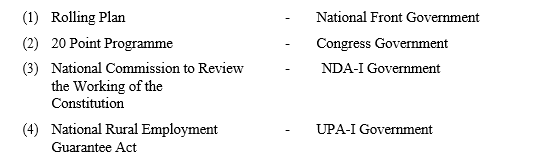
Answer: Option (1)
- (1) Justice R.S. Sarkaria
- (2) G.V. Ramakrishna
- (3) B. Shivaraman
- (4) Dr. S.R. Sen
Answer: Option (2)
- (1) 1989
- (2) 1990
- (3) 1993
- (4) 2001
Answer: Option (3)
(a) Tebhaga
(b) Champaran
(c) Singur
(d) Bardoli
Code :- (1) (b), (a), (c), (d)
- (2) (b), (d), (a), (c)
- (3) (c), (a), (b), (d)
- (4) (d), (b), (c), (a)
Answer: Option (2)
- (1) Classical approach
- (2) Human Relations approach
- (3) Systems approach
- (4) Behavioural approach
Answer: Option (3)
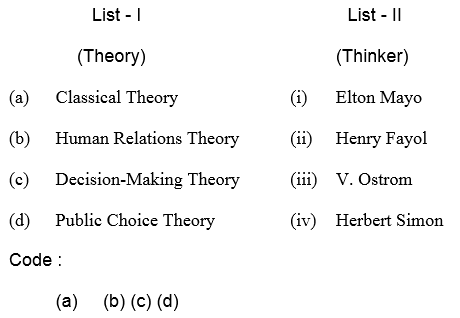
- (1) (i) (ii) (iv) (iii)
- (2) (ii) (iii) (iv) (i)
- (3) (i) (ii) (iii) (iv)
- (4) (ii) (i) (iv) (iii)
Answer: Option (4)
- (1) Fayol
- (2) Gulick
- (3) Urwick
- (4) Follet
Answer: Option (1)
- (1) Department of Defence
- (2) Department of Home
- (3) Prime Minister’s Office (PMO)
- (4) Public Works Department
Answer: Option (4)
- (1) Caste bureaucracy
- (2) Patronage bureaucracy
- (3) Guardian bureaucracy
- (4) Ruling bureaucracy
Answer: Option (2)
(a) Central Bureau of Investigation (CBI)
(b) Research and Analysis Wing (RAW)
(c) Central Reserve Police Force (CRPF)
(d) Prime Minister’s Office (PMO)
Select the correct answer from the code given below :- (1) (a) and (d)
- (2) (a) and (b)
- (3) (a), (b) and (c)
- (4) (c) and (d)
Answer: Option (3)
- (1) L.K. Jha Committee
- (2) Sarkaria Commission
- (3) Sixth Pay Commission
- (4) Second Administrative Reforms Commission
Answer: Option (1)
- (1) Informal training
- (2) Formal training
- (3) Pre - entry training
- (4) Post - entry training
Answer: Option (3)
(a) It was set up on the recommendation of the Santhanam Committee
(b) It is a statutory body
(c) It is a multi-member commission
(d) It exercises superintendence over the working of the CBI
- (1) (a) and (b) only
- (2) (b) and (c) only
- (3) (a), (b) and (c)
- (4) (a), (b), (c) and (d)
Answer: Option (4)
Assertion (A) : The expenditure charged on the Consolidated Fund of India is not subject to the vote of Parliament.
Reason (R) : It is in the nature of obligatory payment.
Code :- (1) Both (A) and (R) are true and (R) is the correct explanation of (A)
- (2) Both (A) and (R) are true, but (R) is not the correct explanation of (A)
- (3) (A) is true, but (R) is false
- (4) (A) is false, but (R) is true
Answer: Option (1)
- (1) Mathematics and Reason
- (2) Reason and Logic
- (3) Logic and Rationality
- (4) Mathematics and Logic
Answer: Option (3)
(a) China is not a member of MTCR
(b) India is a member of MTCR
(c) Aims at restricting complete rocket systems
(d) Pakistan is a member of MTCR
- (1) (a), (b), (c)
- (2) (b), (d), (c)
- (3) (b), (c), (d)
- (4) (d), (b), (a)
Answer: Option (1)
- (1) Be authorized by a sovereign prince
- (2) Be proportionate
- (3) Be pursued for just intent
- (4) be undeclared
Answer: Option (4)
- (1) George H W Bush
- (2) George W Bush Jr
- (3) Bill Clinton
- (4) Barack Obama
Answer: Option (2)
- (1) Security
- (2) Cooperation
- (3) Peace
- (4) Freedom
Answer: Option (4)
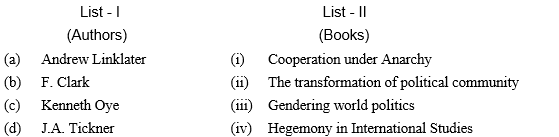
- (1) (ii) (i) (iv) (iii)
- (2) (iii) (ii) (i) (iv)
- (3) (ii) (iv) (i) (iii)
- (4) (iv) (ii) (i) (iii)
Answer: Option (3)
Assertion (A) : India is seeking permanent membership of Security Council of UNO.
Reason (R) : India is a nuclear power.
Code :- (1) Both (A) and (R) are true, and (R) is the correct explanation of (A)
- (2) Both (A) and (R) are true, but (R) is not the correct explanation of (A)
- (3) (A) is true, but (R) is false
- (4) (A) is false, but (R) is true
Answer: Option (2)
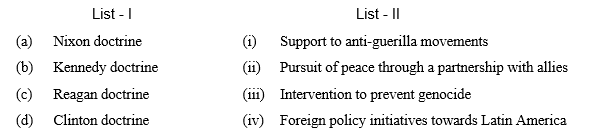
- (1) (i) (iii) (iv) (ii)
- (2) (iii) (ii) (iv) (i)
- (3) (iv) (ii) (iii) (i)
- (4) (ii) (iv) (i) (iii)
Answer: Option (4)
(a) Julius Nyerere was one of the founding members of NAM
(b) India hosted seventh NAM summit
(c) The seventeenth NAM summit was held in Venezuela
(d) The headquarters of NAM is in Belgrade
- (1) (a), (b) and (c)
- (2) (a), (c) and (d)
- (3) (b) and (c)
- (4) (b) and (d)
Answer: Option (3)
- (1) If a state fails to protect its population, International community take collective action in accordance with the UN Charter
- (2) It is state’s responsibility to protect its population from four mass atrocity crimes
- (3) It is the responsibility of International Community to protect people from crimes against humanity
- (4) International Community’s responsibility to assist individual states in meeting the responsibility
Answer: Option (3)