UGC NET Political Science - Previous Years Solved Papers | Paper III November 2017
- (1) Unity in style and manner of argument
- (2) Unity in themes and style
- (3) Unity in searching the same goal
- (4) Unity in having a common vision for humankind
Answer: Option (1)
- (1) Isaiah Berlin
- (2) Karl Popper
- (3) Sheldon Wolin
- (4) Michael Oakeshott
Answer: Option (3)
⭐ Make GKSeries Your Preferred Source on Google
Add GKSeries as Preferred Source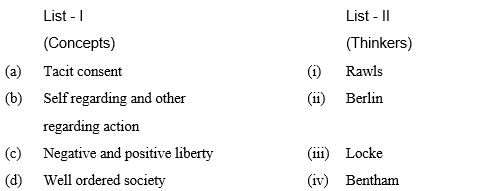
- (1) (ii) (i) (iv) (iii)
- (2) (iii) (iv) (ii) (i)
- (3) (i) (ii) (iii) (iv)
- (4) (iv) (iii) (i) (ii)
Answer: Option (2)
- (1) Lassalle
- (2) Proudhon
- (3) Bakunin
- (4) Luxemberg
Answer: Option (3)
Assertion (A) :In spite of the fact that Rawls theory has strong procedural features it can also be seen as a major contribution to social justice.
Reason (R) :He is categorical that there is a need for rational justification of all departures from equality.
Code :- (1) Both (A) and (R) are true and (R) is the correct explanation of (A).
- (2) Both (A) and (R) are true, but (R) is not the correct explanation of (A).
- (3) (A) is true, but (R) is false
- (4) (A) is false, but (R) is true
Answer: Option (1)
- (1) advanced capitalism and developed socialism
- (2) manufacturing nations and raw material exporting countries
- (3) national interests in international organizations
- (4) need to have common policy to fight climate change
Answer: Option (1)
Assertion (A) : Lenin’s revolutionary seizure of power is like a coup and negation of Marxism.
Reason (R) : Marx thought a communist party would capture power peacefully.
Code :- (1) Both (A) and (R) are true and (R) is the correct explanation of (A).
- (2) Both (A) and (R) are true, but (R) is not the correct explanation of (A).
- (3) (A) is true, but (R) is false.
- (4) (A) is false, but (R) is true.
Answer: Option (3)
- (1) Proletariat
- (2) Intelligentsia
- (3) Combination of the proletariat and the peasantry
- (4) Peasantry
Answer: Option (4)
- (1) Tawney
- (2) Sabine
- (3) Macpherson
- (4) Ashcraft
Answer: Option (4)
- (1) Machiavelli
- (2) Hobbes
- (3) Locke
- (4) Rousseau
Answer: Option (2)
- (1) Karl Popper
- (2) Carl Friedrich
- (3) Hannah Arendt
- (4) Jacob Talmon
Answer: Option (4)
- (1) Power is more important than right.
- (2) Rights will entail duties.
- (3) There is an inherent conflict between power and right.
- (4) Difficult to obtain agreement among individuals.
Answer: Option (4)
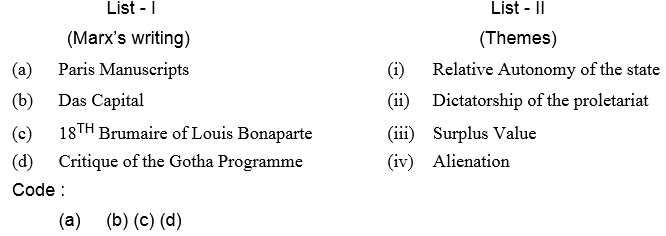
- (1) (i) (ii) (iii) (iv)
- (2) (iv) (iii) (i) (ii)
- (3) (iii) (iv) (ii) (i)
- (4) (ii) (i) (iv) (iii)
Answer: Option (2)
(a) Idolized Ancient Rome
(b) Used History extensively to draw lessons for state-craft
(c) Private army needed for the success of a prince / ruler
(d) Blamed religion for Italy’s moral regeneration
Choose the correct answer from the code given below :- (1) (a) and (b)
- (2) (b) and (d)
- (3) (c) and (d)
- (4) (a) and (c)
Answer: Option (1)
- (1) Philosophical Anarchist
- (2) Liberal democrat
- (3) Social Democrat
- (4) Communist
Answer: Option (1)
(a) To study the then existing political systems
(b) To develop an empirical science of politics
(c) To arrive at the Ideal type
(d) To apply abstract ideas in practice
Code :- (1) (a) and (c)
- (2) (a) and (b)
- (3) (b) and (d)
- (4) (c) and (d)
Answer: Option (2)
- (1) Institutions rather than individuals
- (2) A balance between institutions and individuals
- (3) A group theory in politics
- (4) Economics dominates over politics
Answer: Option (1)
- (1) Counter Reformation
- (2) Genuine Revolution
- (3) Correction to earlier studies
- (4) Abandoning his own earlier research
Answer: Option (2)
- (1) Locke
- (2) Hume
- (3) Montesquieu
- (4) Smith
Answer: Option (4)
- (1) The British practice of following continuity and change peacefully
- (2) The British acceptance of conventions as sacred as law but not enforceable in courts
- (3) The British belief that the ‘King can do no wrong’
- (4) The common law tradition in Britain
Answer: Option (4)
- (1) USA
- (2) UK
- (3) India
- (4) Switzerland
Answer: Option (1)
- (1) USA
- (2) India
- (3) France
- (4) Switzerland
Answer: Option (1)
- (1) Switzerland
- (2) U.K
- (3) U.S.A
- (4) France
Answer: Option (3)
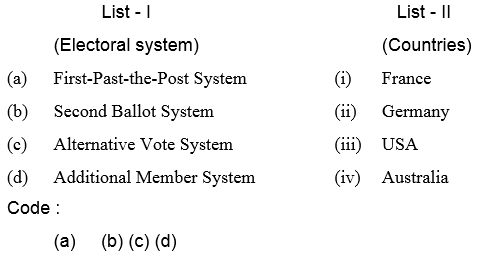
- (1) (iv) (iii) (ii) (i)
- (2) (ii) (iv) (i) (iii)
- (3) (i) (ii) (iii) (iv)
- (4) (iii) (i) (iv) (ii)
Answer: Option (4)
(R). Select the correct answer from the code given below : Assertion (A) :
The theories of development of the 1950’s like behaviouralism, could never develop an universally accepted paradigm because they were locally dated. Reason (R) : They originated during the Cold War period and consequently biased.
Code :- (1) Both (A) and (R) are true and (R) is the correct explanation of (A).
- (2) Both (A) and (R) are true, but (R) is not the correct explanation of (A).
- (3) (A) is true, but (R) is false.
- (4) (A) is false, but (R) is true.
Answer: Option (1)
- (1) Process of formulating political ideas
- (2) Career planning and political socialization
- (3) Elaborating the theories of Durkheim
- (4) Elaborating the theories of Weber
Answer: Option (1)
- (1) Erstwhile communist regimes
- (2) Fascist regimes
- (3) Post Colonial Societies
- (4) Non Ideological dictatorships
Answer: Option (1)
- (1) Leftwich
- (2) Lasswell
- (3) Crick
- (4) Millett
Answer: Option (2)
- (1) Presence of several competing value systems or cultures in traditional society
- (2) The difference between base and superstructure
- (3) The question of leadership
- (4) Overdeveloped nature of modernizing nations
Answer: Option (1)
- (1) Pareto
- (2) Mosca
- (3) Mills
- (4) Burnham
Answer: Option (4)
- (1) W.H. Morris Jones
- (2) Rajni Kothari
- (3) Granville Austin
- (4) Sunil Khilnani
Answer: Option (3)
(a) Security of state
(b) Public order
(c) Decency or morality
(d) Contempt of court
Select the correct answer from the code given below :- (1) (a) and (b) only
- (2) (a) and (d) only
- (3) (a), (b) and (c) only
- (4) (a), (b), (c) and (d)
Answer: Option (4)
- (1) 2 months
- (2) 3 years
- (3) Till the term of that Parliament
- (4) Indefinitely
Answer: Option (4)
(a) Elected by the system of proportional representation by a single transferable vote
(b) Elected by all the members of the Lok Sabha and the Rajya Sabha
(c) Members of State Assemblies have no right to vote
(d) He is the Chairman of the Rajya Sabha
Code :- (1) (a) and (b)
- (2) (b), (c) and (d)
- (3) (a), (b), (c) and (d)
- (4) (a), (b) and (c)
Answer: Option (3)
(a) Bandhua Mukti Morcha V. Union of India
(b) M.C. Mehta V. Union of India
(c) ADM Jabalpur V. Shiv Kant Shukla
(d) BALCO Employees Union V. Union of India
Code :- (1) (c), (a), (b), (d)
- (2) (a), (d), (c), (b)
- (3) (d), (b), (a), (c)
- (4) (b), (a), (d), (c)
Answer: Option (1)
(a) The proclamation issued under Article 356 is subject to judicial review
(b) The state Assembly should not be dissolved immediately after issuing proclamation
(c) The Assembly should be dissolved only after the Parliament has approved the proclamation
(d) The court may require the Union Government to disclose the material on the basis of which it was decided to invoke Art. 356
Code :- (1) (b) and (c)
- (2) (a), (c) and (d)
- (3) (a), (b) and (d)
- (4) (a), (b), (c) and (d)
Answer: Option (4)
- (1) Urban Governance
- (2) Union - State Relations
- (3) District Administration
- (4) Electoral Reforms
Answer: Option (2)
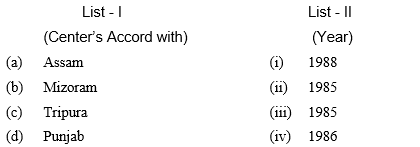
- (1) (iv) (ii) (iii) (i)
- (2) (ii) (iv) (i) (iii)
- (3) (iii) (i) (iv) (ii)
- (4) (i) (iii) (ii) (iv)
Answer: Option (2)
- (1) Asoka Mehta
- (2) L.M. Singhvi
- (3) G V K Rao
- (4) P.K. Thungan
Answer: Option (1)
- (1) Navin Chawla
- (2) N. Gopalaswami
- (3) T.N. Seshan
- (4) M.S. Gill
Answer: Option (2)
Assertion (A) : Law and order is the responsibility of the District Magistrate.
Reason (R) : Law and order is still one of the major problems in India.
Code :- (1) Both (A) and (R) are true and (R) is the correct explanation of (A).
- (2) Both (A) and (R) are true but (R) is not the correct explanation of (A).
- (3) (A) is true, but (R) is false.
- (4) (A) is false, but (R) is true.
Answer: Option (1)
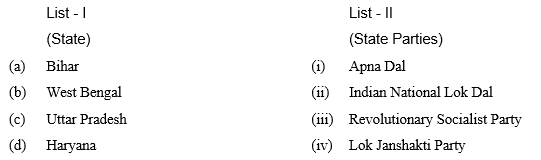
- (1) (iii) (ii) (i) (iv)
- (2) (iv) (iii) (i) (ii)
- (3) (ii) (i) (iii) (iv)
- (4) (i) (iv) (ii) (iii)
Answer: Option (2)
- (1) Lotika Sarkar
- (2) Neera Dogra
- (3) Vina Mazumdar
- (4) Sushila Nayar
Answer: Option (4)
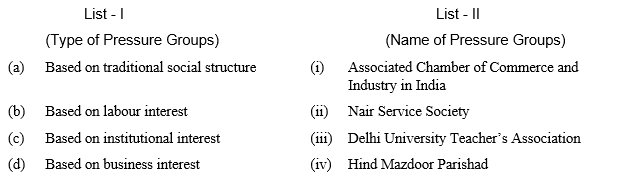
- (1) (i) (iii) (iv) (ii)
- (2) (ii) (iv) (iii) (i)
- (3) (iii) (ii) (i) (iv)
- (4) (iv) (i) (ii) (iii)
Answer: Option (2)
(a) Poverty
(b) Illiteracy
(c) Trade Unions
(d) Corruption
(e) Regional Political Parties
(f) Terrorism
Code :- (1) (a), (b), (e), (f)
- (2) (a), (c), (d), (e), (f)
- (3) (a), (b), (d), (f)
- (4) (b), (d), (e), (f)
Answer: Option (3)
(a) Market Model
(b) Participatory State Model
(c) Flexible Government Model
(d) Deregulated Government Model
Select the correct answer from the code given below :- (1) (a) and (b)
- (2) (a) and (c)
- (3) (a), (c) and (d)
- (4) (a), (b), (c) and (d)
Answer: Option (4)
(a) Willoughby
(b) M.P. Follet
(c) F.W. Riggs
(d) Robert Dahl
- (1) (b), (a), (d) and (c)
- (2) (a), (b), (c) and (d)
- (3) (b), (a), (c) and (d)
- (4) (a), (c), (b) and (d)
Answer: Option (1)
- (1) Fayol
- (2) Urwick
- (3) Gulick
- (4) Mooney
Answer: Option (3)
Assertion (A) : Herbert Simon has ridiculed the classical theory of organisation as a machine model theory.
Reason (R) : Classicists are too much preoccupied with the formal structural part of organisation and that too at the cost of human factors.
Code :- (1) Both (A) and (R) are true and (R) is the correct explanation of (A).
- (2) Both (A) and (R) are true, but (R) is not the correct explanation of (A).
- (3) (A) is true, but (R) is false.
- (4) (A) is false, but (R) is true.
Answer: Option (1)
- (1) The Right to Information Act came into force on 12 October 2005.
- (2) The Freedom of Information Act, 2002 has been repealed.
- (3) The Official Secrets Act, 1923 has also been repealed.
- (4) Central Information Commission and State Information Commissions have been constituted.
Answer: Option (3)
(a) Constitutional status to rural and urban bodies
(b) Three - tier system for all Panchayati Raj Institutions
(c) Direct elections of Chairpersons and members of Panchayati Raj Institutions at all levels
(d) Audit of panchayat funds by CAG
- (1) (b) only
- (2) (a) and (b) only
- (3) (a), (b) and (c)
- (4) (a), (b) and (d)
Answer: Option (1)
- (1) not exceeding three in number
- (2) not exceeding five in number
- (3) not exceeding seven in number
- (4) not exceeding ten in number
Answer: Option (4)
- (1) F.W. Riggs
- (2) Edward Weidner
- (3) Ferrel Heady
- (4) H. Walker
Answer: Option (2)
(a) Providing reservation for backward classes
(b) Setting up a State Finance Commission
(c) Making the Panchayats autonomous bodies
(d) Giving the Panchayats financial powers in relation to taxes, fees, etc.
- (1) (a) and (b)
- (2) (b), (c) and (d)
- (3) (a), (b) and (c)
- (4) (a), (c) and (d)
Answer: Option (4)
- (1) (ii) (i) (iv) (iii)
- (2) (iii) (iv) (ii) (i)
- (3) (i) (ii) (iii) (iv)
- (4) (iv) (iii) (i) (ii)
Answer: Option (2)
(a) Change of title
(b) Change of pay
(c) Change of duties
(d) Change of responsibility
- (1) (a) and (b) only
- (2) (b) and (c) only
- (3) (a), (c) and (d)
- (4) (a), (b), (c) and (d)
Answer: Option (4)
- (1) Selection
- (2) Appointment
- (3) Certification
- (4) Placement
Answer: Option (3)
- (1) Line agency
- (2) Staff agency
- (3) Auxiliary agency
- (4) Both Staff and Line agencies
Answer: Option (1)
(a) Talcott Parsons
(b) Michel Crozier
(c) Robert Presthus
(d) F.W. Riggs
Select the correct answer from the code given below :- (1) (a) and (b) only
- (2) (b) and (d) only
- (3) (b), (c) and (d)
- (4) (a), (b), (c) and (d)
Answer: Option (4)
- (1) Woodrow Wilson
- (2) Frank Goodnow
- (3) Herbert Simon
- (4) Robert Merton
Answer: Option (3)
- (1) John Mearsheimer
- (2) Kenneth Waltz
- (3) Thucydides
- (4) J. Snyder
Answer: Option (2)
(a) Neo realism and neo liberalism are rationalist approaches
(b) Neo realism and feminism are reflectivist approaches
(c) Post - structuralism and neo liberalism are rationalist approaches
(d) Feminism and post structuralism are reflectivist approaches
Select the correct answer from the code given below :- (1) (a) and (b)
- (2) (a), (c) and (d)
- (3) (a), (b) and (d)
- (4) (a) and (d)
Answer: Option (4)
(a) Soft power can be used by state actors
(b) Soft power can be used by non state actors
(c) Soft power is the second face of power
(d) Soft power is a form of idealism
- (1) (a), (b) and (d)
- (2) (b), (c) and (d)
- (3) (a), (b) and (c)
- (4) (c), (d) and (a)
Answer: Option (3)
- (1) Democracies will refrain from using force against other democracies
- (2) Economically important trade creates incentives to maintain peaceful relations
- (3) Global civil society exerts itself
- (4) International organisations can constrain decision makers by promoting peace
Answer: Option (3)
(a) He suggested that conflict could be viewed as triangle with contradiction, attitude and behaviour
(b) He talked of structural, cultural, direct and indirect violence
(c) He discussed about peace building, peace making and peace keeping
(d) He explained about direct war, proxy war and Intrastate
Code :- (1) (a) and (d)
- (2) (b) and (c)
- (3) (a) and (c)
- (4) (a), (b) and (c)
Answer: Option (2)
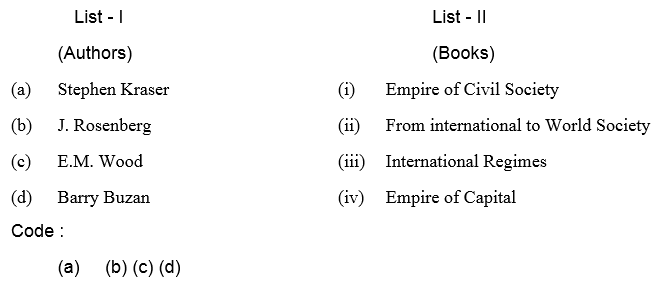
- (1) (iii) (ii) (i) (iv)
- (2) (iii) (i) (iv) (ii)
- (3) (iv) (ii) (i) (iii)
- (4) (ii) (i) (iv) (iii)
Answer: Option (2)
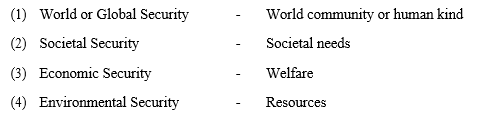
Answer: Option (2)
- (1) Large numbers and deterrent force
- (2) Nuclear parity and capability to retaliate
- (3) Small numbers and capability to deter
- (4) Deterrent force and nuclear parity
Answer: Option (3)
(a) It’s a three tier organisation consisting of strategic policy group, joint intelligence committee and National Security Advisory Board.
(b) Ministers for External Affairs, Defence, Home, Finance and Commerce are its members
(c) It was formed in the year 1998
(d) The former National Security Advisers were Brajesh Mishra, J.N. Dixit, K.P. Singh.
Select the correct answer from the code given below :- (1) (d), (c) and (a)
- (2) (a) and (b)
- (3) (c), (d) and (b)
- (4) (a) and (d)
Answer: Option (2)
(a) The ‘Neemrana Dialogue’ is on India - China Relations
(b) The ‘Ottawa Dialogue’ is on India - Pakistan Relations
(c) Shangri-La Dialogue is on India - Singapore Relations
(d) Raisina Dialogue is India’s flagship conference of geopolitics and geoeconomics
Code :- (1) (a), (b) and (c)
- (2) (b), (c) and (d)
- (3) (a) and (c)
- (4) (c) and (d)
Answer: Option (3)
(a) India is a major contributor to UN Democracy Fund
(b) Indian delegation to San Francisco Conference of 1945 was led by Vijayalakshmi Pandit
(c) In 2001, India piloted a draft comprehensive convention on International Terrorism
(d) India submitted along with other countries an Action Plan for phased elimination of nuclear weapons 1996 - 2020
Select the correct answer from the code given below :- (1) (a), (c) and (d)
- (2) (a), (b) and (c)
- (3) (a) and (d)
- (4) (c) and (d)
Answer: Option (3)
Assertion (A) : States continue to exist as sovereign states.
Reason (R) : Globalization has weakened the Westphalian state system.
Code :- (1) Both (A) and (R) are true, and (R) is the correct explanation of (A).
- (2) Both (A) and (R) are true but (R) is not the correct explanation of (A).
- (3) (A) is true, but (R) is false.
- (4) (R) is true, but (A) is false.
Answer: Option (2)
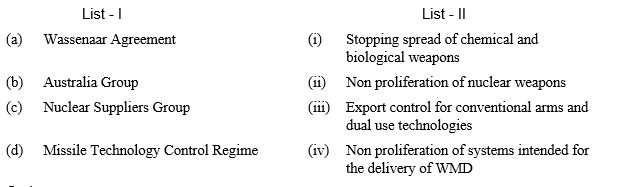
- (1) (iii) (i) (ii) (iv)
- (2) (iii) (ii) (i) (iv)
- (3) (iv) (ii) (iii) (i)
- (4) (ii) (iii) (iv) (i)
Answer: Option 1)
- (1) New Development Bank is a multilateral development bank established by BRICS
- (2) Asian Intrastructure Investment Bank is an initiative of China
- (3) WTO recognises least developed countries as those which are designated as such by
- (4) International Finance Corporation offers political risk insurance and encourages private sector development in developing countries
Answer: Option (4)
(a) India became member of Security Council seven times
(b) Japan became a member of Security Council eleven times
(c) It appoints non permanent members
(d) It appoints Secretary General
Select the correct answer from the code given below :- (1) (a) and (b)
- (2) (b) and (c)
- (3) (b) and (d)
- (4) (d) and (a)
Answer: Option (1)