UGC NET Economics - Previous Years Solved Papers | Paper III November 2017
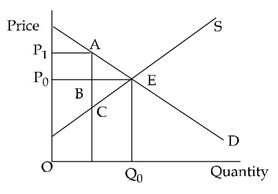
- Area of triangle ABE
- Area of triangle EBC
- Area of triangle ABE+area of triangle EBC
- Area of rectangle P1A B P0
Answer: Option (3)
(a) It yields determinate and stable equilibrium for the duopolists
(b) It is an adequate representation of Nash equilibrium
(c) If the duopolists combine to form a monopoly, the price changed by them will be less than the equilibrium price without their combining together. Of the above which statements are true ? Choose from the code below :
- All the above are correct
- (a) and (c) are correct
- (a) and (b) are correct
- (b) and (c) are correct
Answer: Option (3)
⭐ Make GKSeries Your Preferred Source on Google
Add GKSeries as Preferred Source- positive and is greater than the substitution effect
- Equal to substitution effect
- Less than the substitution effect
- Negative and is greater than the substitution effect
Answer: Option (4)
- increase the utility of all individuals
- increase the utility of at least one individual, but may decrease the level of utility of another person
- increase the utility of one individual, but cannot decrease the utility of any individual
- decrease the utility of all individuals
Answer: Option (3)
(a) Real Income
(b) Money Income
(c) Price ratio
Choose the correct answer from the code given below : Code :- Only (a)
- Only (b)
- Both (b) and (c)
- Both (a) and (c)
Answer: Option (2)
- Existence problem
- Uniqueness problem
- Stability problem
- All of the above
Answer: Option (4)
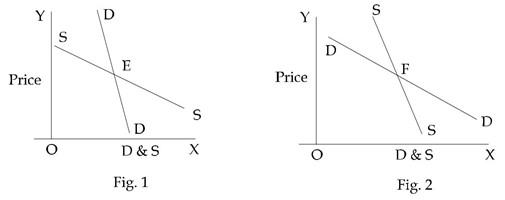
- Both points E and F are the points of stable equilibrium
- Both points E and F are points of unstable equilibrium
- Equilibrium is stable at point E and unstable at point F
- Equilibrium is unstable at point E and stable at point F
Answer: Option (4)
(a) It changes with changes in the distribution of income
(b) At the Pareto optimum, MRS in consumption=MRT in production
(c) It is not unique
(d) It is obtained under perfect competition
- (a), (c) and (d)
- (b) and (c)
- (a), (b) and (d)
- (a) and (b)
Answer: Option (3)
- Consumer Surplus
- Price distribution
- Exchange rate
- Shadow prices
Answer: Option (4)
- Life cycle hypothesis
- Permanent income hypothesis
- Absolute income hypothesis
- Relative income hypothesis
Answer: Option (4)
(a) Phillips curve is an inverse relationship between the rate of unemployment and the rate of inflation in an economy
(b) Engel’s Law observes that as income rises the proportion of income spent on food falls even if the actual expenditure on food rises
Which of the above statement(s) is/are correct ?- Only (a)
- Only (b)
- Both (a) and (b)
- Neither (a) nor (b)
Answer: Option (3)
Concept Economist
Dual decision hypothesis R.W. Clower
Natural rate of unemployment E. Phelps and M. Friedman
Limit Price Theory J. Bhagwati
Planned sales curve Mrs. J. Robinson
Answer: Option (4)
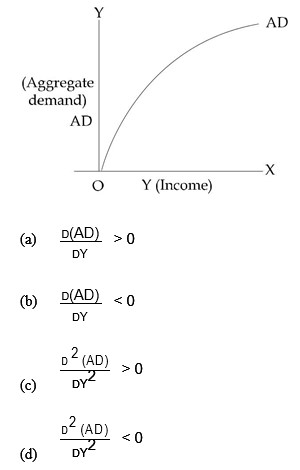
Choose the answer from the code below
- (a) and (d) are correct
- (a) and (c) are correct
- (b) and (c) are correct
- (b) and (d) are correct
Answer: Option (1)
- Permanent income and transitory income
- Permanent income and transitory consumption
- Permanent income and permanent consumption
- Transitory income and transitory consumption
Answer: Option (3)
- Employment would increase, causing a rightward shift in the aggregate demand curve
- The aggregate demand curve would shift to the left, increasing the price level
- The short - run aggregate supply curve would shift to the left, increasing the price level
- Employment would decrease, causing a rightward shift in the aggregate demand curve
Answer: Option (3)
(a) Higher the m.p.c lower is the value of multiplier
(b) Higher the m.p.c higher is the value of multiplier
(c) If m.p.c=1, value of multiplier will be ∞
- (b) alone
- (b) and (c)
- (c) alone
- (a) alone
Answer: Option (2)
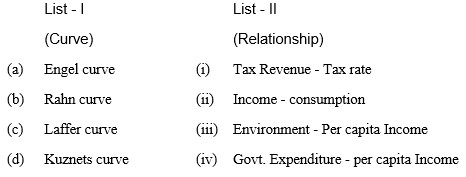
Code : (a) (b) (c) (d)
- (iv) (ii) (i) (iii)
- (i) (iii) (iv) (ii)
- (ii) (iv) (i) (iii)
- (iii) (i) (ii) (iv)
Answer: Option (3)
- maximises the growth rate of output
- optimises the investment in the economy
- maximises the growing per capita consumption
- None of the above
Answer: Option (3)
(a) Development is possible because of credit creation by Banks
(b) Development flourishes in democracy
(c) Capitalist economy develops through trade cycles
Of the above which statements are correct ? Answer from the code below :- All the above are true
- (a) and (b) are true
- (b) and (c) are true
- (a) and (c) are true
Answer: Option (4)
- Directly proportional to rate of exploitation as well as organic composition of capital
- Inversely proportional to rate of exploitation and organic composition of capital
- Inversely proportional to rate of exploitation and directly proportional to organic composition of capital
- Directly proportional to rate of exploitation and inversely proportional to organic composition of capital
Answer: Option (4)
(a) It assumes constant savings rate
(b) This savings rate is exogeneously determined
(c) The marginal product of capital is diminishing as output expands Of the above which statements are correct ?
- All the three above are correct
- Only (a) and (b) are correct
- (a) and (c) are correct
- Only (b) and (c) are correct
Answer: Option (2)
- Agriculture, Services, Industry
- Agriculture, Industry, Services
- Agriculture, Industry, Foreign trade
- Agriculture, Foreign trade, Services
Answer: Option (2)
- attains continuing technical progress
- learns to accept its fate
- has a social structure where high status is maintained
- produces an accommodating personality with a high need for achievement
Answer: Option (1)
- Modern sector increases its output share relative to the traditional sector
- agriculture sector uses modern equipment
- agriculture sector hires labour economically
- modern manufacturing sector is capital intensive
Answer: Option (1)
(a) Workers migrating from villages to foreign - dominated urban complexes
(b) Forming an unskilled labour force to work in factories and mines and on plantations
(c) Replacing indigenous entreprises with technologically more advanced, global, subsidiary companies
(d) Closing the economy to trade with and investment from developed countries Choose the answer from the code given below :
- (a) and (b)
- (b) and (c)
- (a), (b) and (c)
- (a), (b), (c) and (d)
Answer: Option (3)
- Inflation
- Unemployment
- Deflation
- Stagflation
Answer: Option (1)
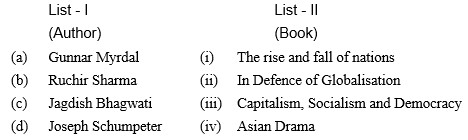
Code : (a) (b) (c) (d)
- (ii) (i) (iii) (iv)
- (iv) (i) (ii) (iii)
- (iv) (ii) (i) (iii)
- (i) (iii) (ii) (iv)
Answer: Option (2)
- High fiscal deficit and high current account deficit
- High fiscal deficit and high revenue deficit
- High fiscal deficit and high governance deficit
- High fiscal deficit and high primary deficit
Answer: Option (1)
(a) Obtain foreign technology and innovative methods of increasing productivity
(b) Employ rural unemployed labour
(c) Finance a savings gap or balance of payments deficit
(d) Generate appropriate technology by adapting existing processes Choose the correct answer from the code given below :
- (a) and (c) only
- (b) and (c) only
- (b) and (c) only
- (a), (b), (c) and (d)
Answer: Option (1)
- Input subsidies
- Export subsidies
- Domestic support
- Market Access
Answer: Option (1)
(a) US has to support a large supply of dollars to act as an internationally accepted currency.
(b) There is a conflict in the short run domestic and long run objective of US trade policy resulting in trade deficit. Which of the above statements are true ? Choose from the code given below :
- Both (a) and (b) are true
- Neither (a) nor (b) are true
- Only (a) is true
- Only (b) is true
Answer: Option (1)
- Gold
- SDRs
- Foreign currency assets
- Foreign currency and securities held by the banks and corporate bodies
Answer: Option (4)
- SAARC
- ASEAN
- BRICS
- EUROPEAN UNION
Answer: Option (2)
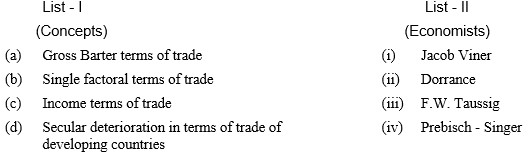
Code : (a) (b) (c) (d)
- (1) (i) (ii) (iii) (iv)
- (ii) (i) (iv) (iii)
- (iii) (i) (ii) (iv)
- (iv) (iii) (i) (ii)
Answer: Option (3)
- discouraging producers from exporting
- give a comparative advantage in that industry to large countries
- make that industry perfectly competitive
- cause price in that industry to rise with output
Answer: Option (2)
- An act of devaluation
- Covering a risk of fluctuations in the foreign exchange rates in future
- Not covering a risk of fluctuations in the foreign exchange rates in future
- An act of revaluation
Answer: Option (2)
(a) Competition Act
(b) Foreign Exchange Management Act
(c) Consumer Protection Act
(d) The Factories Act
Choose the answer from the code below :- (b), (a), (d), (c)
- (d), (b), (c), (a)
- (d), (c), (b), (a)
- (c), (d), (b), (a)
Answer: Option (3)
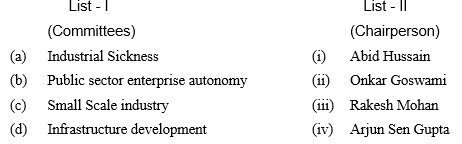
Code : (a) (b) (c) (d)
- (iii) (ii) (i) (iv)
- (ii) (iv) (i) (iii)
- (iv) (i) (iii) (ii)
- (i) (iii) (ii) (iv)
Answer: Option (2)
(a) Electricity
(b) Manufacturing
(c) Mining
Code :- (c), (b) and (a)
- (a), (c) and (b)
- (b), (a) and (c)
- (a), (b) and (c)
Answer: Option (2)
(a) Rate of return is retrospective while the yield is prospective
(b) Rate of return does not include capital gains while the yield includes capital gains. Choose the answer from the code below :
- Both (a) and (b) are correct
- Neither (a) nor (b) is correct
- Only (a) is correct
- Only (b) is correct
Answer: Option (4)
- The commercial Banks will have less money to lend
- The Reserve Bank of India will have less money to lend
- The Union Government will have less money to lend
- The commercial Banks will have more money to lend
Answer: Option (1)
- Headline inflation−food inflation
- Headline inflation−(food inflation+fuel inflation)
- Headline inflation−fuel inflation
- Food inflation+Fuel inflation
Answer: Option (2)
(a) Farmers in developing countries are unresponsive to government set agricultural prices
(b) Farmers in developing countries are willing to innovate and adopt new methods of cultivation
- Both (a) and (b) are true
- Neither (a) nor (b) is true
- Only (a) is true
- Only (b) is true
Answer: Option (4)
- Internalization of negative spill over effects
- Marginal abatement cost
- Examples of a free rider
- Examples of Coase’s theorem
Answer: Option (1)
- 8%
- 5%
- 2 %
- 0.8 %
Answer: Option (4)
- National income is maximum
- Per capita income is maximum
- Population is maximum
- Per capita consumption is maximum
Answer: Option (2)
- Julius Simon
- E. Boserup
- T.W. Malthus
- H. Dalton
Answer: Option (3)
- It shows age - specific death rate
- Age - specific life expectancy can be estimated
- Probability of surviving at particular year of age can be estimated
- Age - specific birth rate can be estimated
Answer: Option (4)
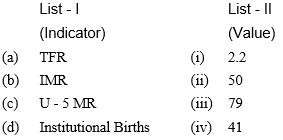
Code : (a) (b) (c) (d)
- (i) (iii) (ii) (iv)
- (i) (iv) (ii) (iii)
- (iv) (i) (iii) (ii)
- (i) (ii) (iii) (iv)
Answer: Option (2)
(a) Madhya Pradesh
(b) Punjab
(c) U.P
(d) Bihar
Code :- (a), (c), (d), (b)
- (b), (a), (c), (d)
- (a), (b), (c), (d)
- (c), (d), (b), (a)
Answer: Option (4)
- The market price is less than the efficient price
- The market price is higher than the efficient price
- Property rights are poorly distributed
- Those who suffer from pollution are compensated outside the market
Answer: Option (1)
- The benefits - received principle
- The second best principle
- The inverse elasticity rule
- The Ramsey Rule
Answer: Option (4)
- Buyers and Sellers equally
- Sellers more than buyers
- government revenue negatively
- Buyers more than sellers
Answer: Option (4)
- Benefits received
- Cost of service
- Ability to pay
- None of the above
Answer: Option (3)
- Fiscal deficit − interest payments
- Budget deficit − interest payments
- Budget deficit + total borrowings
- Total Revenue expenditure −total revenue receipts
Answer: Option (4)
Plan Strategy of Plan
11TH Plan Inclusive growth
2ND Plan Heavy industry investment
3RD Plan Balanced growth
8TH Plan Basic Needs
Answer: Option (4)
(a) B.N. Golder
(b) A. Virmani
(c) D.K. Das
(d) A. Sen
Choose the correct answer- All of the above
- (c) and (d)
- (a), (b) and (c)
- (b) and (d)
Answer: Option (3)
(a) ‘Gender analysis’ of the budget
(b) Preparing a separate budget for women
(c) Government of India adopted gender budgeting in 2005 - 06 Code :
- (a), (b) are correct
- (a), (c) are correct
- (b), (c) are correct
- (a), (b), (c) are correct
Answer: Option (4)
(a) Multi Dimension Poverty Index
(b) Human Poverty Index
(c) Capability Poverty Measure
(d) Human Development Index
- (d), (c), (b), (a)
- (d), (b), (c), (a)
- (b), (a), (d), (c)
- (a), (b), (c), (d)
Answer: Option (1)
- Reserve Bank of India
- Central Statistical Office
- NITI Aayog
- National Sample Survey office
Answer: Option (3)
- Post office deposits
- Public Provident Fund
- Jan Dhan Accounts
- Sukanya Samiridhi Yojana
Answer: Option (3)
(1) Atal Pension Yojna
(2) Pradhan Mantri Jeevan Jyoti Bima Yojna
(3) Pradhan Mantri Suraksha Bima Yojna
(4) Atal Jeevan Beema Yojna Questions 63 to 66 are Assertion (A) and Reason (R) type. Key to these questions is as follows :
- Both (A) and (R) are true and (R) is the correct explanation of (A).
- Both (A) and (R) are true, but (R) is not the correctexplanation of (A).
- (A) is true, but (R) is false.
- (A) is false, but (R) is true.
Answer: Option (3)
Questions 63 to 66 are Assertion (A) and Reason (R) type. Key to these questions is as follows :
- Both (A) and (R) are true and (R) is the correct explanation of (A).
- Both (A) and (R) are true, but (R) is not the correctexplanation of (A).
- (A) is true, but (R) is false.
- (A) is false, but (R) is true.
63. Assertion (A) : Public utilities do not opt for profit maximisation policy.
Reason (R) : It would lead to under utilization of capacity.
Answer: Option (2)
64. Assertion (A) : The existence of industries with increasing returns to scale create an additional opportunity to gain from trade.
Reason (R) : By specializing in a smaller number of industries, countries can produce more in each industry and the costs of production will, therefore, fall.
Answer: Option (2)
65. Assertion (A) : Recursive models can be suitably estimated by OLS method
Reason (R) : Recursive models satisfy Identification conditions
Answer: Option (1)
66. Assertion (A) : Classical macro model is decomposable into real and monetary sectors
Reason (R) : Money affects both income and employment
Answer: Option (2)
- 7
- 6
- 5
- 2/3
Answer: Option (2)
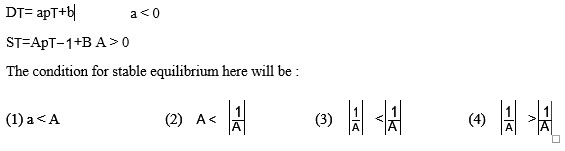
- One
- Zero
- Constant
- Infinity
Answer: Option (2)
- +0.5
- +0.2
- +0.7
- +0.3
Answer: Option (2)
- Constant returns to scale
- Unit elasticity of substitution
- Variable elasticity of substitution
- Linear homogeneity
Answer: Option (3)
- t
- Binomial
- Chi - square
- Normal
Answer: Option (4)
- Close to zero
- Close to plus one
- Close to minus one
- Close to either minus or plus one
Answer: Option (2)
- it will be biased
- it will be inconsistent
- it will be inefficient
- All (1), (2) and (3) will be true
Answer: Option (3)
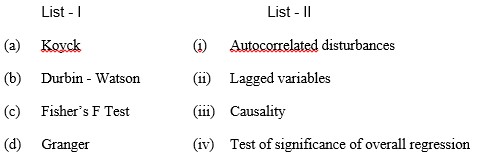
Code : (a) (b) (c) (d)
- (i) (ii) (iii) (iv)
- (ii) (i) (iv) (iii)
- (iii) (iv) (i) (ii)
- (i) (iii) (iv) (ii)
Answer: Option (2)
UGC NET Economics November 2017 Paper II