UGC NET Economics - Previous Years Solved Papers | Paper II November 2017
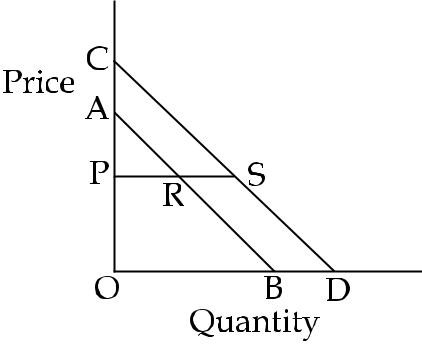
The price elasticity of demand at :
- points R and S is equal
- point R is greater than that at point S
- point R is less than that at point S
- points R and S is infinity
Answer: Option (2)
- analysis of trade pattern and location of economic activity
- analysis of asset prices
- analysis of globalization
- contributions to contract theory
Answer: Option (4)
⭐ Make GKSeries Your Preferred Source on Google
Add GKSeries as Preferred Source- Price =LAC
- Market demand curve for a commodity is horizontal to X-axis
- Firms earn normal profits
- In the long run firms operate at the minimum point of average cost
Answer: Option (2)
- The minimum point of AVC and MC are at the same level of output
- Minimum of AVC is at lesser output than the minimum of MC
- Minimum of AVC is at larger output than the minimum of MC
- Any of the above is possible depending upon operating of the law of returns
Answer: Option (3)
- make its product more similar to its competitors’
- shift the demand curve for its product to the left
- make the demand for its product less price elastic
- reduce the industry’s price
Answer: Option (3)
(a) The demand for labour is relatively inelastic
(b) The demand for labour is relatively elastic
(c) The demand for labour is a derived demand
Choose the correct answer from the code given below :
- remain unchanged because hamburgers and onions are different goods
- increase because hamburgers and onions are substitutes
- increase because hamburgers and onions are complements
- decrease because hamburgers and onions are complements
Answer: Option (4)
- Total variable cost
- Total fixed cost
- Average variable cost
- Average fixed cost
Answer: Option (4)
- 0.91
- 0.87
- 0.25
- 4
Answer: Option (2)
- There will be no trade - off between inflation and unemployment
- The unemployment rate will be less than the natural rate of unemployment
- The price level will be constant
- Changes in the money supply will not lead to changes in the price level
Answer: Option (1)
- Milton Friedman
- James Tobin
- T.W. Swan
- A.W. Phillips
Answer: Option (1)
- W. Leontief
- J.R Hicks
- M. Friedman
- D. Patinkin
Answer: Option (4)
(a) laissez faire
(b) the invisible hand
(c) free trade policy
(d) competitive markets
- (a) and (b)
- (b) and (c)
- (a), (b),
- (c) and (d)
Answer: Option (4)
(a) Income tax
(b) Expenditure tax
(c) Value - added tax at the state level
(d) Service tax
- (a), (c), (b), (d)
- (a), (b), (d), (c)
- (b), (c), (d), (a)
- (c), (d), (a), (b)
Answer: Option (2)
(a) Income tax
(b) Expenditure tax
(c) Value - added tax at the state level
(d) Service tax
- (a), (c), (b), (d)
- (a), (b), (d), (c)
- (b), (c), (d), (a)
- (c), (d), (a), (b)
Answer: Option (2)
(a) F.T.A
(b) Economic Union
(c) Common Market
(d) Custom Union
- (a), (d), (c), (b)
- (a), (c), (b), (d)
- (b), (a), (d), (c)
- (b), (c), (d), (a)
Answer: Option (1)
- declining imports and rising exports
- higher tariffs imposed by its trading partners
- an increase in domestic inflation
- an increase in capital inflow
Answer: Option (1)
(a) it shows the net income generated in the foreign trade sector
(b) it relates to claims and liabilities of financial nature
- Only (a) is true
- Only (b) is true
- Both (a) and (b) are true
- Neither (a) nor (b) is true
Answer: Option (1)
- F. List and A. Hamilton
- Adam Smith and David Ricardo
- J.S. Mill and P. Krugman
- A. Hamilton and J.S. Mill
Answer: Option (1)
- Tariffs on imported capital goods
- Subsidies to business for purchases of capital goods
- Unemployment compensations
- Pension payments
Answer: Option (2)
- Monopolistic business from abroad
- Conservative ruling coalitions
- Weak domestic middle class
- All of the above
Answer: Option (4)
- Seligman
- Lindhal
- Dalton
- Pigou
Answer: Option (2)
(a) Oligopolistic market structure
(b) Economics of scale
of the above, which are the essential feature of Rosenstein Rodan’s approach to development ?- Both (a) and (b) above
- Neither (a) nor (b) above
- Only (a)
- Only (b)
Answer: Option (1)
- C=a+bY
- C=bY
- C=bY2
- C=a+bY2
Answer: Option (2)
- Electricity
- Liquified Petroleum Gas
- High Speed Diesel
- Petroleum Crude
Answer: Option (2)
- Incidence of tax on buyers
- Incidence of tax on sellers
- Impact of tax onsellers
- Impact of tax on buyers
Answer: Option (1)
- tax neutrality
- horizontal equity
- value - added taxation
- vertical equity
Answer: Option (4)
- Taxation only
- Public expenditure only
- Public debt only
- Both taxation and public expenditure
Answer: Option (4)
(a) The beneficiary country is a large country in the world market for a particular good.
(b) A deviation from optimal tariff will lead to fall in welfare.
Of the above, which statement is correct ? Choose the answer from the code below :- Both (a) and (b) are correct
- Neither (a) nor (b) is correct
- Only (a) is correct
- Only (b) is correct
Answer: Option (1)
- Trade increases the average productivity as more productive firms expand
- Helpful state intervention
- Trade encourage R & D and lead to new products
- A country may both export and import the goods from the same industry
Answer: Option (1)
- Supported by all empirical studies
- Supported mainly by cross section studies and not by time series studies
- Supported by time series and not by cross section studies
- Generally repudiated by empirical studies
Answer: Option (2)
- benefits if each acts in his/her own interest
- will increase their profits in a free market
- should act to maximise economic growth
- should act to promote the public interest
Answer: Option (1)
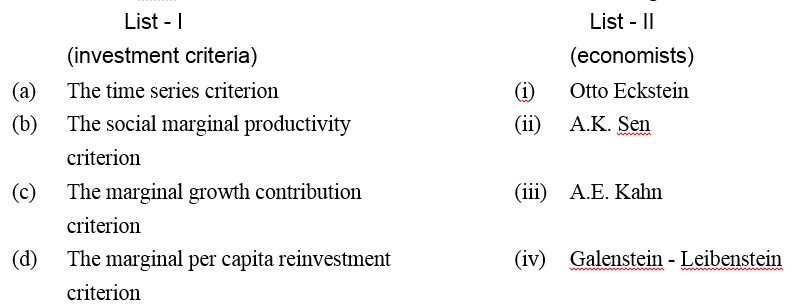
Code
(a) (b) (c) (d)
- (ii) (i) (iv) (iii)
- (iv) (iii) (i) (ii)
- (ii) (iii) (i) (iv)
- (iii) (ii) (iv) (i)
Answer: Option (3)
- Per capita real GDP difference among nations will increase
- Per capita real GDP difference among the nations will diminish
- Economic freedom as measured by Heritage Foundation Index will decrease
- Population growth rate in rich countries will increase
Answer: Option (2)
- Y=110−0.75 i
- Y=440−i
- Y=500−0.25 i
- Y=400−0.75 i
Answer: Option (2)
- Agriculture
- Construction
- Manufacturing
- Mining and Quarrying
Answer: Option (2)
(a) Mahalnobis model
(b) Introduction of rolling plan
(c) Declaration of plan holiday
(d) Inclusive growth strategy
Select the answer from the code below :- (b), (a), (c), (d)
- (a), (c), (b), (d)
- (c), (a), (b), (d)
- (a), (c), (d), (b)
Answer: Option (2)
- Exports have been buoyant
- Private capital investment happened at brisk pace
- Both (1) and (2) are true
- Neither (1) nor (2) is true
Answer: Option (4)
- NIC
- HSN
- GSTN
- ITC
Answer: Option (2)

This trends will be described as :
- Disinflation
- Deflation
- Creeping inflation
- Stagflation
Answer: Option (1)
- Bihar
- Odisha
- Himachal Pradesh
- Meghalaya
Answer: Option (3)
- Laspeyre’s Index
- Paasche Index
- Fisher Index
- Kelly Index
Answer: Option (2)
- P(A+B)=P(A)+P(B)
- P(AB)=P(A)⋅P(B)
- P(AB)=P(A)/P(B)
- P(A/B)=P(A)−P(B)
Answer: Option (1)
- Simple random sampling
- Cluster sampling
- Stratified random sampling
- Systematic sampling
Answer: Option (3)
- Arithmetic mean
- Harmonic mean
- Median
- Geometric Mean
Answer: Option (1)
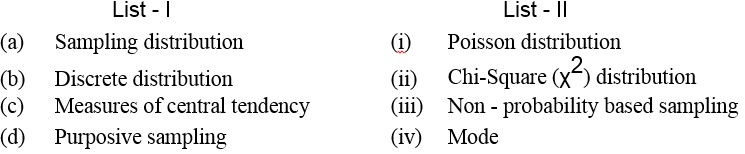
Code
(a) (b) (c) (d)
- (i) (ii) (iii) (iv)
- (iii) (i) (ii) (iv)
- (ii) (i) (iv) (iii)
- (iv) (iii) (i) (ii)
Answer: Option (3)
Note : Questions 47 to 50 are Assertion (A) and Reason (R) type. Key to these questions is as follows :
- Both (A) and (R) are true and (R) is the correct explanation of (A).
- Both (A) and (R) are true, but (R) is not the correct explanation of (A).
- (A) is true, but (R) is false
- (A) is false, but (R) is true.
47. Assertion (A) : Many developing countries demand that movement of natural persons across countries should be promoted.
Reasons (R) : The developing countries have comparative advantage in labour intensive services.
Answer: Option (1)
48. Assertion (A) : Revealed preference theory excludes the explanation of Giffen good.
Reasons (R) : Revealed preference theory considers only negative income elasticity of demand
Answer: Option (3)
49. Assertion (A) : Indian agriculture still absorbs a major part of workforce.
Reasons (R) : Employment elasticity in agricultural sector is high.
Answer: Option (3)
50. Assertion (A) : Friedman argues that money demand function is a stable function.
Reasons (R) : Friedman treats money as one type of asset in which wealth holders can keep a part of their wealth.
Answer: Option (2)
UGC NET Economics November 2017 Paper III