Four identical resistive strain gauges with gauge factor of 2.0 are used in a Wheatstone bridge as

Four identical resistive strain gauges with gauge factor of 2.0 are used in a Wheatstone bridge as

Q. Four identical resistive strain gauges with gauge factor of 2.0 are used in a Wheatstone bridge as shown in the figure below. Only one of the strain gauges 𝑅𝑆𝐸𝑁𝑆𝐸 changes its resistance due to strain. If the output voltage 𝑉𝑂𝑈𝑇 is measured to be 1 mV, the magnitude of strain, in units of microstrain, […]

Four identical resistive strain gauges with gauge factor of 2.0 are used in a Wheatstone bridge as Read More »

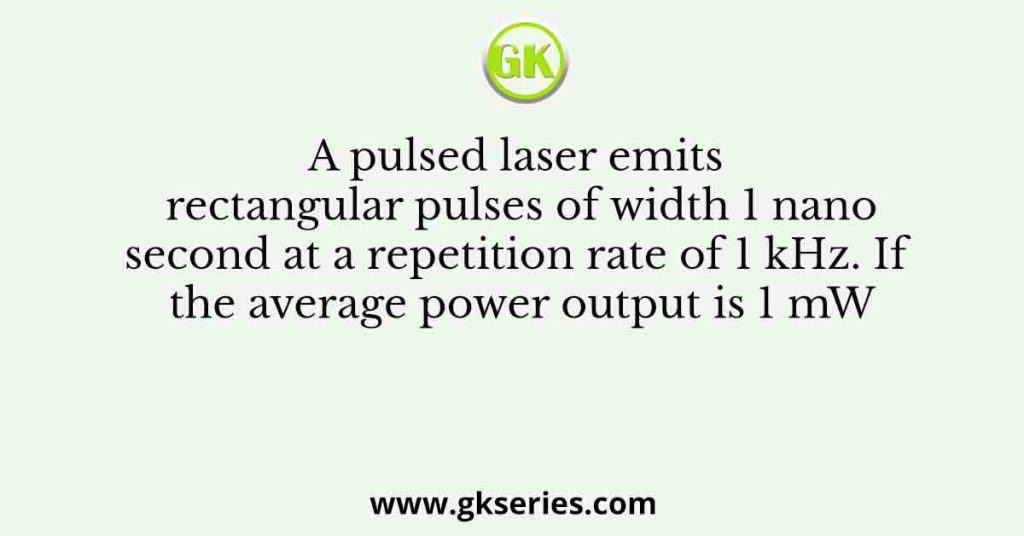
A pulsed laser emits rectangular pulses of width 1 nanosecond at a repetition rate of 1 kHz. If the average power output is 1 mW

A pulsed laser emits rectangular pulses of width 1 nanosecond at a repetition rate of 1 kHz. If the average power output is 1 mW

Q. A pulsed laser emits rectangular pulses of width 1 nanosecond at a repetition rate of 1 kHz. If the average power output is 1 mW, the average power over a single pulse duration, in watts, is              (A) 1               (B) 10                          (C) 100                        (D) 1000 Ans: 1000 Sol: The underlying concept here to be

A pulsed laser emits rectangular pulses of width 1 nanosecond at a repetition rate of 1 kHz. If the average power output is 1 mW Read More »

A pulsed laser emits rectangular pulses of width 1 nanosecond at a repetition rate of 1 kHz. If the average power output is 1 mW

A pulsed laser emits rectangular pulses of width 1 nanosecond at a repetition rate of 1 kHz. If the average power output is 1 mW

Q. A pulsed laser emits rectangular pulses of width 1 nanosecond at a repetition rate of 1 kHz. If the average power output is 1 mW, the average power over a single pulse duration, in watts, is              (A) 1               (B) 10                          (C) 100                        (D) 1000 Ans: 1000 Sol: The underlying concept here to be

A pulsed laser emits rectangular pulses of width 1 nanosecond at a repetition rate of 1 kHz. If the average power output is 1 mW Read More »

A resistance-meter has five measurement range-settings between 200 Ω and 2 MΩ in multiples of 10. The meter measures resistance

A resistance-meter has five measurement range-settings between 200 Ω and 2 MΩ in multiples of 10. The meter measures resistance

Q. A resistance-meter has five measurement range-settings between 200 Ω and 2 MΩ in multiples of 10. The meter measures resistance of a device by measuring a full-range voltage of 2 V across the device by passing an appropriate constant current for each range-setting. If a device having a resistance value in the range 8

A resistance-meter has five measurement range-settings between 200 Ω and 2 MΩ in multiples of 10. The meter measures resistance Read More »

A 100 W light source emits uniformly in all directions. A photodetector having a circular active area whose diameter is 2 cm is placed 1 m away from the source

A 100 W light source emits uniformly in all directions. A photodetector having a circular active area whose diameter is 2 cm is placed 1 m away from the source

Q. A 100 W light source emits uniformly in all directions. A photodetector having a circular active area whose diameter is 2 cm is placed 1 m away from the source, normal to the incident light. If the responsivity of the photodetector is 0.4 A/W, the photo-current generated in the detector, in units of mA,

A 100 W light source emits uniformly in all directions. A photodetector having a circular active area whose diameter is 2 cm is placed 1 m away from the source Read More »

A piezoelectric transducer with sensitivity of 30 mV/kPa is intended to be used in the range of 0 kPa to 100 kPa. The readout

Q. A piezoelectric transducer with sensitivity of 30 mV/kPa is intended to be used in the range of 0 kPa to 100 kPa. The readout circuit has a peak noise amplitude of 0.3 mV and measured signals over the full pressure range are encoded with 10 bits. The smallest pressure that produces a non-zero output,

A piezoelectric transducer with sensitivity of 30 mV/kPa is intended to be used in the range of 0 kPa to 100 kPa. The readout Read More »

In the circuit below, the light dependent resistor (LDR) receives light from the LED. The LDR has resistances of 5 k W and 500 W under dark and illuminated conditions

In the circuit below, the light dependent resistor (LDR) receives light from the LED. The LDR has resistances of 5 k W and 500 W under dark and illuminated conditions

Q. In the circuit below, the light dependent resistor (LDR) receives light from the LED. The LDR has resistances of 5 k W and 500 W under dark and illuminated conditions, respectively. The LED is OFF at time 𝑡 < 0. At time t = 0 s, the switch S1 is closed for 1 ms and

In the circuit below, the light dependent resistor (LDR) receives light from the LED. The LDR has resistances of 5 k W and 500 W under dark and illuminated conditions Read More »

In the circuit shown below, assume that the comparators are ideal and all components have zero propagation delay. In one period of the input signal 𝑉𝑖𝑛 = 6 sin(𝜔𝑡)

In the circuit shown below, assume that the comparators are ideal and all components have zero propagation delay. In one period of the input signal 𝑉𝑖𝑛 = 6 sin(𝜔𝑡)

Q. In the circuit shown below, assume that the comparators are ideal and all components have zero propagation delay. In one period of the input signal 𝑉𝑖𝑛 = 6 sin(𝜔𝑡), the fraction of the time for which the output OUT is in logic state HIGH is Sol: The output represents X-NOR gate. So, the given

In the circuit shown below, assume that the comparators are ideal and all components have zero propagation delay. In one period of the input signal 𝑉𝑖𝑛 = 6 sin(𝜔𝑡) Read More »

voltage amplifier is constructed using enhancement mode MOSFETs labeled M1, M2, M3 and M4 in the figure below. M1, M2 and M4 are n-channel MOSFETs

voltage amplifier is constructed using enhancement mode MOSFETs labeled M1, M2, M3 and M4 in the figure below. M1, M2 and M4 are n-channel MOSFETs

Q. A voltage amplifier is constructed using enhancement mode MOSFETs labeled M1, M2, M3 and M4 in the figure below. M1, M2 and M4 are n-channel MOSFETs and M3 is a p-channel MOSFET. All MOSFETs operate in saturation mode and channel length modulation can be ignored. The low frequency, small signal input and output voltages

voltage amplifier is constructed using enhancement mode MOSFETs labeled M1, M2, M3 and M4 in the figure below. M1, M2 and M4 are n-channel MOSFETs Read More »

Scroll to Top